
ΑΙhub.org
Radical AI podcast: featuring Moses Namara
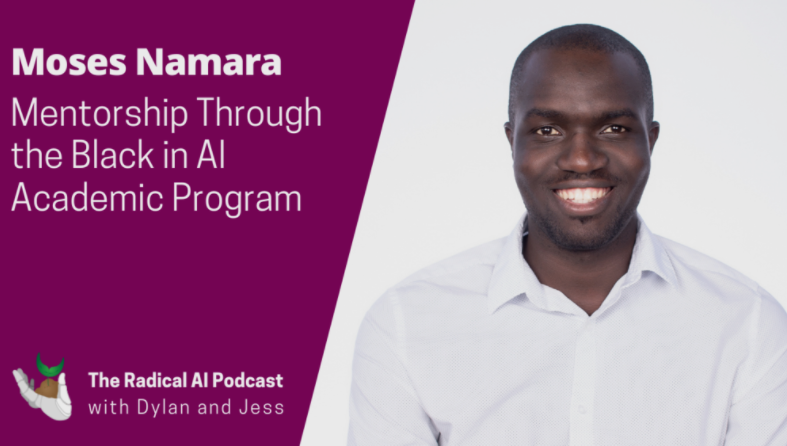
Hosted by Dylan Doyle-Burke and Jessie J Smith, Radical AI is a podcast featuring the voices of the future in the field of artificial intelligence ethics. In this episode Jess and Dylan chat to Moses Namara about the new Black in AI academic program.
Mentorship through the Black in AI academic program with Moses Namara
In this episode, we interview Moses Namara of Black in AI about the new Black in AI academic program, a program that serves as a resource to support black junior researchers as they apply to graduate programs, navigate graduate school, and enter the postgraduate job market.
Moses Namara is a Facebook Research Fellow and Ph.D. candidate in Human-Centered Computing (HCC) at Clemson University. He uses interdisciplinary research methods from computer science, psychology, and the social sciences to understand the principles behind users’ adoption and use of technology, decision-making, and privacy attitudes and behaviors. His research interests are in the field of usable privacy and security and human-computer interaction.
Full show notes for this episode can be found at Radical AI.
Listen to the episode below:
About Radical AI:
Hosted by Dylan Doyle-Burke, a PhD student at the University of Denver, and Jessie J Smith, a PhD student at the University of Colorado Boulder, Radical AI is a podcast featuring the voices of the future in the field of Artificial Intelligence Ethics.
Radical AI lifts up people, ideas, and stories that represent the cutting edge in AI, philosophy, and machine learning. In a world where platforms far too often feature the status quo and the usual suspects, Radical AI is a breath of fresh air whose mission is “To create an engaging, professional, educational and accessible platform centering marginalized or otherwise radical voices in industry and the academy for dialogue, collaboration, and debate to co-create the field of Artificial Intelligence Ethics.”
Through interviews with rising stars and experts in the field we boldly engage with the topics that are transforming our world like bias, discrimination, identity, accessibility, privacy, and issues of morality.
To find more information regarding the project, including podcast episode transcripts and show notes, please visit Radical AI.
AUAI is supported by:








