
ΑΙhub.org
“Computing and Technology Ethics: Engaging Through Science Fiction” – an interview with the authors
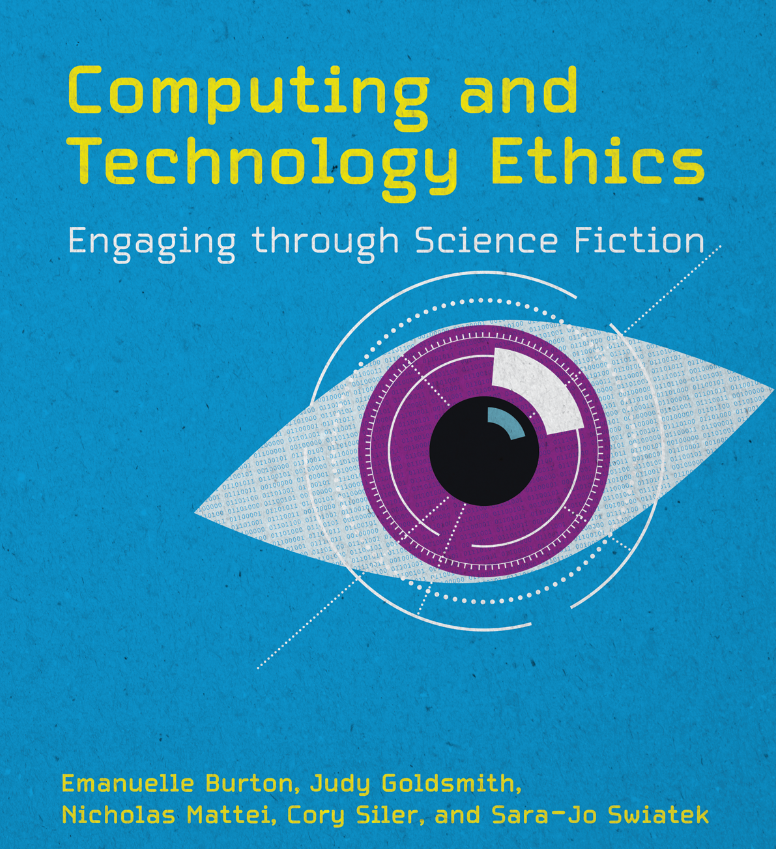
Emanuelle Burton, Judy Goldsmith, Nicholas Mattei, Cory Siler and Sara-Jo Swiatek are the authors of a new book entitled: Computing and Technology Ethics: Engaging Through Science Fiction. We caught up with them to find out more about the book, what it covers, and what inspired them to use science fiction as a tool to teach about ethics.
Could you give us an introduction to the book and what it covers?
The book has five big content chapters:
- An introduction to Ethical Frameworks including Deontology, Utilitarianism, Virtue Ethics and Communitarianism. We also have a section on contemporary developments: responsibility ethics, feminist ethics, and capabilities. Expanding the scope of ethical inquiry beyond the traditional western “big 3” was important to us, and adds a lot of potential for students and teachers to think about many of the modern issues in new ways.
- A chapter on Managing Knowledge which includes a discussion of different ways to define and theorize data and information, and why it matters how we do it; cultures of knowledge; how humans store and work with large data (and how we differ from machines); and bias in automated reasoning systems. This chapter pulls back from much of the heated discussion around data and asks broader questions about how we acquire, store and interpret the things we know, and is there really such a thing as “raw data”?
- An introduction to and connections between the concepts of Personhood and Privacy including multiple definitions of personhood, a history of the concept of privacy, and how modern technology challenges our past notions of the separation between the two.
- Tools for and examples of looking at Technology and Society together including an introduction to socio-technical systems, an analysis of complex technical systems, and a section that applies these ideas in a modern context in areas such as structures of care, public discourse, labor, and power. This chapter gives some ideas and thinking tools / best practices for looking at technology and society and then puts those tools to work with lots of examples!
- Finally, a chapter on Professional Ethics including an overview of major ethical codes, a history of professionalization and practical steps on being an ethical practitioner. This chapter covers a lot of the material that a traditional professional ethics course would cover with some added context and history.
In addition to the content chapters there is a science fiction anthology at the end of the book containing 12 stories from contemporary authors including Ken Liu, T.C. Boyle, Elizabeth Bear, Paolo Bacigalupi, and Rebecca Roanhorse. The book also provides Story Frames for each story that includes an introduction and reflection questions that tie the story, the characters, and their choices to the ethical frameworks. Each of these stories is anchored in multiple places in the content chapters through what we call Story Points where that story picks up on themes and/or ideas from the chapter. Of course the story points we provide are only the starting point and one could weave the stories into many places throughout the textbook.
Who would you say is the intended audience for the book?
The book was written primarily as a textbook to be used for a full term undergraduate course for teaching about computing and technology ethics. However, the design of the book is very flexible. Many of the chapters and sections are written in a way that parts of them could be used to develop modules as part of larger classes. Nicholas uses parts of the book and one of the science fiction stories to teach about the epistemic roots of data in an Introduction to Data Science course.
In addition to just being used as a textbook we feel like the book is of more general interest to practitioners, researchers, and maybe even the casual reader. The chapters are written in an accessible way and contain many pointers to the literature in both moral philosophy and ethical practice in modern technology development. We also think we gathered a really cool anthology of science fiction stories that are just a joy to read on their own!
What was the inspiration behind the book, and in particular the use of science fiction as a tool to teach about ethics?
One of the core commitments that we had, as a team, is that teaching ethics is not simply about telling students how to make easy judgments about what is right and what is wrong. Instead, strong ethical thinking requires one to recognize and understand situations in which we are called upon to make ethical judgements. We feel very strongly that many of the questions brought about by new technology often do not originate with those new technologies, but rather allow us to see age-old questions through new lenses or facets.
Science fiction, as a modality, really helps us support this core belief. There is a great quote from Martha Nussbaum that we pull out a lot: “fiction … frequently places us in a position that is both like and unlike the position we occupy in life; like, in that we are emotionally involved with the characters, active with them, and aware of our incompleteness; unlike, in that we are free of the sources of distortion that frequently impede our real-life deliberations.” In this vein, we use the science fiction stories, in place of more traditional case studies, as it gives students (and instructors!) room to think about these questions in a different way that is both close to us but at a remove. This isn’t to say that case studies don’t have their place, and we even point to many of them in the book, but we felt that the science fiction lens was a new and exciting way to get students to engage with these topics.
Have you had any feedback from teachers or students who’ve used the book?
Both Emanuelle and Judy have been using components of the book for several semesters while it has been in development. The responses from students have been overwhelmingly positive! Students have really enjoyed the opportunity to learn practical methodologies for thinking about their work and practice… as well as getting to read science fiction stories! Early versions of several of the chapters were also used by colleagues at other universities and they were also very positive about the response from students and the engagement with the topics that students showed switching to this pedagogy.
Where can people find the book, and any further information?
Computing and Technology Ethics: Engaging Through Science Fiction is now available from MIT Press. We have recently given tutorials at both AAAI 2023 and SIGCSE 2023 and all the materials from those tutorials as well as preview content from the book is available here.
About the authors
Emanuelle Burton is a lecturer in Computer Science at the University of Illinois Chicago. She holds a PhD in Religion and Literature from the University of Chicago and has published articles on ethical meaning-making in several works of children’s and young adult fantasy fiction, including the Chronicles of Narnia, the Hunger Games and the His Dark Materials series. She is a member of ACM’s Committee on Professional Ethics.
Judy Goldsmith is a Professor of Computer Science, and has been teaching computer ethics using science fiction since 2013. She is a founding member of SIGCSE Reads!, and has recently been presenting widely through university colloquia on using fiction to teach computer ethics. She is a member of the AAAI Ethics Committee.
Nicholas Mattei is an Assistant Professor of Computer Science at Tulane University and the vice-chair of ACM: SIGAI. He is an active researcher in the area of Artificial Intelligence and Ethics and uses parts of this book in both his Introduction to Artificial Intelligence and Introduction to Data Science courses.
Cory Siler is a PhD student in Computer Science at the University of Kentucky. She has served as a recurring guest lecturer for her department’s science fiction and computer science ethics class.
Sara-Jo Swiatek holds a PhD in Ethics from the University of Chicago. She has taught courses on the philosophy and ethics of technology and in the areas of both philosophical and theological ethics. In 2019 she taught Communication and Ethical Issues in Computing at the University of Chicago Illinois.

AIhub is supported by:








