
ΑΙhub.org
How can we characterize consensus in a network of agents?
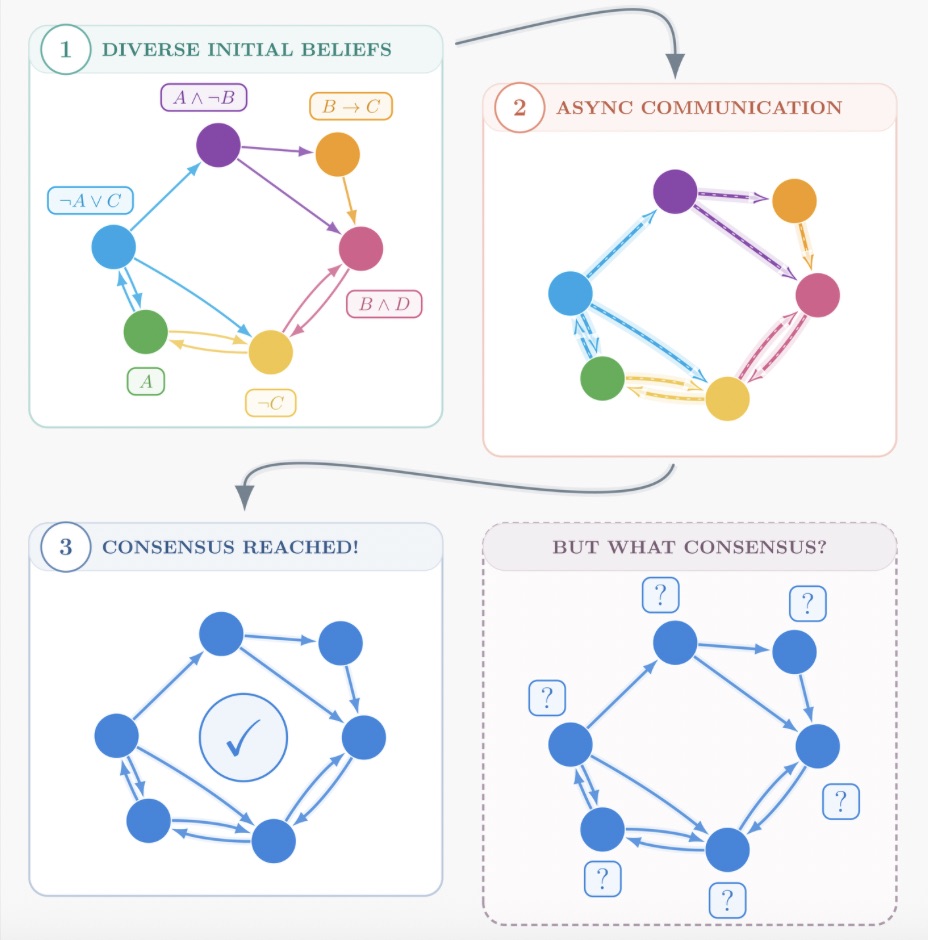 A schematic Belief Flow Network: agents exchange beliefs along directed influence links, and the research asks which final consensus beliefs can emerge.
Imagine a set of artificial agents, expert systems, or decision-makers, each beginning with their own “beliefs” about a shared situation. For example, one transport agent may believe that there is a train strike, another may believe that there is no strike, and a third may believe that if there is a strike, then buses will be overcrowded. They exchange messages over a directed network whose edges represent influence: one agent revises its beliefs after hearing from another, then a different pair communicates, and so on. If influence can eventually travel from every agent to every other agent, will the group end up agreeing? And, if agreement is inevitable, what exactly can they end up agreeing on?
These questions are simple to ask but subtle when beliefs are logical and therefore complex. A belief may be a statement such as “the diagnosis is A”, “the sensor is unreliable”, or a more complex combination of facts, rules, and conditional beliefs, such as “I believe there is no strike, but if there were a strike, I would believe transportation would be disrupted”. Revising such beliefs is not the same as averaging numerical opinions. New inputs may conflict with an agent’s current beliefs, and the agent should keep as much of its current beliefs as possible while making room for the information received from others. This problem has been studied for decades in belief revision, iterated belief revision, and the broader family of improvement operators, which formalize different policies for rational change.
This is the setting of Belief Flow Networks. A Belief Flow Network, or BFN, represents agents as nodes in a directed graph. An edge says that one agent can influence another. Each agent holds an epistemic state: an abstract representation of its current beliefs and the conditional beliefs that guide future changes. Communication is asynchronous: at each step, one agent receives information from one of its influencers and revises its epistemic state using an iterated belief change operator. Different agents may use different rational change policies: some may be relatively skeptical, and others may be more credulous, but all are assumed to follow the basic principles captured by iterated belief change operators.
In a previous AAAI 2024 paper BeliefFlow: A Framework for Logic-Based Belief Diffusion via Iterated Belief Change, we introduced this model and proved a reassuring convergence result. In any strongly connected BFN—meaning that information can travel from every agent to every other agent through directed paths—all agents converge after finitely many steps to a global consensus. This convergence is robust: it holds independently of the order in which communications are activated and even when agents use different change policies. Eventually, all agents accept the same final belief. The paper also studied formal bribery or control: external influence operations that make selected agents accept a chosen target piece of beliefs. Under the assumptions of the model, an optimal strategy can be characterized from the network topology and computed in polynomial time.
Our AAMAS 2026 paper Characterizing Consensuses in Belief Flow Networks studies what can be predicted before any formal intervention, such as bribery or control, is added to the model. The AAAI result tells us that a strongly connected BFN reaches consensus. The new question is: if we know the influence graph and the agents’ initial beliefs, which candidate shared beliefs can become the final consensus?
The answer first depends on whether the agents’ initial beliefs are mutually compatible. If all initial beliefs can consistently hold together, then there is no surprise: the only possible consensus is their conjunction, the combined information initially distributed across the group. Communication simply propagates and reinforces compatible information.
The more interesting case is inconsistency. Agents may begin with beliefs that cannot all be true together. Then different orders of communication, together with different rational change policies used by the agents, can lead to different possible consensuses. Our AAMAS 2026 paper characterizes exactly when a candidate shared belief can arise as a consensus, using conditions based on logical entailment and structural properties of the influence graph. Intuitively, a candidate shared belief can arise as a consensus if it is initially either supported or rejected by the agents’ initial beliefs, and if a rejecting agent disagrees with a supporting group among its predecessors in the graph.
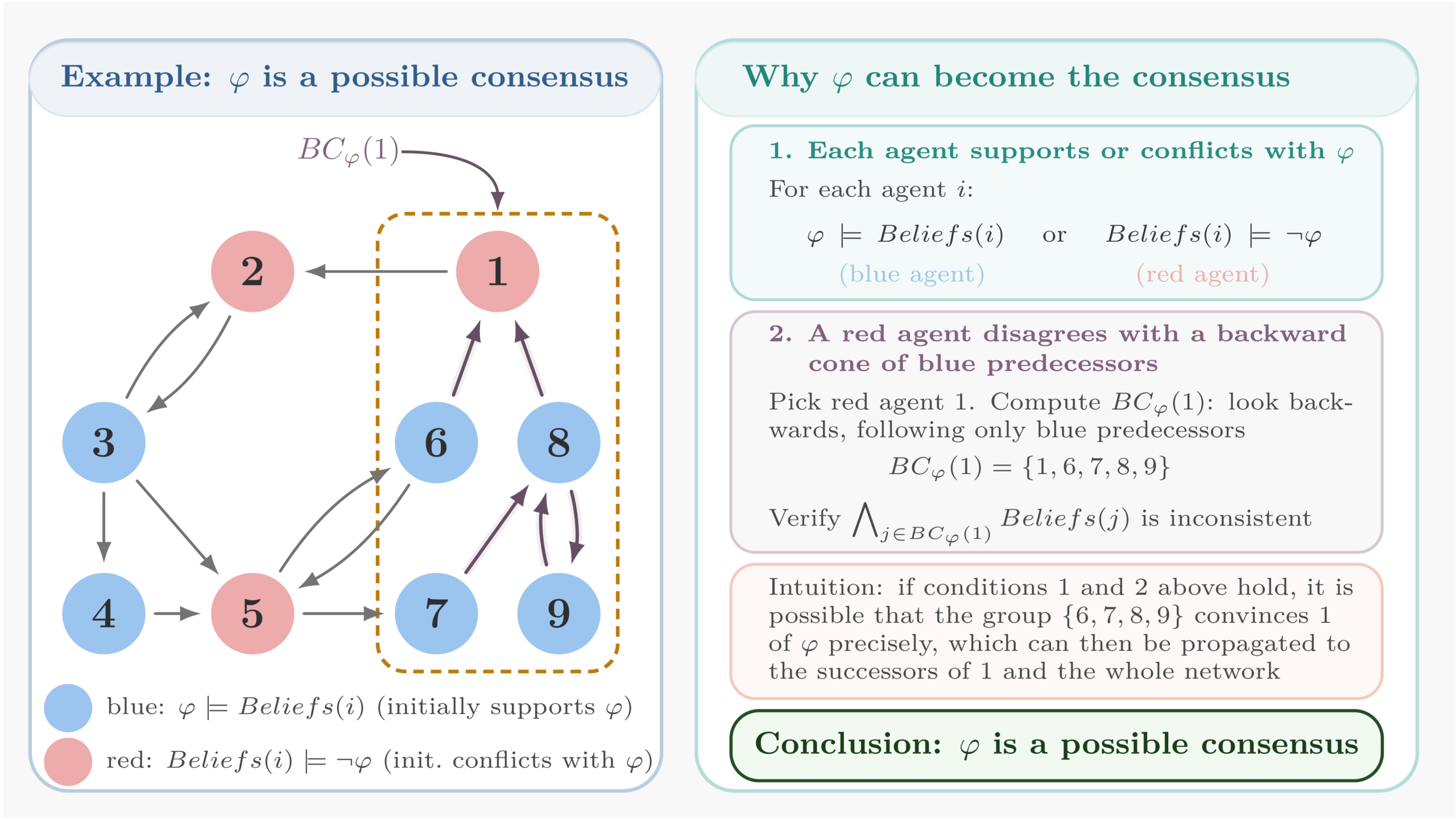
Identifying the possible consensuses matters for prediction and risk assessment in belief diffusion. In a formal model of a network, one may ask whether a false claim could become a possible consensus, whether a desired piece of information is guaranteed to be accepted by everyone, or which collective beliefs can emerge without any additional intervention. The result is also computationally appealing: whether a candidate shared belief is a possible consensus can be decided with polynomially many calls to an NP oracle. This matches the known complexity of ordinary inference for iterated belief change, so the consensus question is no harder than the underlying belief-change reasoning task.
The work also points to useful perspectives on applying the model. The characterization assumes that the full network topology is known, so a practical use would first require identifying the relevant agents and influence links. The model is abstract and logic-based, which is a strength for giving formal guarantees, but applying it to real online communities, scientific groups, or distributed AI systems would require choices about how to represent agents, beliefs, influence links, and observations of communication. The results should therefore be read as formal guarantees for BFNs, not as a direct predictor of every real social-media or human-belief process.
Still, BFNs provide a precise way to connect logical belief change with network diffusion. They show how consensus can be guaranteed, and how the final shared beliefs that may arise can be characterized from the network and initial beliefs and computed efficiently.
Our AAMAS 2026 paper is the main focus of this post, and it was selected as a best paper nominee.
You can watch the video presentation of the work here:
References
- Characterizing Consensuses in Belief Flow Networks, Nicolas Schwind, Gauvain Bourgne, Katsumi Inoue. In AAMAS’26, pages 2665–2673. Best Paper Nominee. Extended version with proofs.
- A Framework for Logic-Based Belief Diffusion via Iterated Belief Change, Nicolas Schwind, Katsumi Inoue, Sébastien Konieczny, Pierre Marquis. In AAAI’24, pages 10696–10704. Extended version with proofs.
Funding acknowledgement
The work described here benefited from support acknowledged in the source AAAI’24 and AAMAS’26 papers: JSPS KAKENHI Grant Numbers JP21H04905 and JP25K00375; JST CREST Grant Number JPMJCR22D3; the AI Chair BE4musIA (ANR-20-CHIA-0028); the THEMIS project (ANR-20-CE23-0018) of the French National Research Agency (ANR); and the France 2030 programme under the ANR-23-IACL-0007 grant PostGenIA.
tags: AAMAS, AAMAS2026

AUAI is supported by:








