
ΑΙhub.org
Humans trained to spot AI faces in the battle against deepfake fraud
 Yutong Liu & Kingston School of Art / Talking to AI 2.0 / Licenced by CC-BY 4.0
Humans have been successfully trained to spot AI-generated faces in a study led by researchers at the Australian National University (ANU) Emotions and Faces Lab.
AI-generated deepfake faces have become so realistic that it is difficult for people to tell them apart from photos of real humans, contributing to increases in AI-related fraud.
“Training on visual artifacts, like looking for a sixth finger or odd earrings, has had limited success, partly because the AI is getting too good, and fraudsters may avoid using pictures with obvious flaws anyway,” lead researcher Associate Professor Amy Dawel said.
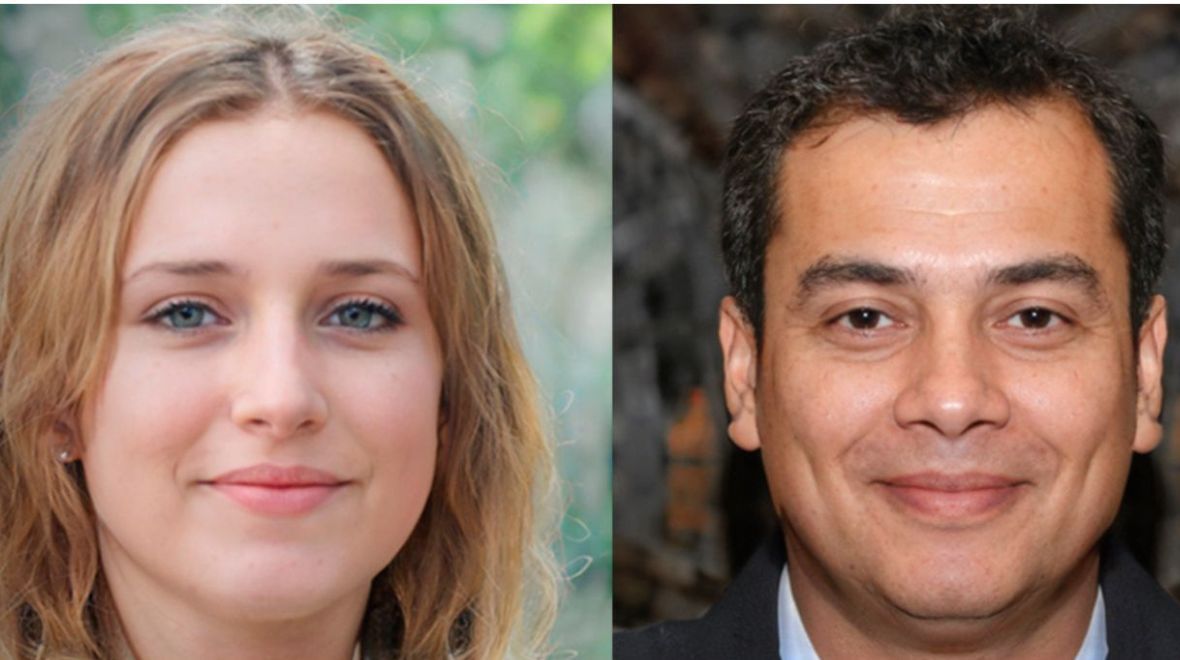 AI-faces generated using StyleGAN3.
“Our training directs people’s attention to global qualities that differ between AI and human faces. AI faces tend to be more symmetrical, proportional and attractive, but without training we often think these are markers of being human.”
The researchers trained people to spot AI-generated faces by drawing their attention to six perceptual qualities: distinctiveness, memorability, proportionality, symmetry, attractiveness and expressiveness.
The ability of all participants to spot AI faces improved, with “high performers” achieving near perfection.
“It was amazing to see the dramatic improvement in people’s ability to detect AI faces,” Associate Professor Dawel said.
“We’ve shown our training is effective for some of the most convincing fakes available, StyleGAN faces. Now we need to find out whether that training generalises to other AI-generated faces.
“We are also working on how to optimise the training – making it shorter and ensuring the benefits last over time.”
The participants in the main study were trained by ANU Honours student Tanya George.
“We found that even relatively short training sessions helped participants improve their accuracy in detecting AI-generated faces, highlighting the potential for practical education tools in this area,” Ms George said.
“AI image-generation technology is improving extremely quickly, and many people underestimate how convincing these faces can be. Research like this can help people navigate increasingly complex online environments.”
The research was successfully replicated by a team led by Professor Jim Tanaka and Dr Eric Mah at the University of Victoria, Canada.
“The replication shows that the findings weren’t a fluke – when we trained a new set of people in a different country, we saw them improve just as much,” Dr Mah said.
“Online training was effective, so our training program could easily be implemented at scale for little cost.”
Associate Professor Dawel said it was important to improve human AI-detection abilities because AI could not be relied upon to solve the problem alone.
“While algorithms offer one solution to detecting deepfake faces, their decision-making processes remain opaque and recent benchmarking reveals serious weaknesses,” she said.
“We need approaches that are ethical and explainable – for which keeping humans in the loop is key.”
The ANU Emotions and Faces Lab would like to hear from people interested in undertaking the AI face detection training or participating in other AI face studies. People can register to participate here.
Read the work in full
Training humans to detect AI-generated faces, Amy Dawel, Tanya George, Eric Y. Mah, James D. Dunn, Clare A. M. Sutherland, Nick Argument and James W. Tanaka, PNAS (2026).

AUAI is supported by:








