ΑΙhub.org
AI for ethology: an interview with Isla Duporge
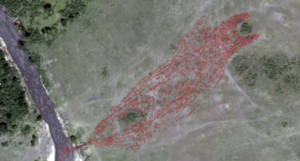
U-Net AI detections of migratory wildebeest crossing the Mara River between Kenya and Tanzania. Taken from high resolution satellite imagery.
Can you tell us a bit about your background and your current area of research?
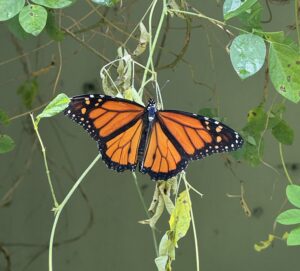
I use computational tools to study animal behaviour. After my PhD, I joined the U.S. Army Research Office, where I used satellite imagery to follow animals across whole landscapes, which is a powerful technique for seeing broad patterns, but far too coarse to capture what individuals are actually doing. That gap is what drives my current work at Princeton: I combine drone video with AI methods to resolve movement at much finer scales, as I have done in studies of Olive Baboons and lions. This year, I am focused on the Monarch migration, using Bluetooth tracking devices to follow individual butterflies.
What are the implications of your research, and why is it an interesting area of study?
I think ethology is at an inflection point. Remote sensing and tracking tools are becoming more sophisticated in terms of being able to collect longitudinal data on individuals, paired with AI-driven analysis, this enables us to capture animal movement at a spatial and temporal resolution that simply wasn’t available before. For most of the field’s history, our theories were built on what a person could observe and record by hand, comprised of a handful of individuals, for a few hours, in one place. Those observations were remarkable, but they were also a narrow window.
We can now watch very large groups of animals from satellites and drones, and follow individuals across a full migration with animal-borne tags. Some long-held ideas will hold up under that scrutiny, while others will need revising. Take navigation: for most migrating animals, we still don’t know how an individual knows where it is in relation to where it is going, or whether it is truly navigating at all. It could be following a genetically inherited compass vector (“fly southwest”) or using social information to set a heading. For many species, we don’t know to what degree the environment or genes drive movement. Tracking more individuals, at higher accuracy, across their whole lives, will let us close that gap.
What have you learned about collective animal behaviour?
The most interesting thing is how much structure emerges once you can resolve individual movement within a group. In plains zebra, the protective behaviour of a stallion for its family group together appears to break down above a certain group size during escape: there is a threshold beyond which the group fragments. In Monarchs, my data point towards vector-based compass orientation e.g., fixed-direction flight rather than true navigation, i.e., knowing where one is in relation to where it is trying to go. This means a migration that looks purposeful at the continental scale may be built from much simpler individual rules. These two projects are still ongoing.
The same principle applies to my population work at a much larger scale: a satellite census of migratory wildebeest produced a substantially lower figure than previously assumed, and my elephant work showed that satellite imagery combined with AI detection can complement aerial surveys in open habitat – as the tools improve, so does what we can see and understand. Technology drives science: the quality of our data sets a ceiling on the accuracy of our theories.
Your work combines long-range drones, very high-resolution satellite imagery, and deep learning to track animals. Could you walk us through how these technologies work together, and what advantages this approach has over traditional tracking methods?
They operate at different scales and fill each other’s gaps. Satellite imagery covers whole landscapes and finds where animals are. Drones can fly into those areas and record at sub-meter resolution, close enough to follow individuals within a group and to read their behaviour. The miniaturisation of tracking tags also enables us to now track individuals at fine scales. Deep learning makes the volume tractable: detecting, identifying, and tracking thousands of animals across footage that would take a person years to annotate by hand.
What future work are you planning in this area? Is there anything coming up that particularly excites you?
Quieter drones with longer flight times would let us observe undisturbed behaviour for hours rather than tens of minutes, which matters for observing rare events, i.e., a predation event or a fight which leads to a switch in the social hierarchy. Video from satellites, as opposed to still imagery, would extend observations of movement behavior to an unprecedented scale. And continued miniaturisation of biologging tags means we can instrument smaller species, and eventually whole social groups rather than a handful of individuals.
What excites me most is the convergence of these technologies which will allow questions about collective behaviour that we currently answer with models to become directly observable and testable with empirical data.
About Isla
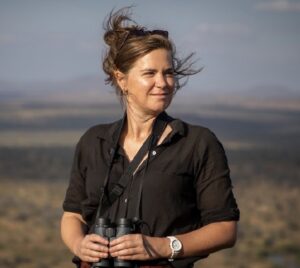 |
Isla Duporge is a zoologist and a National Geographic Explorer based at Princeton University. Isla holds a PhD in Zoology from the University of Oxford, and has worked in the United States for the past four years, developing remote-sensing and AI methods to track animal movement in the wild. |

AUAI is supported by: