ΑΙhub.org
Interview with Sarah Alyami – Continuous Sign Language Recognition: Dataset Development and Novel Frameworks
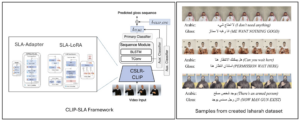
Overview of the proposed CLIP-SLA framework for continuous sign language recognition (left) and annotated sample sequences of Saudi Sign Language from the Isharah dataset (right). Image credits: Sarah Alyami.
In this crosspost from AI Matters, the ACM SIGAI’s quarterly newsletter, Ella Scallan interviews Sarah Alyami. Sarah received an Honourable Mention for the 2025 ACM / AAAI Doctoral Dissertation Award for her research in continuous sign language recognition, including the development of the first large-scale dataset for sentence-level Saudi Sign Language.
You were awarded an Honourable Mention for the 2025 AAAI Doctoral Dissertation Award. What was the topic of your dissertation research, and why was this an interesting area of study to you?
My dissertation focused on Continuous Sign Language Recognition (CSLR), with an emphasis on developing large-scale datasets and designing novel deep learning frameworks capable of recognizing natural sign language from video. The work addressed a fundamental gap in AI accessibility, particularly the limited research and scarcity of linguistic resources for sentence-level Saudi Sign Language, where most existing technologies have historically concentrated on isolated signs or controlled experimental settings.
This challenge presented both a scientific and societal opportunity. From a research perspective, advancing sentence-level recognition requires solving complex problems in temporal modeling, visual understanding, and language representation. From a societal perspective, enabling machines to understand sign language has the potential to reduce communication barriers for Deaf and hard-of-hearing communities while advancing multimodal AI toward more inclusive human–computer interaction.
I was especially drawn to this area because it sits at the intersection of computer vision, language understanding, and real-world impact, offering the possibility of contributing both methodological innovation and meaningful accessibility advancements.
What were the main contributions or findings of your dissertation?
The dissertation made contributions on both the data and modeling fronts. A central contribution was the development of Isharah, the first large-scale dataset for sentence-level Saudi Sign Language and one of the largest benchmarking datasets for continuous sign language recognition, designed to reflect realistic signing conditions rather than controlled studio environments.
On the modeling side, I proposed transformer-based architectures for learning rich spatio-temporal representations and explored how to adapt large vision-language models to sign language despite limited training data. Through parameter-efficient adaptation techniques, the models were able to transfer pretrained visual knowledge effectively without extensive retraining.
The results showed that these strategies improve recognition performance while remaining computationally efficient, achieving state-of-the-art results across multiple datasets. More broadly, the work highlights the importance of aligning dataset design with real-world deployment goals, emphasizing that progress in sign language AI depends on both representative data and model innovation.
How has your research developed since then? What are you focusing on now?
Since completing my PhD, I have focused on expanding the Isharah dataset to support more realistic and large-scale research in continuous sign language recognition. This includes broadening its linguistic coverage and recording conditions to better reflect real-world communication.
I am also broadening my research toward AI systems with societal impact, including multimodal healthcare applications and intelligent assistive technologies. Across these efforts, my goal remains consistent: designing AI systems that are both technically rigorous and meaningfully beneficial.
How have you seen your field of research evolve in recent years?
The field has moved rapidly from isolated gesture recognition toward holistic multimodal language understanding. Advances in transformers, vision-language models, and large-scale pretraining have significantly improved performance, but they have also raised expectations around generalization and realism.
Another encouraging shift is the growing recognition that accessibility technologies deserve the same level of scientific rigor as mainstream AI tasks. We are seeing stronger datasets, more realistic evaluation protocols, and increasing interdisciplinary collaboration between AI researchers and domain experts.
What future directions or open questions excite you most?
One exciting direction is the advances in gloss-free sign language translation and sign language generation. Moving toward end-to-end translation directly from video can improve scalability by reducing reliance on costly gloss annotations, while progress in generation opens the door to more natural bidirectional communication. Addressing challenges such as linguistic accuracy, visual realism, and data efficiency will be essential for building inclusive AI systems that operate reliably in real-world settings.
Were you always set on being a researcher?
Not initially. My interest in research grew gradually through exposure to challenging problems and inspiring mentors. What ultimately drew me in was the opportunity to contribute new knowledge and tackle problems whose solutions could extend beyond academia. Research offers a unique combination of intellectual curiosity and long-term impact, and that balance is what continues to motivate me.
Do you have any advice for early career researchers in your field?
Focus on problems that matter, not just problems that are fashionable. Strong research often comes from identifying gaps that others have overlooked. At the same time, invest in fundamentals. Trends evolve quickly, but deep technical understanding endures. I would also encourage researchers to think carefully about dataset design and evaluation protocols, as these often shape the trajectory of an entire research area. Finally, seek collaborations and remain open to interdisciplinary perspectives. Many of today’s most important breakthroughs happen at the boundaries between fields.
About Sarah
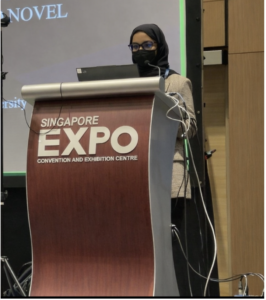 |
Sarah Alyami is an Assistant Professor of Computer Science at Imam Abdulrahman Bin Faisal University. She received her Ph.D. in Computer Science from King Fahd University of Petroleum and Minerals in 2025, where her dissertation earned an Honorable Mention for the AAAI/ACM SIGAI Doctoral Dissertation Award. Her research focuses on artificial intelligence for video understanding, with an emphasis on Sign Language Recognition. Her work has been published in leading journals and venues including IEEE Transactions on Multimedia, Neurocomputing, Information Processing and Management, and CVPR and ICCV workshops. |

AUAI is supported by: