
ΑΙhub.org
Interview with Zijian Zhao: Labor management in transportation gig systems through reinforcement learning

Each year, a small group of PhD students are chosen to participate in the AAAI/SIGAI Doctoral Consortium. This initiative provides an opportunity for the students to discuss and explore their research interests and career objectives in an interdisciplinary workshop together with a panel of established researchers. For the past couple of years, we’ve been meeting with some of the students to find out more about their work. In the second of our interviews with the 2026 cohort, we hear from Zijian Zhao.
Tell us a bit about your PhD – where are you studying, and what is the topic of your research?
I am a second-year Ph.D. student at the Hong Kong University of Science and Technology, under the supervision of Professor Sen Li. I have broad interests in AI, with previous work focused on developing various deep learning methods in cross-subject applications such as smart cities, intelligent transportation, and wireless sensing. Currently, I am concentrating on labor management in transportation gig systems through reinforcement learning (RL). Our aim is to enhance system efficiency while also identifying and mitigating algorithmic discrimination against workers.
Could you give us an overview of the research you’ve carried out during your PhD?
My research initially focused on developing advanced RL control methods for labor management tasks in transportation gig systems, such as order dispatch and payment settings for food delivery and ride-sharing platforms. Despite significant advancements in this area, several challenges remain for further optimization: (i) First, the large-scale nature of real-world transportation systems presents a chain-of-draft (CoD) challenge for RL algorithms. The sheer number of vehicles (workers) and trips (orders) results in an enormous state space, while the potential combinations of trips and vehicles create an exceedingly large action space. (ii) While multi-agent reinforcement learning (MARL) can address some of these challenges, specific restrictions, such as a trip not being assignable to the same vehicle repeatedly, make it difficult to adapt standard MARL algorithms for transportation systems. (iii) When considering joint task optimization like order dispatch, order bundling, repositioning, and payment and pricing settings, it adds further complexity, particularly when accounting for practical conditions such as real-time requirements and computational resource efficiency.
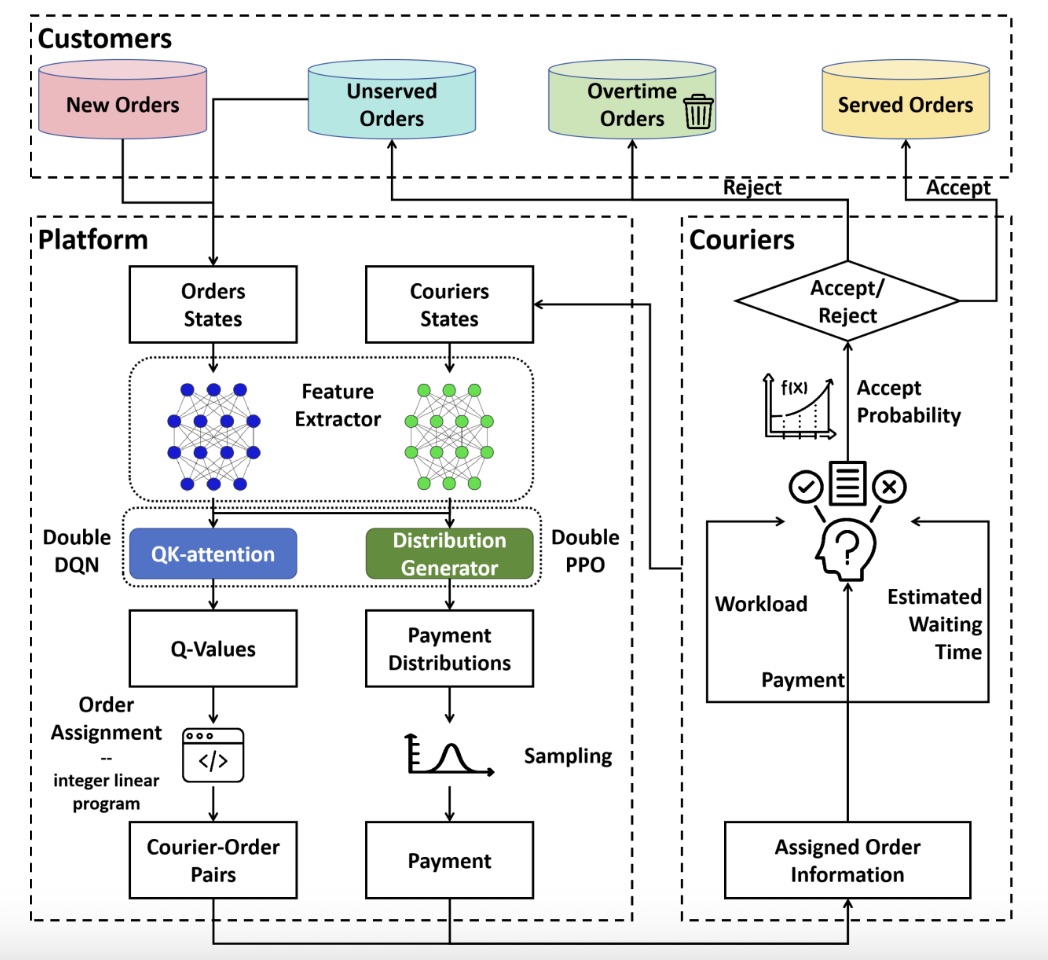
In my previous research, I developed several novel methods for order dispatch in ride-sharing and food delivery systems, including: (i) The first MARL ride-sharing method that does not require value function decomposition, significantly reducing computation costs while improving system efficiency. (ii) The first centralized single-agent RL method, which tackles the CoD challenge through a novel network structure and policy space design, enhancing system performance by considering all trips and vehicles holistically. (iii) The first micro-level MARL framework for a mixed approach to pre-booked and on-demand order dispatch, allowing for optional ride-sharing choices while balancing punctuality for pre-booked orders and timeliness for on-demand requests. (iv) A novel multi-action MARL framework for joint control of discrete order dispatch and continuous payment settings.
However, even though black-box RL algorithms significantly enhance system efficiency, they also raise concerns about algorithmic discrimination due to their low explainability and the overuse of individual data. For instance, some research has shown that algorithms may exhibit different order dispatch preferences for workers, and payment structures might be personalized, violating the principle of “equal pay for equal work”. Moreover, in the long term, these algorithms can manipulate workers’ schedules through discriminatory practices. Unfortunately, most current studies rely on user surveys and statistical analyses, leaving the specific reasons and impacts of algorithmic discrimination unclear. To address this issue, we first apply our developed algorithm to a discriminatory food delivery platform. Our simulation results indicate that the platform prefers couriers with higher acceptance rates by assigning them more workloads and longer-distance orders, which can yield higher profits, even if these couriers receive lower unit payments. Additionally, we aim to explore whether data privacy regulations can help mitigate this unethical phenomenon. To this end, we’ve developed a multi-stage MARL framework to simulate the effects of such regulations. The results demonstrate that data privacy regulations not only protect couriers’ rights but also provide benefits for both platforms and customers.
Recently, we completed a study on federated traffic prediction, aiming to integrate it with ride-sharing projects to address challenges such as repositioning amid long-term order uncertainty.
Is there an aspect of your research that has been particularly interesting?
Yes. In our paper The impacts of data privacy regulations on food-delivery platforms, we discovered a compelling finding: implementing data privacy regulations can actually lead to higher profits for platforms, contrary to the intuition that regulations would harm them. By granting couriers the right to keep their individual data private, more couriers choose to work with the platform. When the platform cannot discriminate based on individual data, it creates greater opportunities for disadvantaged groups. The increase in active couriers allows the platform to handle more orders, resulting in higher profits. Additionally, customers benefit from reduced delivery times due to improved planning driven by the larger active courier base.
However, the irony of this situation struck me while revising the paper. After I wrote, “we create a win-win scenario for the platform, customers, and couriers,” I encountered a courier delivering my coffee who mentioned he was rushing so much he got hit by a car. This highlights that we still have a long way to go in creating a more courier-friendly food delivery market.
What are your plans for building on your research so far during the PhD – what aspects will you be investigating next?
During the remainder of my Ph.D. journey, I plan to focus on three key areas: (i) First, I intend to further investigate algorithmic discrimination within transportation gig systems, studying long-term discriminatory strategies and assessing how emerging technologies like autonomous vehicles and drones impact the market. (ii) Second, I aim to integrate my previous research on traffic prediction with order dispatch tasks, exploring how prediction results and errors can influence decision-making models, particularly regarding fairness among different regions. (iii) Lastly, I plan to continue my earlier research on media processing, cross-domain learning, and LLM agents from before my Ph.D. I intend to investigate their applications in intelligent transportation and smart city systems. For instance, I am particularly interested in exploring cross-region traffic prediction using cross-domain and transfer learning techniques.
What made you want to study AI?
My interest in AI began in junior school when I naively believed it could achieve the impressive feats depicted in science fiction films. I also recognized various unfair phenomena in society and thought that emotionless machines could provide the fairest management for humanity. Although this perspective may seem simplistic, it sparked my passion for studying AI at a young age. Ironically, while I initially viewed machines as impartial, my research has since focused on identifying the unethical behaviors of AI algorithms. My goal is to ensure that AI helps create a more just and equitable society.
Could you tell us an interesting (non-AI related) fact about you?
Outside of academia, I have a passion for heavy music, particularly metal and core genres. I serve as the vocalist and guitarist in a melodic death metal band, and I also have a personal alternative rock project. In my free time, I enjoy both attending and performing live events. I’m particularly proud of having released the first stage lighting dataset for research, utilizing videos I recorded during my undergraduate studies, which have been processed to avoid copyright issues.
About Zijian Zhao

|
Zijian Zhao received a B.Eng. degree in computer science and technology from School of Computer Since and Engineering, Sun Yat-sen University in 2024. He is currently pursuing a Ph.D. degree in civil engineering (scientific computation) with the Department of Civil and Environmental Engineering, The Hong Kong University of Science and Technology. He was a visiting student in Shenzhen Research Institute of Big Data, The Chinese University of Hong Kong (Shenzhen) from 2023 to 2024. His current research interests include deep learning, reinforcement learning, intelligent transportation, and smart cities. |
tags: AAAI, AAAI Doctoral Consortium, AAAI2026, ACM SIGAI

AUAI is supported by:








