
ΑΙhub.org
Interview with Yash Saxena: how is external knowledge used in AI systems?
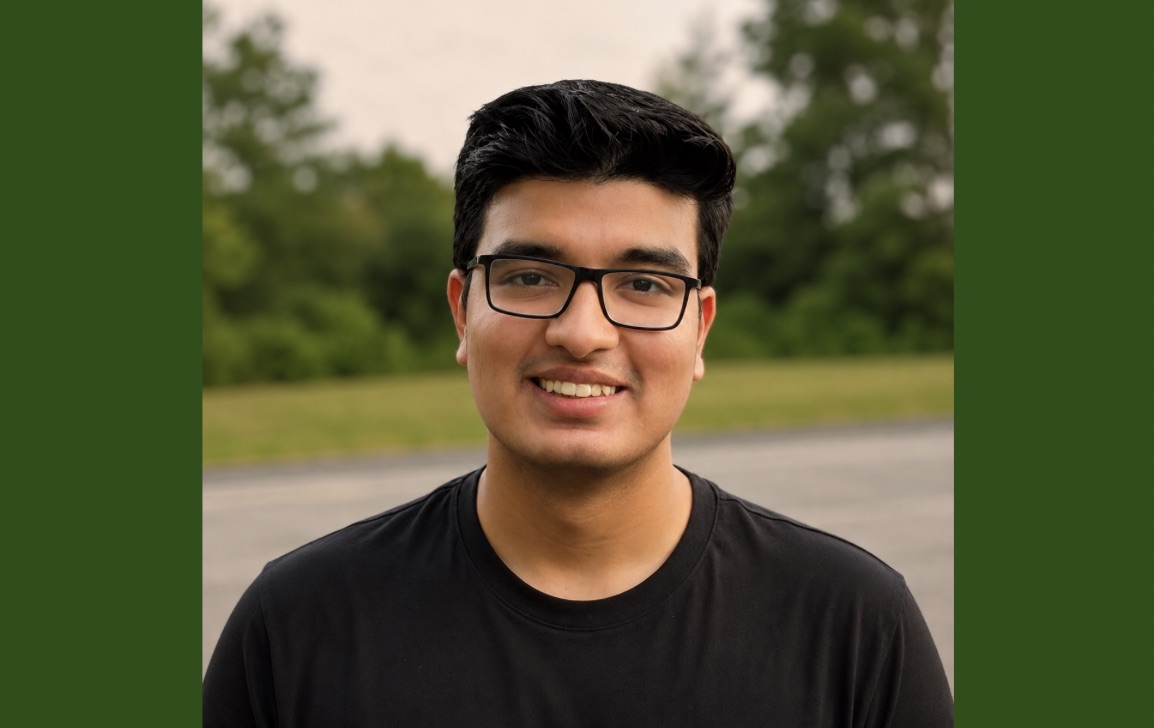
In a new series of interviews, we’re meeting some of the PhD students that were selected to take part in the Doctoral Consortium at the International Joint Conference on Artificial Intelligence and the 29th European Conference on Artificial Intelligence (IJACI-ECAI 2026). In this first article of the series, we caught up with Yash Saxena to find out how he is trying to make it easier to understand how external knowledge is used in AI systems.
Tell us a bit about your PhD – where are you studying, and what is the topic of your research?
I am a PhD student in Computer Science at the University of Maryland, Baltimore County (UMBC), advised by Dr. Manas Gaur in the Knowledge Infused AI and Inference (KAI2) Lab. My PhD focuses on making AI systems that use external information easier to understand and audit.
Many AI systems now look through external documents before answering a question. My research follows what happens to that evidence as it moves through the system. I study where it came from, why certain evidence was selected, whether it actually supports the claim being made, and whether the context needed to interpret that evidence correctly is preserved along the way.
I call this broader research direction IKnowFlow, or Interpretable Knowledge Flow. The aim is to keep the evidence trail visible so that someone can inspect a generated claim and understand how the system arrived at it. This is especially important in areas such as law, science, and healthcare, where an incorrect AI-generated claim can have serious real-world consequences.
Could you give us an overview of the research you’ve carried out so far during your PhD?
I started by studying source attribution, or how an AI-generated claim can be linked back to the source that supports it. In REASONS (REtrieval and Automated citationS Of scieNtific Sentences), we evaluated retrieval and citation generation across more than 20,000 scientific papers from 12 research areas. I later compared two ways of adding citations to large language model responses: generating them together with the answer or assigning them afterward. In our human evaluation, adding citations afterward was more accurate, but this also showed that a citation alone does not necessarily reveal how the model arrived at its answer.
From there, I started looking earlier in the process. Interpretable Modular Retrieval Neural Networks (IMRNNs) focuses on retrieval, where the system decides which documents are relevant to a question. It makes this step more interpretable by showing which parts of the query and document influenced that match.
I then worked on Method for Interpretable Rank-Free Evidence Selection with Optimal Rationale (METEORA), which looks at what happens after documents are retrieved. Instead of passing everything directly to the language model, METEORA reasons about why each retrieved passage may be useful and selects the evidence that should be used to generate the answer. Across six datasets from law, science, and finance, it improved answer accuracy by 33.34% while using about half as many retrieved passages.
As these projects developed, I became more interested in following evidence across the whole process. That led to IKnowFlow, which connects retrieval, evidence selection, attribution, and provenance so that the path from a source to a generated claim can be understood and audited.
Is there an aspect of your research that has been particularly interesting?
One aspect I have found particularly interesting is that a citation can support an answer without showing what information the model actually used to generate it.
For example, a model can generate an answer first and then search for a source that supports it. The citation it finds may be relevant and correct, but it still does not tell us what evidence influenced the model when the answer was produced. Our work comparing generation-time and post-hoc citation made this distinction especially clear to me.
It changed how I think about trust in these systems. A final citation is only one part of the story; we also need to know what evidence actually reached the model and how it connects to the answer.
What are your plans for building on your research so far during the PhD – what aspects will you be investigating next?
The next part of my PhD will focus more deeply on claim-level provenance. I want to trace the evidence behind a generated statement while preserving the context needed to interpret that evidence correctly. I am also interested in how other relevant sources affect the way that evidence should be understood, so that important context is not lost when a claim is generated. More broadly, I want to extend IKnowFlow from individual stages to a connected evidence trail that runs from the original sources to the generated claim. Someone auditing an answer should be able to see where the claim came from and whether the evidence has been used in the right context.
How did you find the IJCAI-ECAI doctoral consortium, and the conference experience in general?
I found the Doctoral Consortium very useful because I could discuss IKnowFlow as a complete PhD direction and get feedback on how the different parts of the thesis fit together. My mentor, Maria Chang from IBM Research, gave me detailed feedback on the scope of the work and some of the questions I should think about as I develop it further. I also had several good discussions with other researchers and doctoral students during the consortium.
Overall, I really enjoyed the IJCAI-ECAI experience. It was a good opportunity to present my PhD work, meet other researchers, and have conversations that I would not normally have within my own research group.
What made you want to study AI?
During my undergraduate studies, I was exploring different areas of computer science, from cloud computing and blockchain to AI. As I took courses in machine learning and later in areas such as computer vision and natural language processing (NLP), AI gradually became the field I was most interested in because of the idea that a system could learn patterns from data rather than having every behavior explicitly programmed.
NLP drew me in further. I found the idea of representing language as vectors or embeddings especially intriguing because it gave computers a way to work with relationships and meaning in language. That interest eventually grew into the research questions I work on today.
Could you tell us an interesting (non-AI related) fact about you?
Outside of research, I enjoy playing chess and listening to music. Chess keeps me engaged in a different way, and music is usually how I unwind.
About Yash

|
Yash Saxena is a PhD student in Computer Science at the University of Maryland, Baltimore County (UMBC), advised by Dr Manas Gaur in the Knowledge Infused AI and Inference (KAI2) Lab. His research focuses on trustworthy retrieval-augmented generation and interpretable information retrieval, with an emphasis on making the evidence behind AI-generated answers traceable and auditable. His PhD research, IKnowFlow (Interpretable Knowledge Flow), studies how evidence moves from source documents to generated claims and how that path can be preserved for auditing. His work has been published at ICML, Findings of EACL, AAAI, IEEE DSAA, and in IEEE Intelligent Systems. |
tags: ECAI, ECAI2026, IJCAI, IJCAI2026

AUAI is supported by:








