ΑΙhub.org
The CLAIRE COVID-19 Initiative: a bottom-up effort from the European AI community
By Gianluca Bontempi, Ricardo Chavarriaga, Hans de Canck, Emanuela Girardi, Holger Hoos and Iarla Kilbane-Dawe
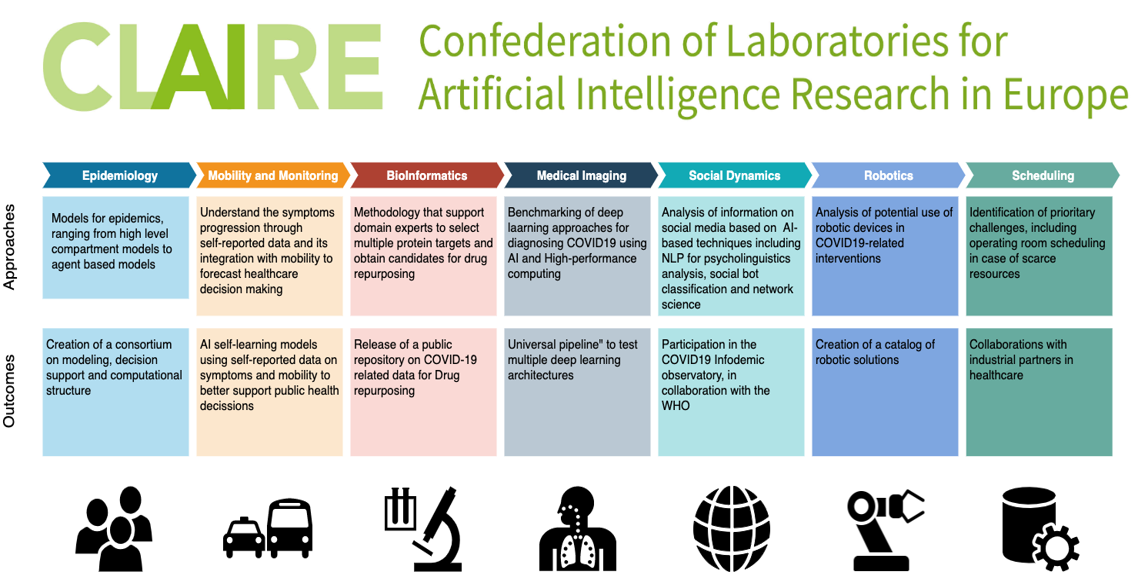
CLAIRE, the Confederation of Laboratories for AI Research in Europe, launched its COVID-19 initiative in March 2020 as the first wave of the pandemic hit the continent. Its objective is to coordinate volunteer efforts of its members to contribute to tackling the effects of the disease. The taskforce was able to quickly gather a group of about 150 researchers, scientists and experts in AI organized in seven topic groups: epidemiological data analysis, mobility data analysis, bioinformatics, medical imaging, social dynamics monitoring, robotics, and scheduling and resource management.
Activities of these groups yielded multiple outcomes including a publicly released resource on COVID-19 related data for drug-repurposing; the development the COVID-19 Infodemic Observatory to track spread of misinformation in social media and tools for the diagnosis based on CT scans using High Performance Computing (HPC) platforms. The latter was the catalyst for establishing a partnership between CLAIRE, the Italian National Inter-University Consortium for Informatics (CINI) and the Associazione Big Data (ABD) to provide HPC-enabled AI technologies to our network members.
The experience of the CLAIRE COVID-19 task force showed the possibility of rapidly assembling and coordinating scientific experts from a broad range of fields. This bottom-up approach can lead to significant outcomes like public datasets and tools, new project consortia and outreach information about how science can contribute to address global challenges. Correspondingly, we identified multiple aspects that need to be reinforced to improve preparedness for future events.
One of these aspects concerns the need for more efficient collaboration mechanisms between the AI community, domain experts and public authorities. Despite the mutual interest, existing mechanisms do not appear flexible enough to provide the necessary resources for collaboration in a timely manner. Another specific challenge for the application of AI approaches stems from difficulties in collecting and sharing data among stakeholders. This is due to a lack of clarity regarding privacy regulation, dearth of standards for sharing critical-data, heterogeneous data collection policies, and the absence of integrated data acquisition and storage pipelines at health institutions and at governments level.
Currently there is intensive discussion on the global governance for AI, as well as growing interest in the promotion of private and public partnerships on the field. These discussions should provide instruments that promote resilience by setting up fast-response mechanisms to mobilise experts from different domains. These mechanisms shall include tools for identifying and calling-up experts based on expertise; maintain permanent dialogs between researchers, field experts, policy makers and interest groups; set-up flexible infrastructures for data-sharing that support emergency use (with e.g. in-built privacy by design). Bottom-up initiatives like CLAIRE can be instrumental in ensuring that these mechanisms are well founded in research excellence and are designed with a clear human-centred focus.
The challenges raised by COVID-19 were a wake-up call for the need for a strong European AI ecosystem and agile, fast-response mechanisms to mobilise experts from different domains. At CLAIRE, we are currently studying the lessons learned from the experience in the last months in order to generate resources that will help us manage the next phases of the pandemic and future societal emergencies.
Find out more about the CLAIRE COVID-19 task force here.
Contact by email: covid19@claire-ai.org.
Task force coordinators
Gianluca Bontempi, CLAIRE Belgium (French community) NCP; Université Libre de Bruxelles,
Ricardo Chavarriaga, CLAIRE office Switzerland; Zurich University of Applied Sciences-ZHAW, Switzerland
Hans de Canck, CLAIRE office Belgium
Emanuela Girardi, Member of High-Level Expert Group on AI of the Italian Ministry of Economic Development, AIxiA, Pop AI, Italy
Holger Hoos, Board of Directors, CLAIRE; Universiteit Leiden, The Netherlands.
Iarla Kilbane-Dawe (From March to Dec 2020), Parliament Hill Research Ltd, UK
About CLAIRE
The Confederation of Laboratories for Artificial Intelligence Research in Europe (CLAIRE) is an organisation created by the European AI community that seeks to strengthen European excellence in AI research and innovation, with a strong focus on human-centred AI. CLAIRE aims to ensure that societies and citizens across all of Europe, and beyond, benefit from AI as a major driver of innovation, future growth and competitiveness, and to achieve world-wide brand recognition for “AI made in Europe”.
CLAIRE, founded in 2018, has garnered the support of more than 3500 AI experts and stakeholders, who jointly represent the vast majority of Europe’s AI community, spanning academia and industry, research and innovation. Among them are more than 140 fellows from various key scientific associations. CLAIRE has opened administrative offices in The Hague (HQ), Brussels, Oslo, Paris, Prague, Rome, Saarbrücken and Zürich.
CLAIRE’s membership network consists of over 380 research groups and institutions, covering jointly more than 21,000 employees in 35 countries. Furthermore, CLAIRE is currently in the process of setting up an Innovation Network that, together with the established Research Network, will foster a strong link between research and industry.
The CLAIRE vision is officially supported by the governments of nine European countries, 28 scientific associations across all of Europe, the European Association for Artificial Intelligence (EurAI), the Association for the Advancement of Artificial Intelligence (AAAI), and the European Space Agency (ESA).
CLAIRE is also actively liaising with other important AI-organisations, including ELLIS, the HumanE AI consortium, the Big Data Value Association, euRobotics and AI4EU.
Follow CLAIRE on: Twitter | LinkedIn | Facebook | YouTube
tags: CLAIRE, Focus on good health and well-being, Focus on UN SDGs
AUAI is supported by: