ΑΙhub.org
Conference on Reinforcement Learning and Decision Making
The 5th Multi-disciplinary Conference on Reinforcement Learning and Decision Making (RLDM) 2022 took place at Brown University from 8-11 June. The programme included invited and contributed talks, workshops, and poster sessions. The goal of RLDM is to provide a platform for communication among all researchers interested in learning and decision making over time to achieve a goal.
Over the last few decades, reinforcement learning and decision making have been the focus of an incredible wealth of research spanning a wide variety of fields including psychology, artificial intelligence, machine learning, operations research, control theory, neuroscience, economics and ethology. The interdisciplinary sharing of ideas has been key to many developments in the field, and the meeting is characterized by the multidisciplinarity of the presenters and attendees.
Michael Littman (one of the conference general chairs) said that the conference had been a great success, both in terms of the organization and the content: “For many of us, it was the first in-person conference since the start of the pandemic. The organizers put a lot of thought into ways of keeping people safe from COVID and it appears to have paid off, with very few attendees testing positive. RLDM is always exciting, in part because of the effort to coordinate between the cognitive/neuroscience researchers studying decision-making in natural systems and the AI/ML researchers looking at decision-making in machines”.
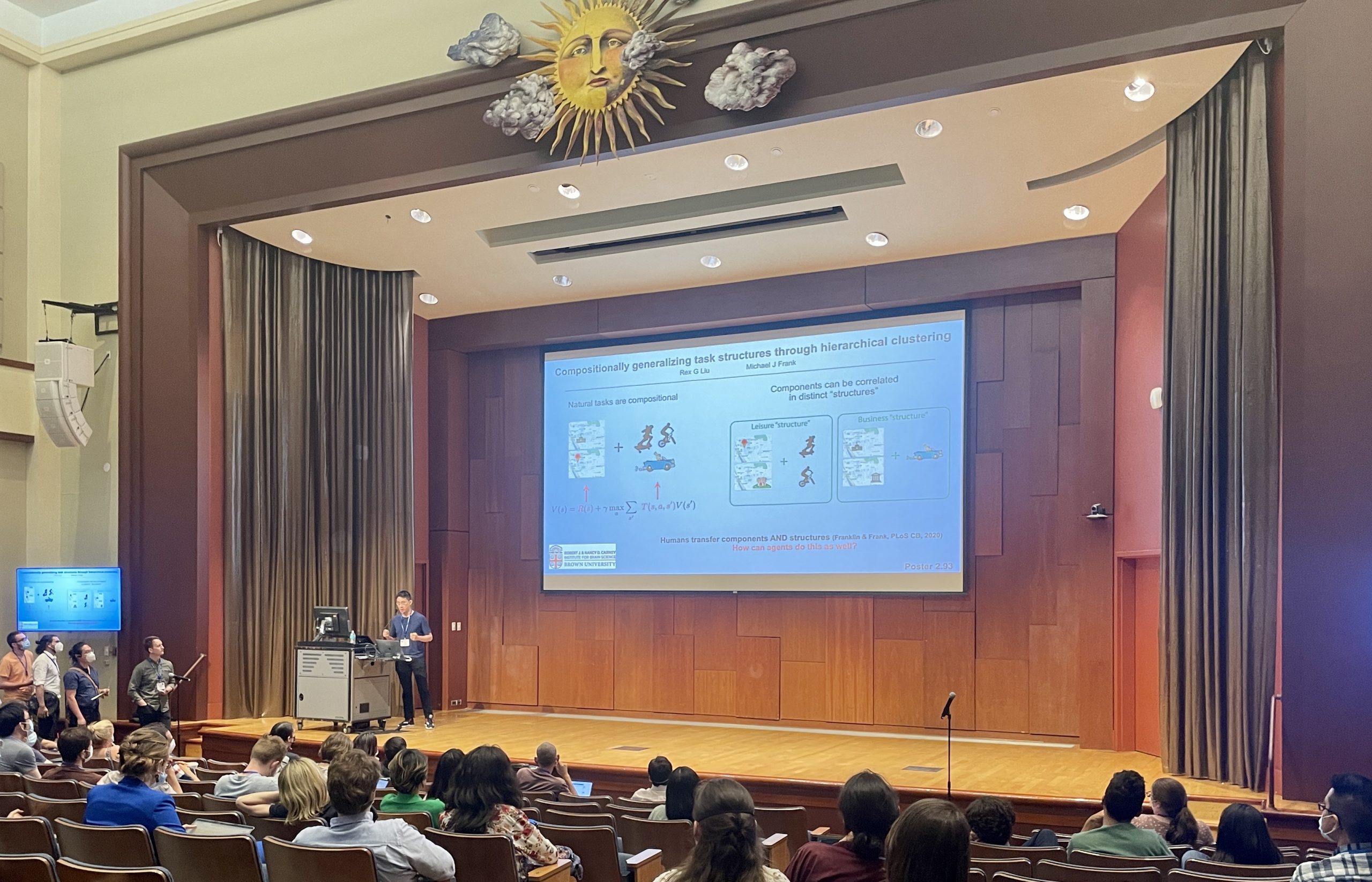 One of the speakers at RLDM. Photo credit: Michael J Frank.
Watch the recordings of the talks
The talks from the four days of the conference were recorded, and you can watch them here:
Day 1 | Day 2 | Day 3 | Day 4
The talks are also available split by individual speakers here.
Best paper awards
Two articles received the honour of RLDM 2022 Best Paper Award:
- Yash Chandak, Scott Niekum, Bruno Castro da Silva, Erik Learned-Miller, Emma Brunskill, Philip S. Thomas, Universal off-policy evaluation.
- Diksha Gupta, Brian DePasquale, Charles Kopec, Carlos Brod, An explanatory link between history biases and lapses.
Some of the participants shared their experience on Twitter.
The event website is here.

AUAI is supported by: