ΑΙhub.org
Nobel Prizes in physics and chemistry awarded for machine learning research
 ©Johan Jarnestad/The Royal Swedish Academy of Sciences
The 2024 Nobel Prizes for physics and chemistry were announced on 8 and 9 October respectively. Both prizes were awarded for work enabling or using machine learning.
2024 Nobel Prize in Physics
The physics prize has been awarded to:
- John Hopfield – “for foundational discoveries and inventions that enable machine learning with artificial neural networks”
- Geoffrey Hinton– “for foundational discoveries and inventions that enable machine learning with artificial neural networks”
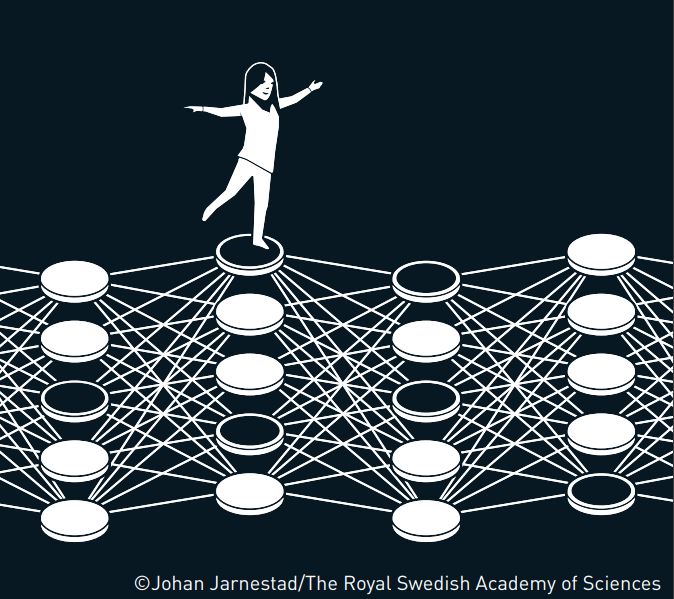
More specifically, Hopfield is recognised for “inventing a network that uses a method for saving and recreating patterns”. This Hopfield network utilises physics that describes a material’s characteristics due to its atomic spin. The network as a whole is described in a manner equivalent to the energy in the spin system found in physics, and is trained by finding values for the connections between the nodes so that the saved images have low energy. When the Hopfield network is fed a distorted or incomplete image, it methodically works through the nodes and updates their values so the network’s energy falls. The network thus works stepwise to find the saved image that is most like the imperfect one it was fed with.
Hinton is recognised for “using the Hopfield network as the foundation for a new network that uses a different method: the Boltzmann machine“. The Boltzmann machine is programmed to “recognise” characteristic elements in a given type of data, and is trained on examples that are very likely to arise when the machine is run. The Boltzmann machine can be used to classify images or create new examples of the type of pattern on which it was trained.
2024 Nobel Prize in Chemistry
One half of the chemistry prize has been awarded to:
- David Baker – “for computational protein design”
and the other half jointly to:
- Demis Hassabis – “for protein structure prediction”
- John Jumper– “for protein structure prediction”
In more detail, Baker was honoured for “using amino acids to design a new protein that was unlike any other protein”. Since then, his research group has produced more new proteins, including those that can be used as pharmaceuticals, vaccines, nanomaterials and sensors.
Hassabis and Jumper are recognised for their model AlphaFold2 which is used for protein structure prediction. AlphaFold2 has been used by more than two million people from 190 countries, and “has enabled researchers to better understand antibiotic resistance and create images of enzymes that can decompose plastic”.
Find out more
- Physics prize scientific background
- Physics prize popular science background
- Chemistry prize scientific background
- Chemistry prize popular science background
tags: quick read

AUAI is supported by: