
ΑΙhub.org
Deep learning-powered biochip to detect genetic markers
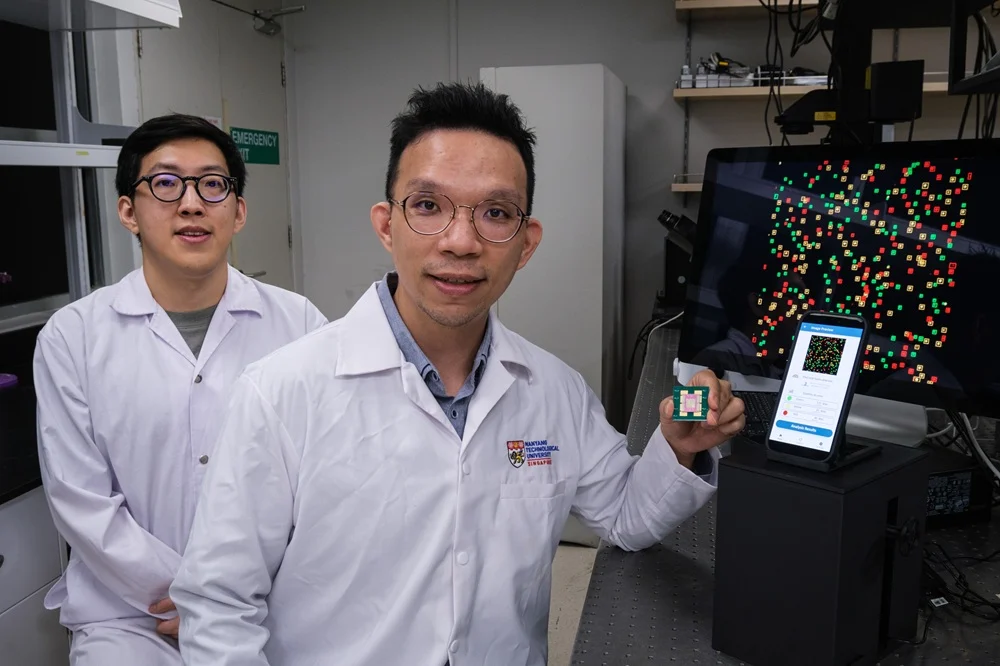 NTU Associate Professor Y.C. Chen (right) holding the new biochip, which can detect miRNA in 20 minutes using computer vision, with PhD student Fu Bowen (left).
A team of scientists from Nanyang Technological University Singapore has developed a new biochip that, when paired with computer vision, can detect quickly and accurately extremely small amounts of microRNAs, which are tiny genetic markers linked to diseases such as heart disease.
Published in the scientific journal Advanced Materials, the new biosensing platform combines a specially designed nanophotonic chip with AI-automated image analysis.
With a tiny drop of blood loaded into the chip, it can rapidly detect multiple microRNA biomarkers. With its integrated AI imaging function, thousands of microRNA signals can be imaged and analysed in a single snapshot.
Compared with the current gold standard of detecting microRNA – PCR (polymerase chain reaction) detects tiny amounts of genetic material by copying them many times – the new device can cut detection time from hours to 20 minutes.
MicroRNAs are short RNA molecules that help regulate genes that work in the body. Because changes in microRNA levels are linked to many diseases, scientists have been studying them as possible biomarkers for conditions such as cardiovascular disease, cancer, neurodegenerative disorders and metabolic illnesses.
NTU Associate Professor Chen Yu-Cheng, who led the study at the School of Electrical and Electronic Engineering, said the team aims to build a system that can quickly and accurately measure multiple microRNAs, with the potential to detect biomarkers linked to a wide range of diseases.
“Our successful tests with lung cancer cells show that, with the right probes targeting different biomarkers, this technology could potentially be adapted for many other cancers and diseases, including cardiovascular and viral diseases. In the future, it may be possible to use a blood or saliva sample in an automated system that screens for hundreds or even thousands of biomarkers at once. This could support large-scale screening and may help advance personalised medicine.”
The team has constructed a compact prototype that includes a colour camera that can capture images of the nanophotonic chip, and a mobile phone application designed to analyse images for microRNA using AI algorithms and provide rapid results.
Their innovation is supported by NTU’s Innovation and Entrepreneurship initiative, and a technology disclosure has been filed through NTUitive, the University’s innovation and enterprise company.
Overcoming the challenges of detecting microRNA
The importance of microRNAs was underscored in 2024, when the Nobel Prize in Physiology or Medicine recognised the discovery of microRNA and its role in gene regulation.
MicroRNAs are very small, often found in tiny amounts, and closely related microRNAs can share similar sequences, making them hard to tell apart. To overcome this, the NTU team designed a nanocavity, a tiny light-trapping structure hundreds of times smaller than the width of a human hair.
Shaped like a cave lined with mirrors, the nanocavity reflects and boosts fluorescent signals that glow when a target microRNA binds to its matching probe. This makes it easier to detect even single microRNA molecules.
The system measured three microRNAs associated with non-small cell lung cancer – miR-191, miR-25, and miR-130a – from human lung cancer cell extracts without amplification or complex preparation.
Unlike PCR and hybridisation kits that require labelled probes, the NTU platform directly and quantitatively detects multiple microRNAs in liquid samples.
The platform also uses a deep-learning model known as Mask R-CNN to automatically analyse microscopic images.
An automated AI imaging system captures the microRNA signals in one shot, after which the AI system identifies and classifies fluorescent signals and distinguishes between different microRNA types, removing the need for manual counting and reducing human error.
The platform also performed well when synthetic microRNAs were added to biological extracts, suggesting that it can work reliably in more realistic sample conditions.
The researchers said the platform could detect microRNAs at extremely low concentrations, down to just a few molecules in a sample, and achieved more than 99 per cent accuracy in identifying its targets across different test channels.
The study’s first author, Bowen Fu, a PhD student at NTU’s Institute for Digital Molecular Analytics and Science (IDMxS), said: “Our goal was to create a platform that can directly measure multiple microRNAs with very high sensitivity and at high throughput. By combining nanophotonic signal enhancement with AI-based image analysis, we were able to detect tiny amounts of RNA molecules across thousands of nanocavities within minutes.”
Professor Chen added: “We are also exploring whether this platform could one day analyse biomarkers from samples such as blood, saliva or urine, which may support less invasive molecular testing. The device could also potentially be useful for pharmaceutical companies in miRNA-related drug testing.”
Giving an independent expert comment on the findings, Associate Professor Sunny Wong Hei, Consultant in the Department of Gastroenterology and Hepatology at Tan Tock Seng Hospital, and a clinician scientist who specialises in human genetics, gut microbiome and metabolic diseases, said: “From a clinical perspective, one of the major unmet needs is to detect and monitor disease early using non-invasive biomarkers. MicroRNAs have long been recognised for their potential in this regard, particularly in cancers. A platform that can accurately detect multiple microRNAs could have huge clinical applications, including earlier detection of cancer, risk stratification of patients, and monitoring of treatment response or disease recurrence. Such a technology could potentially enable more accessible and precise clinical decision-making in oncology and across a range of diseases.”
The team will be looking to talk to clinicians and industry to see how they can scale up to do further trials on other microRNA markers.

AUAI is supported by: