
ΑΙhub.org
Unmasking AlphaFold to predict large protein complexes
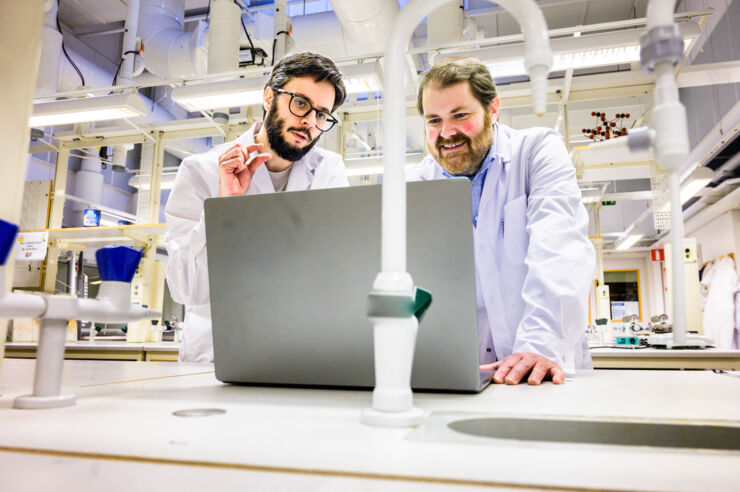 Claudio Mirabello and Björn Wallner have developed AlphaFold further. It can now take in information from experiments and partial data as well as predict very large and complex protein structures. Photographer: Thor Balkhed
By Anders Törneholm
In all living organisms, there is a huge variety of proteins that regulate cell functions. Basically, everything that happens in the body, from controlling muscles and forming hair to transporting oxygen into the blood and digesting food, involves proteins. But proteins are also found outside the body in, for example, detergents and medical drugs.
Proteins are large molecules consisting of 20 different amino acids that stick together in long rows, much like beads in a necklace. The sequences, or chains, can be anything from 50 up to a few thousand amino acids long. This gives rise to several billion different combinations, which in turn determine the three-dimensional shape of the protein. Depending on the shape of the protein chain, that is, the way it is folded, the protein has completely different functions.
For over 50 years, researchers have been trying to both predict and design different protein structures to gain a deeper understanding of the body’s mechanisms, various diseases, and to develop new types of medical drugs. This has been a laborious and expensive task involving a lot of manual handling.
Breakthrough with AI
In 2020, the company Deepmind released open source software called AlphaFold. It can predict with great accuracy how proteins will fold, and thus what functions they will have. This was a breakthrough that also resulted in the Nobel Prize in Chemistry 2024.
However, the programme has had its limitations. Among other things, it has not been able to predict very large protein compounds nor draw conclusions from experimental or incomplete data.
Researchers at Linköping University have now developed AlphaFold further to overcome these shortcomings. The tool, which they call AF_unmasked, can now take in information from experiments and partial data as well as predict very large and complex protein structures.
“We’re giving a new type of input to AlphaFold. The idea is to get the whole picture, both from experiments and neural networks, making it possible to build larger structures. But you can also have a draft of a structure that you feed into AlphaFold and get a relatively accurate result,” says Claudio Mirabello, docent at the Department of Physics, Chemistry and Biology at Linköping University.
Refine experiments
The idea behind AF_unmasked is for researchers to refine the experiments carried out by providing guidance on how the researchers could design the protein. This is a step toward even better understanding of the functions of proteins and designing new types of protein drugs.
The AlphaFold breakthrough was made possible by researchers around the world collecting data since the 1970s on the structure of approximately 200,000 different proteins in a database. This database provided training data for AlphaFold. What finally made it work on a large scale was the technological development of supercomputers that use GPUs for heavy calculations.
Björn Wallner is a professor of bioinformatics at Linköping University and has worked with one of the three Nobel Prize winners.
“The possibilities for protein design are endless, only the imagination sets limits. It’s possible to develop proteins for use both inside and outside the body. You always have to find new, more difficult problems when you have solved the old ones. And within our field, finding problems is no problem,” says Björn Wallner.
An idea from Linköping University
Together with Claudio Mirabello, he developed a precursor to AlphaFold that also inspired Deepmind in developing the tool. Thanks to the resources of the Google-owned company, they were then able to develop what is now an indispensable tool for the world’s protein scientists.
“AlphaFold wasn’t the first tool to use deep neural networks to solve the problem. In fact, one of the most important characteristics of AlphaFold is that it encodes the evolutionary history of a protein inside the neural network, an idea that actually originated here at Linköping University and was published by Björn and me in 2019. So, you could say that AlphaFold was based on our idea, and now we are building on AlphaFold,” says Claudio Mirabello.
The study was funded mainly by SciLife Lab, the Knut and Alice Wallenberg Foundation, and the Swedish Foundation for Strategic Research. The calculations were performed on the supercomputers Tetralith and Berzelius at the National Supercomputer Centre at Linköping University.
Read the work in full
Unmasking AlphaFold to integrate experiments and predictions in multimeric complexes, Claudio Mirabello, Björn Wallner, Björn Nystedt, Stavros Azinas & Marta Carroni, Nature Communications (2024).

AUAI is supported by: