ΑΙhub.org
#AAAI2025 workshops round-up 2: Open-source AI for mainstream use, and federated learning for unbounded and intelligent decentralization
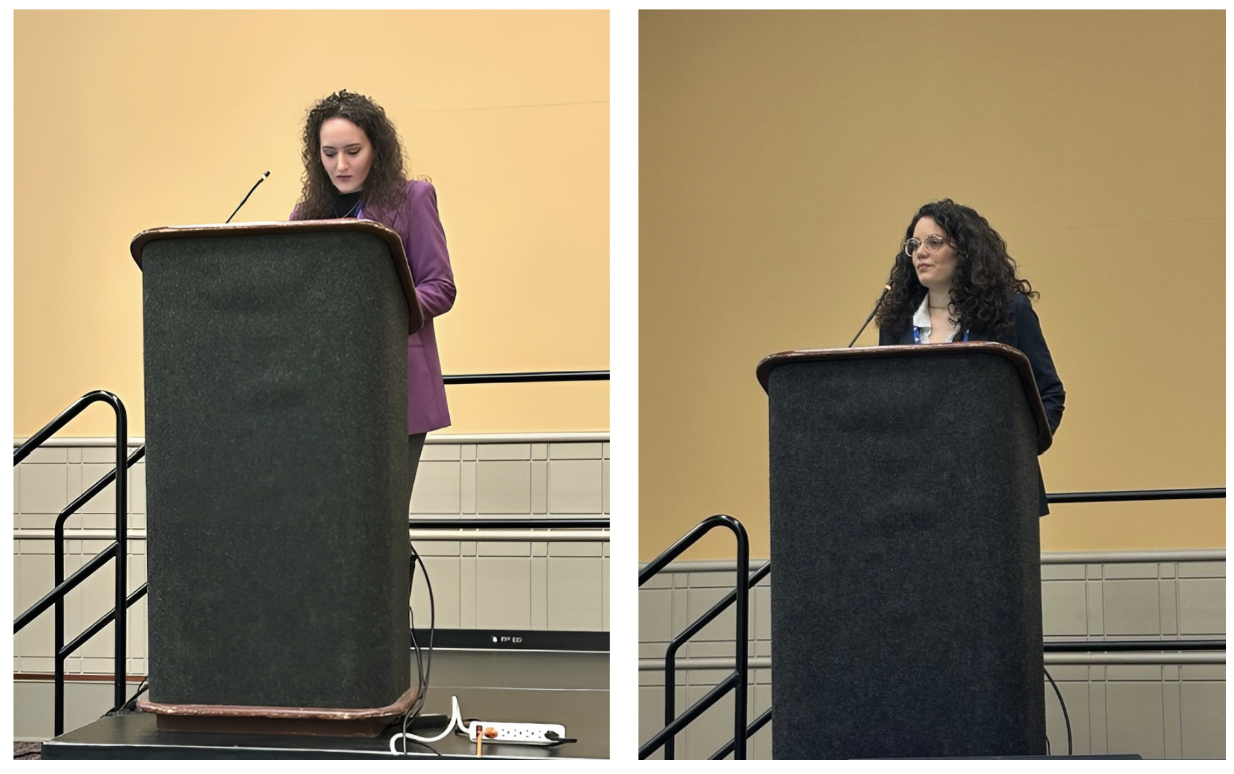 Images from the workshop: FLUID: Federated Learning for Unbounded and Intelligent Decentralization. Workshop chairs Marzia Canzaniello and Daniela Annunziata.
In this series of articles, we’re publishing summaries with some of the key takeaways from a few of the workshops held at the 39th Annual AAAI Conference on Artificial Intelligence (AAAI 2025). In this second round-up article, we hear from the organisers of the workshops on:
- Open Source AI for Mainstream Use
- FLUID: Federated Learning for Unbounded and Intelligent Decentralization
Open Source AI for Mainstream Use
By Peter Santhanam
Chair organizer: Peter Santhanam
Program committee: Alexandru Cioba, James Hendler, Serdar Kadioglu, Ezequiel Lanza, Greg Lindahl, Sujee Maniyam, Manish Parashar, Pushkar Singh, Jonathan Starr, Raphaël Vienne
The first ever workshop on “Open Source AI for Mainstream Use” was held on March 4, 2025 at the Pennsylvania Convention Center in Philadelphia. The goal of this workshop was to bring the researchers and practitioners into a single forum to discuss topics at the intersection of AI and open source and demonstrate relevant technology.
- The workshop started with a keynote by Kate Soule (IBM Research) on “Granite: Open Source Models for the Enterprise”. She explained the details behind the development of these models, the evaluation benchmarks against various in-class models and their suitability for enterprise use cases.
- The session on “Open Source & Policy” addressed the on-going technical arguments surrounding the definition of ‘openness’ of AI models and the various evolving frameworks to regulate AI model deployment.
- We discussed an AI application to suggest recommendations to avoid industrial safety incidents and an evolving standard for a Natural Language Interaction Protocol.
- The session on “Domain Specific Foundation Models” covered four presentations/demos in semiconductor manufacturing, geo-spatial, materials & chemistry and agriculture.
- The session on “Open Source Tools” covered topics that included document conversion to support model building, streamlining enterprise AI retrieval-augmented generation (RAG) pipelines, late fusion implementation of generative fusion decoding and an agent to facilitate natural language interaction with relational databases.
- The panel on “Building an Open Ecosystem” [with Nathaniel Bastian (DoD), Sean Hughes (Service Now), and John McBroom (IBM)] addressed the practical, technical and legal concerns of deploying open-source AI systems and the challenges in building an open ecosystem from the perspective of commercial companies.
Overall, the participants appreciated the interdisciplinary nature of this workshop and are looking forward to repeating it next year.
FLUID: Federated Learning for Unbounded and Intelligent Decentralization
By Daniela Annunziata and Marzia Canzaniello
Organisers: David Camacho, Diletta Chiaro, Francesco Picciali, Shadi Albarqouni
Chairs: Daniela Annunziata, Marzia Canzaniello
This first edition of the FLUID workshop focused on the emerging challenges and opportunities in federated learning and intelligent decentralization, bringing together a growing international community of researchers working across optimization, privacy, scalability, and practical deployment of decentralized learning systems.
Workshop chairs Marzia Canzaniello and Daniela Annunziata.
Real-world deployment challenges in federated learning were explored in the keynote by Holger Roth (NVIDIA), who discussed the gap between theoretical models and their application in real-world settings. His talk emphasized the practical complexities faced in deploying privacy-preserving systems at scale and sparked productive discussion among attendees.
Yang Liu’s keynote (Tsinghua University) introduced new perspectives on collaborative training across heterogeneous models, highlighting novel techniques for integrating large and small models in federated settings. His talk underlined the importance of designing flexible learning frameworks that can adapt to diverse client capabilities and data distributions.
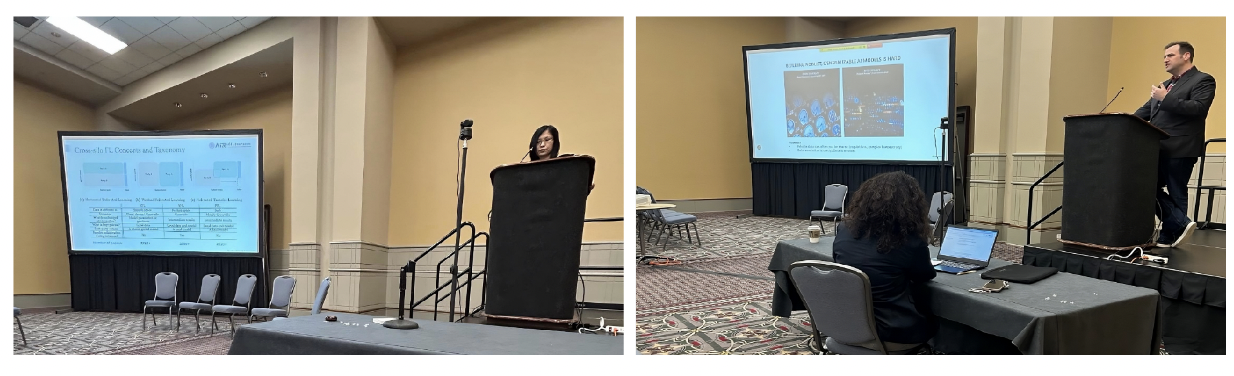 Keynote speakers Yang Liu and Holger Roth.
The workshop showcased a broad spectrum of research topics, ranging from efficient communication and split learning architectures to applications in smart cities and medical diagnostics. This thematic diversity reflects the rapid evolution of the field and the critical role of interdisciplinary collaboration in addressing the technical and ethical dimensions of decentralized learning.
You can read this summary in a newspaper-style format here.
You can find the first article in this series here:
tags: AAAI, AAAI2025

AUAI is supported by: