
ΑΙhub.org
Interview with Amar Halilovic: Explainable AI for robotics

In this interview series, we’re meeting some of the AAAI/SIGAI Doctoral Consortium participants to find out more about their research. The Doctoral Consortium provides an opportunity for a group of PhD students to discuss and explore their research interests and career objectives in an interdisciplinary workshop together with a panel of established researchers. In this latest interview, we hear from Amar Halilovic, a PhD student at Ulm University.
Tell us a bit about your PhD – where are you studying, and what is the topic of your research?
I’m currently a PhD student at Ulm University in Germany, where I focus on explainable AI for robotics. My research investigates how robots can generate explanations of their actions in a way that aligns with human preferences and expectations, particularly in navigation tasks.
Could you give us an overview of the research you’ve carried out so far during your PhD?
So far, I’ve developed a framework for environmental explanations of robot actions and decisions, especially when things go wrong. I have explored black-box and generative approaches for the generation of textual and visual explanations. Furthermore, I have been working on planning of different explanation attributes, such as timing, representation, duration, etc. Lately, I’ve been working on methods for dynamically selecting the best explanation strategy depending on the context and user preferences.
Is there an aspect of your research that has been particularly interesting?
Yes, I find it fascinating how people interpret robot behavior differently depending on the urgency or failure context. It’s been especially rewarding to study how explanation expectations shift in different situations and how we can tailor explanation timing and content accordingly.
What are your plans for building on your research so far during the PhD – what aspects will you be investigating next?
Next, I’ll be extending the framework to incorporate real-time adaptation, enabling robots to learn from user feedback and adjust their explanations on the fly. I’m also planning more user studies to validate the effectiveness of these explanations in real-world human-robot interaction settings.
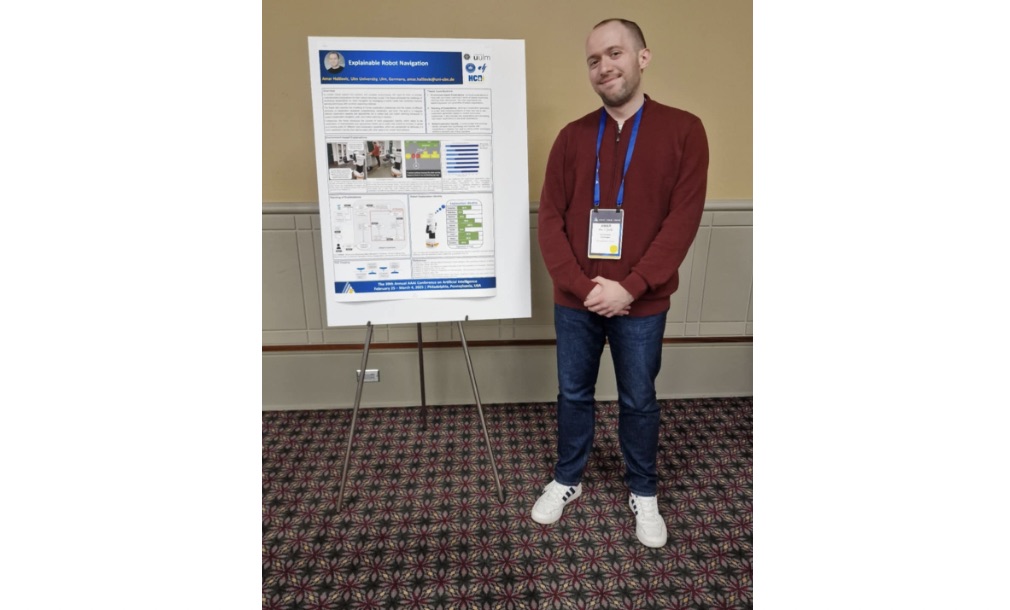 Amar with his poster at the AAAI/SIGAI Doctoral Consortium at AAAI 2025.
What made you want to study AI, and, in particular, explainable robot navigation?
I’ve always been interested in the intersection of humans and machines. During my studies, I realized that making AI systems understandable isn’t just a technical challenge—it’s key to trust and usability. Robot navigation struck me as a particularly compelling area because decisions are spatial and visual, making explanations both challenging and impactful.
What advice would you give to someone thinking of doing a PhD in the field?
Pick a topic that genuinely excites you—you’ll be living with it for several years! Also, build a support network of mentors and peers. It’s easy to get lost in the technical work, but collaboration and feedback are vital.
Could you tell us an interesting (non-AI related) fact about you?
I have lived and studied in four different countries.
About Amar
|
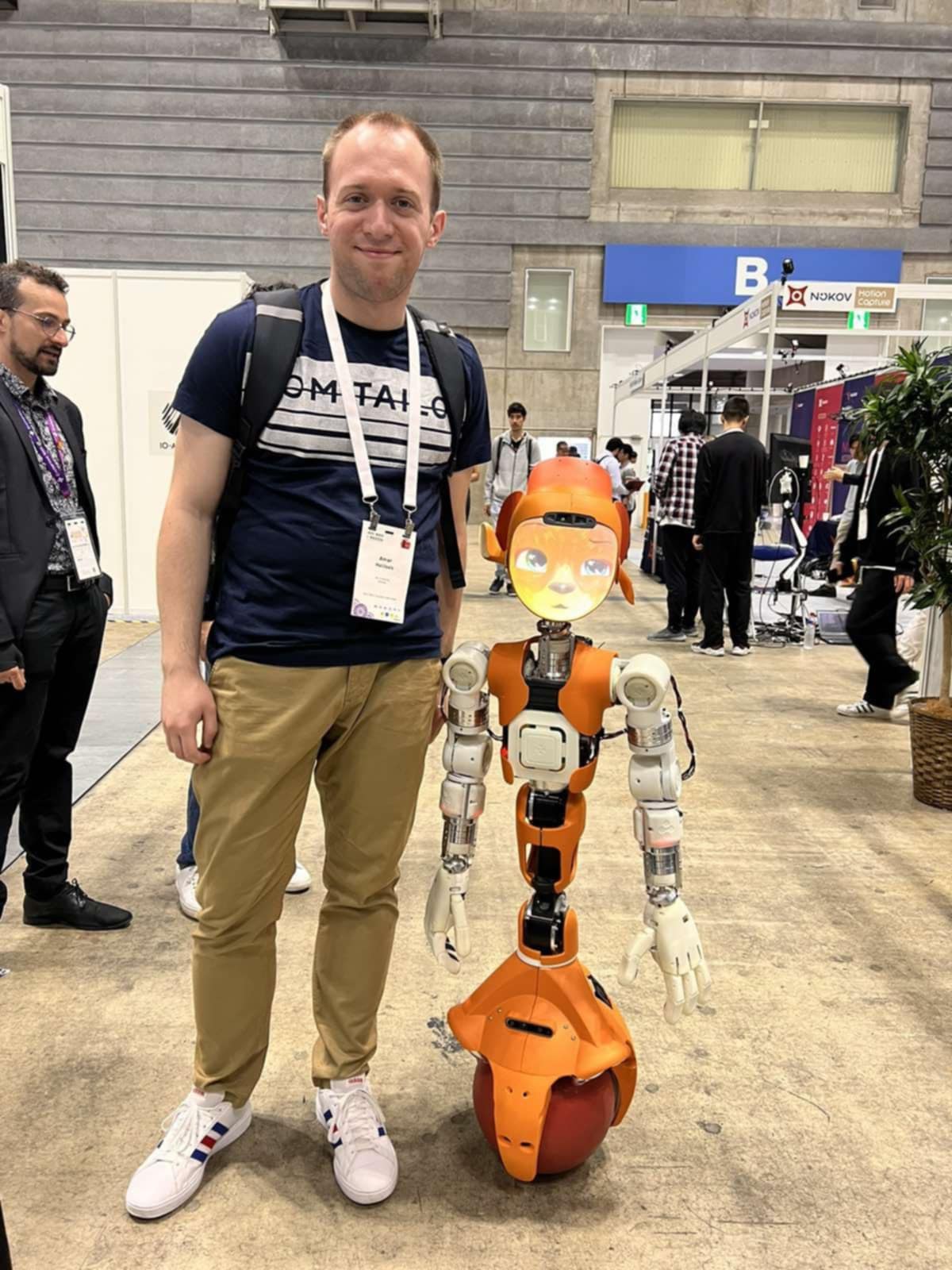
Amar is a PhD student at the Institute of Artificial Intelligence of Ulm University in Germany. His research focuses on Explainable Artificial Intelligence (XAI) in Human-Robot Interaction (HRI), particularly how robots can generate context-sensitive explanations for navigation decisions. He combines symbolic planning and machine learning to build explainable robot systems that adapt to human preferences and different contexts. Before starting his PhD, he studied Electrical Engineering at the University of Sarajevo in Sarajevo, Bosnia and Herzegovina, and Computer Science at Mälardalen University in Västerås, Sweden. Outside academia, Amar enjoys travelling, photography, and exploring connections between technology and society. |
tags: AAAI, AAAI Doctoral Consortium, AAAI2025, ACM SIGAI

AUAI is supported by:








