
ΑΙhub.org
Wildlife researchers train AI to better identify animal species in trail camera photos
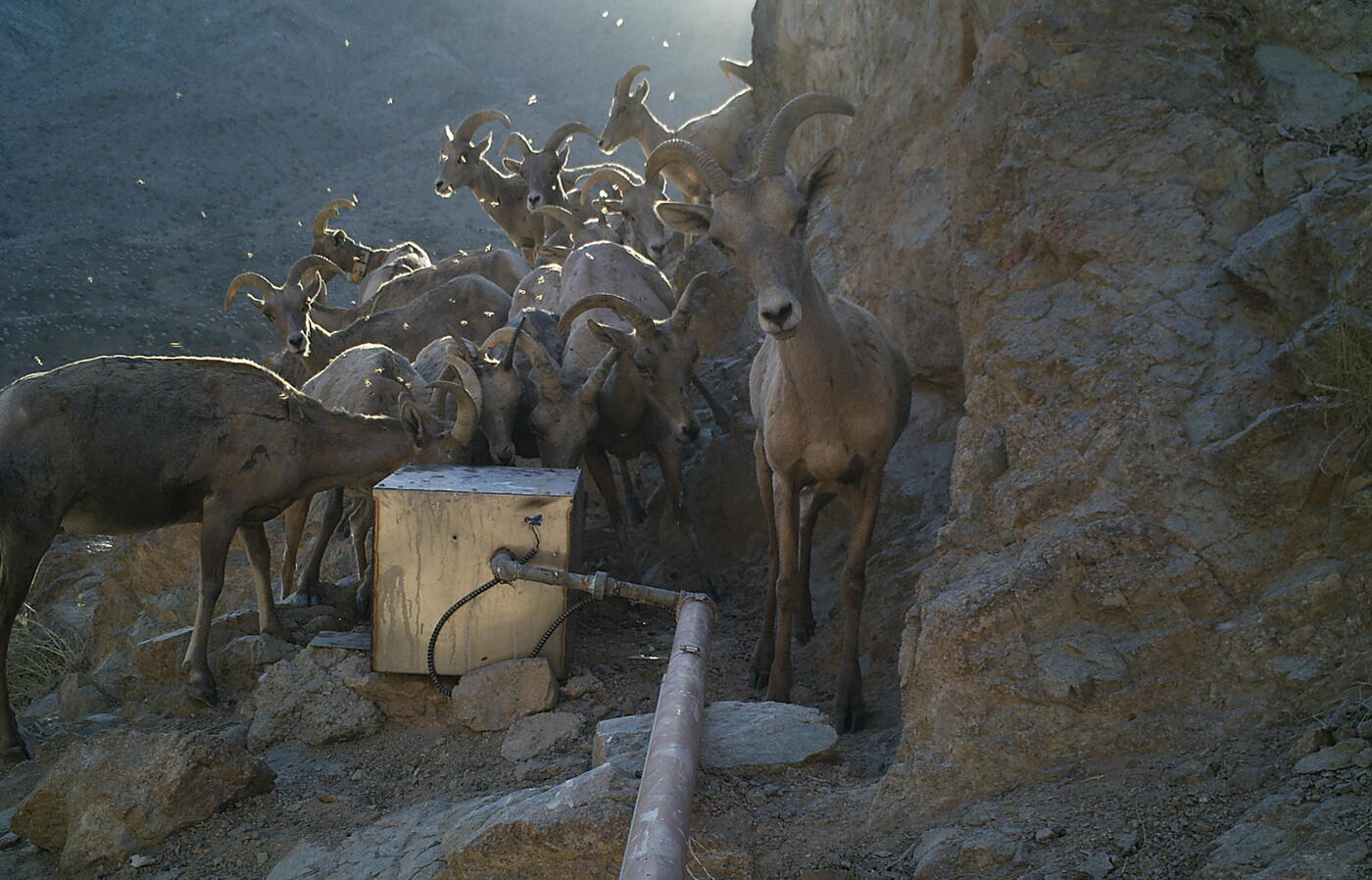 In this trail camera photo, provided by Oregon State University undergraduate student Owen S Okuley, bighorn sheep are seen at the Kerr Guzzler in the Mojave Desert.
By Steve Lundeberg
Oregon State University scientists have improved artificial intelligence’s ability to identify wildlife species in photos taken by motion-activated cameras.
Their study, which introduces a less-is-more approach to the data on which an AI model is trained, opens the door to wildlife image analysis that’s more accurate and also more cost effective.
Motion-activated cameras are an important wildlife monitoring tool, but reviewing thousands of images manually can be prohibitively time consuming, and current AI models are at times too inaccurate to be useful for scientists and wildlife managers.
“One of the biggest problems in using AI in wildlife research is limited accuracy when we use the model to classify images at a novel location – one the model has never ‘seen’ before,” said study co-author Christina Aiello, a research associate in the Oregon State University College of Agricultural Sciences. “The approach we used improved accuracy at novel sites as well as non-novel sites, and made for a more consistently accurate model across diverse locations.”
The research, led by Owen Okuley, an undergraduate student under Aiello’s mentorship in the Department of Fisheries, Wildlife and Conservation Sciences, was published in Ecological Informatics. The study used bighorn sheep as an example species but the AI training described in the paper is widely applicable, the scientists say.
“Owen is exploring ways to curate training datasets so that we improve AI accuracy faster, with less data, which I think is a much-needed shift in how our field uses AI,” Aiello said. “We’ve been getting as much convenience imagery of wildlife as possible for use in training, and as the number of training images goes up, most scientists expected the accuracy of the AI models to improve.
“But at a certain point there are minimal improvements as more data are added. I think we need to be more selective with the information we feed these models to achieve better results.”
Aiello, Okuley, OSU professor Clinton Epps and collaborators learned the best identification results stemmed from limiting an AI model’s training to one species – rather than all species – and to include images taken in a range of local, project-specific environments. The model was able to identify bighorn sheep from novel sites within a region with similar accuracy to training sites when the images included enough background variation.
“By narrowing objectives while still ensuring training data variety, we achieved almost 90% identification accuracy with a small fraction of the training data – 10,000 training images – required by similar-performing AI models,” Okuley said. “And fewer images means a model requires less computing power and less energy, both of which are beneficial to the wildlife we seek to study.”
Okuley, who is graduating in June, and Aiello were paired up through the Fisheries and Wildlife Undergraduate Mentoring Program. Working in Epps’ lab, Okuley learned how to manage camera trap data and survey for bighorn genetic samples with a graduate student on a military base before leading his own AI research project.
“Being able to tackle a project from start to finish has allowed me to grow immensely as a scientist,” he said. “I was able to not only make strong connections with my co-authors and mentors, but got to engage with the aspects of research most undergrads never see, like conceptualization, grant writing and publication.”
Okuley will pursue a Ph.D. in ecology and environmental biology at the University of Texas at El Paso, where he will try to create a suite of AI programs sequentially classifying specific traits of waterfowl with the goal of identifying not just individual species but hybrids as well.
Researchers from Johns Hopkins University, the California Department of Fish and Wildlife, and the National Park Service also took part in the bighorn study, which was supported by the National Park Service through the Pacific Northwest Cooperative Ecosystem Studies Unit, Oregon State University, and the College of Agriculture Sciences Continuing Researcher Support Program.
Read the research in fill
Improving AI performance in wildlife monitoring through species and environment-specific training: A case study on desert Bighorn sheep, Owen S. Okuley, Christina M. Aiello, Will Glad, Kyle Perkins, Richard Ianniello, Neal Darby, Clinton W. Epps, Ecological Informatics (2025).
tags: Focus on life on land, Focus on UN SDGs

AUAI is supported by:








