
ΑΙhub.org
#AAAI2026 invited talk: Yolanda Gil on improving workflows with AI
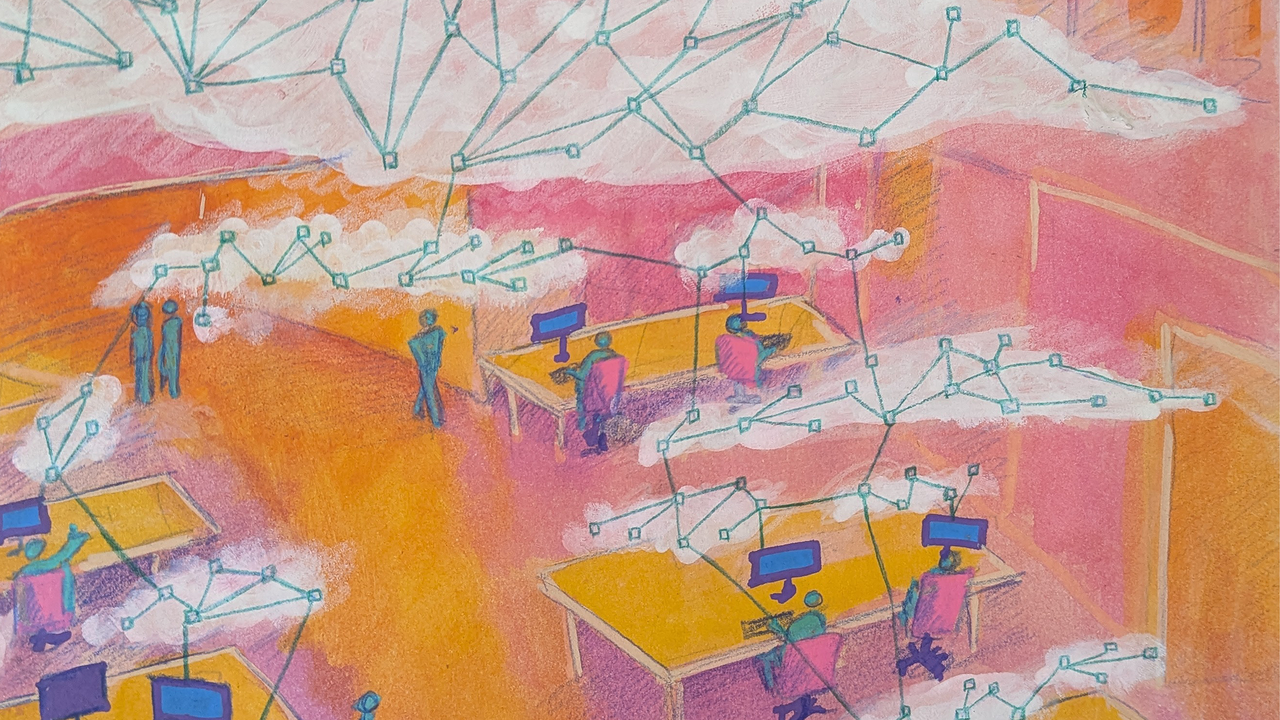 Jamillah Knowles & Digit / Pink Office / Licenced by CC-BY 4.0
Yolanda Gil is a professor at the University of Southern California, where she also serves as Senior Director for major strategic AI and data science initiatives. From 2018 – 2020, she was president of AAAI. In her invited talk at AAAI 2026, she spoke about using AI to improve some of the processes involved in scientific research. In one particular project, she followed a group of geoscientists and observed the way they undertook field trips, soon understanding that researchers with different specialities have very different methodologies. For instance, a petrologist will work very differently from a sedimentologist, who in turn will use a different method to a geophysicist.
Yolanda has studied scientists, and communities of scientists for many years. One thing that fascinates her is that scientific discoveries are increasingly the result of large collaborations and contributions of many people. The ATLAS collaboration that discovered the Higgs boson involved over 4000 people, for example. Plotting the workflow of this collaboration made her realise that machine learning-aided solutions could be beneficial to help large groups of scientists approach a problem and work together. As such, she has been working on ways to help scientists and communities. A tactic she has found particularly helpful in identifying issues within their existing procedures was to join in on “watercooler conversations”. It is in these informal chats that scientists tend to be more relaxed and happy to talk about some of the issues they are facing in their research. In her talk, Yolanda highlighted several seven problems she identified during such conversations, and presented work that she and her team have carried out over the years to address these issues.
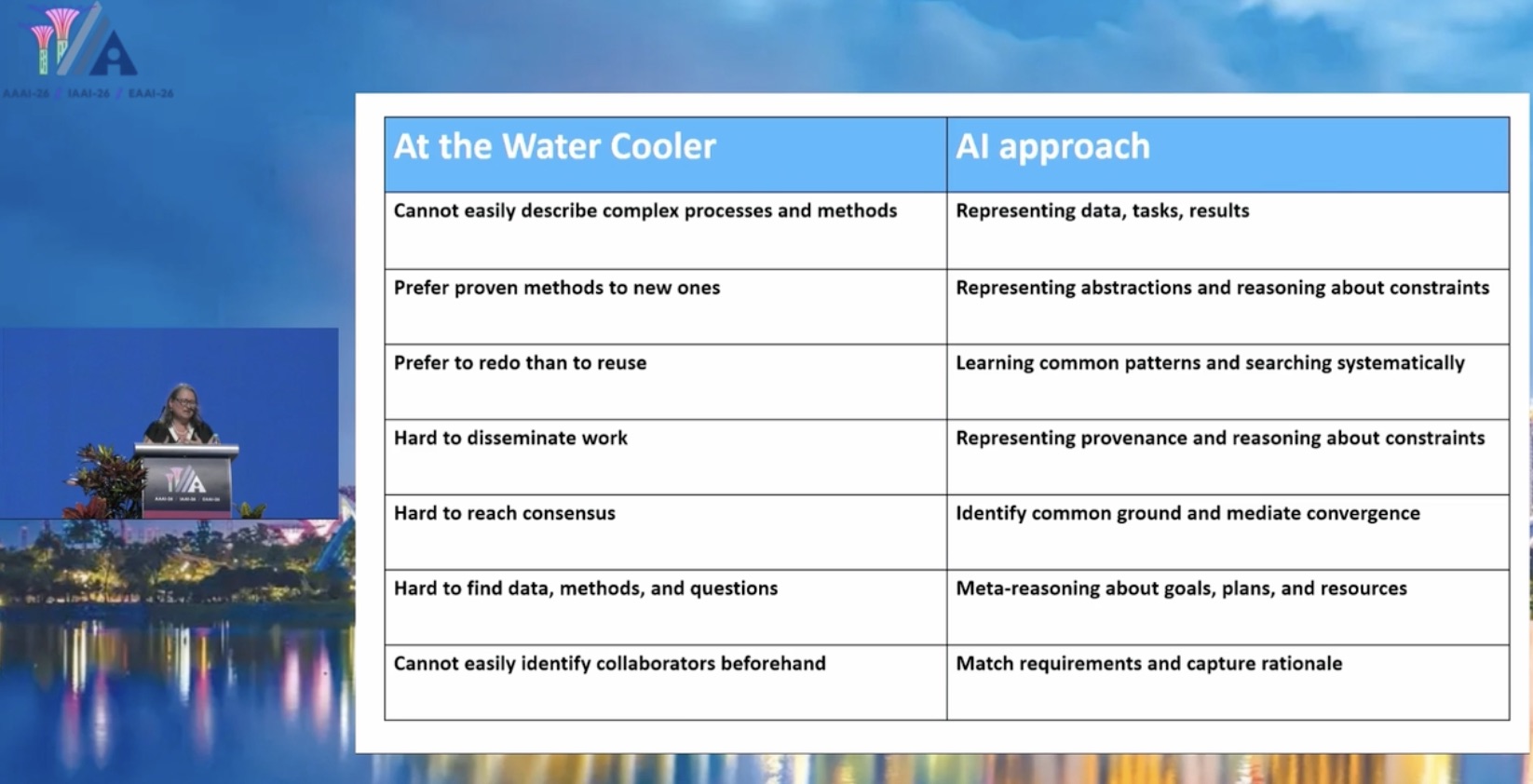 Seven issues identified and the AI approach to ease these problems.
One such issue is that researchers prefer to use proven methods rather than methods that AI models have synthesised. This makes sense as they have seen the existing methods time and again and it’s much easier to publish results if everybody understands the method used. Yolanda and her team used abstraction and hierarchical planning, key methods in AI, to describe the functions that needed to be carried out in a method. They proved to the scientists that with AI you can actually represent general methods, reason with them, and capture what’s reusable at a very high level – and all of this from very different papers.
Another identified concern was that people often struggle to reach a consensus over standard nomenclature. For example, paleoclimatologists (who look at cores that they extract from the sea bed or ice) have very diverse ways of describing the data that they collect. Using an AI model, Yolanda and her team helped them converge on a common language. The model identified what overlapped with other scientists and gave suggestions about which common language terms they could adopt.
The kinds of problems that Yolanda has worked on are quite different to most AI research. There is no clear data in any of these scenarios, and no clear criteria for success. There is no formal proof that a method has worked better than another, this just has to be gauged from watching the teams working together. Sometimes the outcome is changing the minds of the people involved. Testament to the impact that her work has had in the community, Yolanda has received geoscience awards.
Yolanda closed her talk by emphasizing that, for her, AI depends critically on knowledge. She appealed to the early-stage researchers to consider a career in AI systems with knowledge, thus helping to capture, disseminate, and preserve such knowledge.
tags: AAAI, AAAI2026
AUAI is supported by:








