
ΑΙhub.org
How generative AI and physics can help design new antibiotics
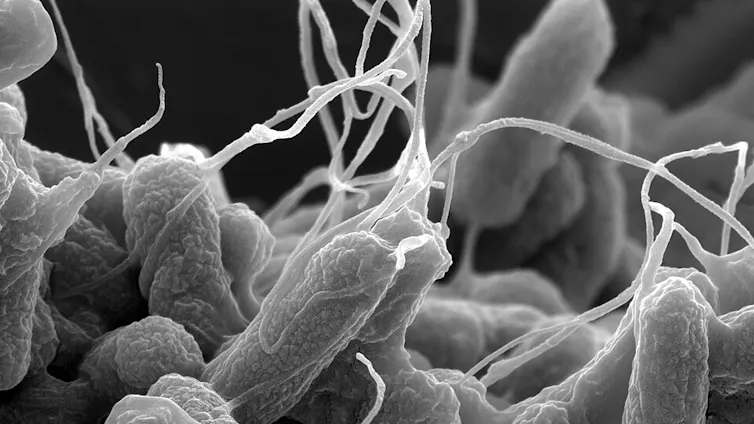 Physics-based simulations can help identify which peptide antibiotics can kill a bacteria like E. coli, pictured here using electron microscopy. (Nurgul D / Wikimedia Commons) CC BY-SA 4.0.
By Rachael (Ré) A Mansbach, Concordia University and Jyler Menard
By 2050, scientists estimate that antibiotic-resistant infections will be associated with more than eight million deaths around the world every year.
These are bacterial infections that resist traditional antibiotics like penicillin. They can develop when you eat contaminated food, have an open wound or undergo surgery. E. coli is a good example, as several strains have become highly resistant to conventional antibiotics. They can also arrive as secondary infections, like pneumonia after a virus.
 Professor Alexander Fleming, who first discovered penicillin, in his laboratory at St Mary’s, Paddington, London (1943). (Wikimedia Commons), CC BY
We need new antibiotics and designing them is difficult.
It can take 10 years and more than one billion dollars to bring just one new drug to market. And 10 out of 13 new antibiotics developed since 2017 are already ineffective against at least one type of bacteria.
A potential solution is to use generative AI models, guided by trained scientists, to come up with designs for never-before-seen molecules.
Physics-based simulations, where a computer mimics the laws of reality, can then help us figure out whether they would make good drugs in a fast and cost-efficient way.
The peptide haystack
All methods need a starting point. “Develop a new drug” isn’t a specific enough prompt. If we were looking for a needle in a haystack, we would at least need to know which haystack to look in. One good haystack for drugs, especially antibiotics, is peptides.
Peptides are short proteins that can perform many different functions in our bodies. For example, insulin, which is widely used to treat diabetes, is a naturally occurring peptide in the body. Vancomyin is another peptide and an important antibiotic that is created in nature as a defence mechanism by bacteria that live in the soil. Both occupy a place of honour on the WHO Model List of Essential Medicines.
We can use AI and physics-based simulations together to design new peptides that will kill bacteria. A good AI model has two parts: one that can quickly dream up millions of new designs (the generator) and one that can recommend which design to simulate next (the recommender).
 This diagram shows the workflow scientists use when designing drugs with physics and AI. The recommender generates letters specifying the different amino acids that make up a peptide.
Training the generator
The recommender is a bit like the YouTube algorithm that suggests videos you might want to watch next. It’s useful, important and tricky to set up just right. In fact, our lab has recently published a research paper that examines a few different strategies for generators and recommenders.
In our research, we tested what kinds of information are most useful to include when training the generator. While it’s possible to provide a generator with almost any available information about peptides, we showed it was better to give it just a tiny bit of very relevant information than a lot of semi-relevant information.
Why might this be important? Because in many cases we only have a little bit of relevant information: only a few peptides out of the hundreds of thousands we know of have been experimentally tested, for example, for antimicrobial properties. We also tested different strategies for the recommender, and found a way to more accurately visualize the path that it takes through peptide search space.
Why not just use the generator by itself? Well, like any AI-generated content, we have to validate it before trusting it.
A deadly dance
That’s where physics comes in! Peptides perform their functions by changing their shapes. For example, the unusual drug Ziconotide is a painkiller that works by physically “jamming” the proteins that send pain signals in the spine.
Many peptide antibiotics, or “antimicrobial peptides,” have fluctuating shapes that depend on their proximity to the outside of a cell.
Each copy of an antimicrobial peptide is a dancer in a choreography. One dance is performed near the cell of a mammal, while a different, deadlier dance is performed near the cell of a bacterium. This second dance can kill a microbe like E. coli by attacking and breaking apart the membrane.
We can validate the molecules the AI recommends by peeking at the performance our peptide dancers put on near different kinds of membranes.
 Without effective antibiotics, routine procedures such as hip replacements and C-sections can become life-threatening.(Unsplash/Volodymyr Hryshchenko).
Video game physics engine
In physics-based simulations, we put many peptides near a simplified membrane, surround the whole system with a box of water and treat every atom as a soft sphere. Then, using something like a video game physics engine, we can watch how the atoms of the peptides and membrane dance as time goes on.
Some people call this an “in silico” microscope, which allows us to zoom in and watch what happens at the molecular scale.
With this molecular microscope in hand, we can validate generated peptides. If we see modelled peptides disturbing a simplified bacteria membrane, then we can say it is likely antimicrobial. If we see it disturbing a simplified red blood cell membrane, then we can say it is likely toxic.
By doing this, we can pre-screen novel, never-before-seen peptides for non-toxic antimicrobial activity before wasting experimental effort. And we can also use the information we get from these simulations to improve our generators and our recommenders.
That way, scientists can avoid the time-consuming process of identifying promising peptides, and devote their laboratory experiments to validating their clinical use and safety. This could mean more, cheaper drugs, exactly when we need them most.
Rachael (Ré) A Mansbach, Assistant professor, Physics, Concordia University and Jyler Menard, PhD Student, Department of Physics, Concordia University
This article is republished from The Conversation under a Creative Commons license. Read the original article.

AUAI is supported by: