
ΑΙhub.org
AI plus chemistry can expand battery electrolyte design
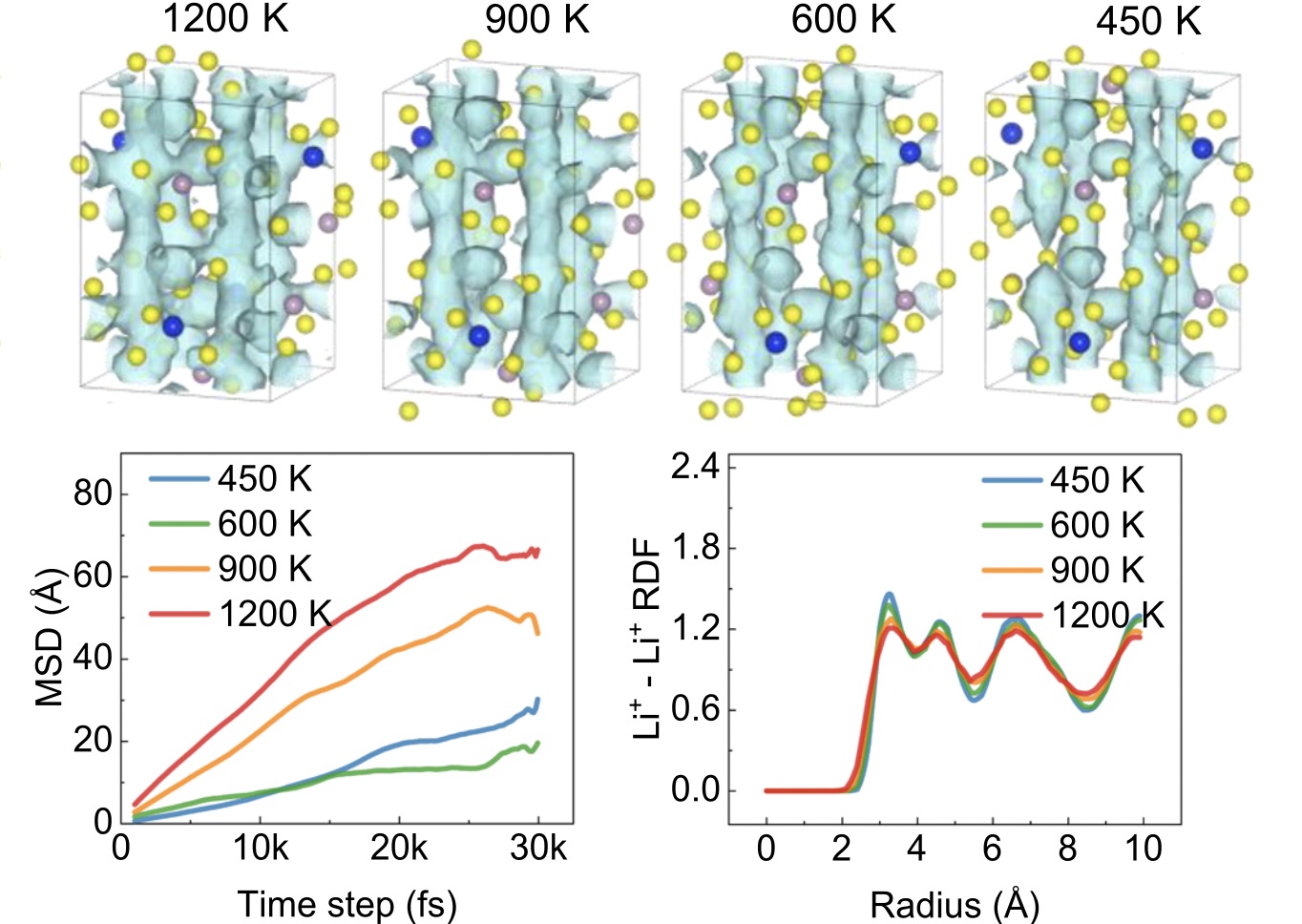 Figure from Decoding the chemical space of fast-ion conductors via a descriptor-guided transfer learning framework. It shows the three-dimensional migration path of Li+ and MSd over time in Li10SiP2S12 at various temperatures. Reproduced under a Creative Commons Attribution License 4.0 (CC BY).
By Syl Kacapyr
Cornell researchers are using artificial intelligence to speed the search for better battery materials while using a creative approach to chemistry to expand the design space for electrolytes, unlocking new possibilities for safer, higher-performing energy storage.
Electrolytes shuttle ions between battery electrodes and are key to a battery’s energy density, lifetime and charging speed, yet they are difficult to design because small changes in composition can dramatically change how they work.
“Electrolytes are not just supporting materials in batteries; they are a design space,” said Fengqi You. You’s research group integrates theoretical frameworks, artificial intelligence and other computational methods to help discover next-generation battery materials, among other research themes.
His group has introduced IonNet, an AI framework that predicts how well lithium ions move through solid materials using only their chemical composition. Published in Science Advances, the framework allows researchers to evaluate potential candidates for solid-state electrolytes much earlier in the engineering process.
“Most AI models for materials require reliable crystal structures, which are often unavailable for new or experimentally reported compounds,” said You, who led the study with postdoctoral researcher and first author Zhilong Wang. “IonNet predicts ion mobility from chemical composition, even without precise crystal structures.”
Fast-ion conductors are a critical component of solid-state batteries, which use solid materials instead of the flammable liquid electrolytes used in most lithium-ion batteries. IonNet identified 87 fast-ion conductor candidates among about 4,500 stable compounds, and nearly 63,000 candidates from about 5 million substituted compositions. The researchers then used physics-based simulations to test 20 of the predictions, confirming 13 as fast-ion conductors.
“While IonNet does not replace experiments or high-level simulations, it is a fast front-end that prioritizes candidates before committing major experimental or computational resources,” You said. “Evaluating a single material by physics-based simulation can take tens-of-thousands of CPU hours.”
Another feature of IonNet is that it identifies chemical design rules that hint at why certain compositions work better than others.
“We did not just want a list of promising materials,” said You, who is also a director of the Cornell University AI4S Initiative, which applies AI to challenges in materials, energy and sustainability. “We wanted to understand the chemical principles that make lithium ions move quickly, because that is what makes AI useful for experimental design.”
A second study, published in Nature Communications, approaches electrolyte engineering from a different angle and focuses on concentration batteries, an unconventional type of battery that generates electricity from differences in electrolyte composition rather than from different electrode materials.
Because concentration batteries use the same redox couple – the pair of chemical substances that exchange electrons – at both electrodes, scientists have long assumed these batteries could produce less than 0.06 volts. By engineering how ions are surrounded by molecules in the electrolyte, the researchers boosted the voltage of zinc- and copper-based concentration batteries up to 0.7 volts, more than 10 times the assumed limit. When paired with conventional electrodes, the approach produced water-based batteries operating at 2.2-2.5 volts – higher than the 1.5 volts typically produced by alkaline AA batteries.
The collaboration between You’s lab and researchers at the University of Puerto Rico–Río Piedras reframes concentration batteries from an impractical, low-voltage method of energy storage to a tunable electrolyte design platform.
“These electrolyte studies share the same larger goal,” You said, “to move battery design from trial and error toward rational design guided by AI, chemistry and physical insight.”

AUAI is supported by: