ΑΙhub.org
 

First 11 vs 11 humanoid soccer game played at RoboCup 2026

by
26 August 2026


share this:

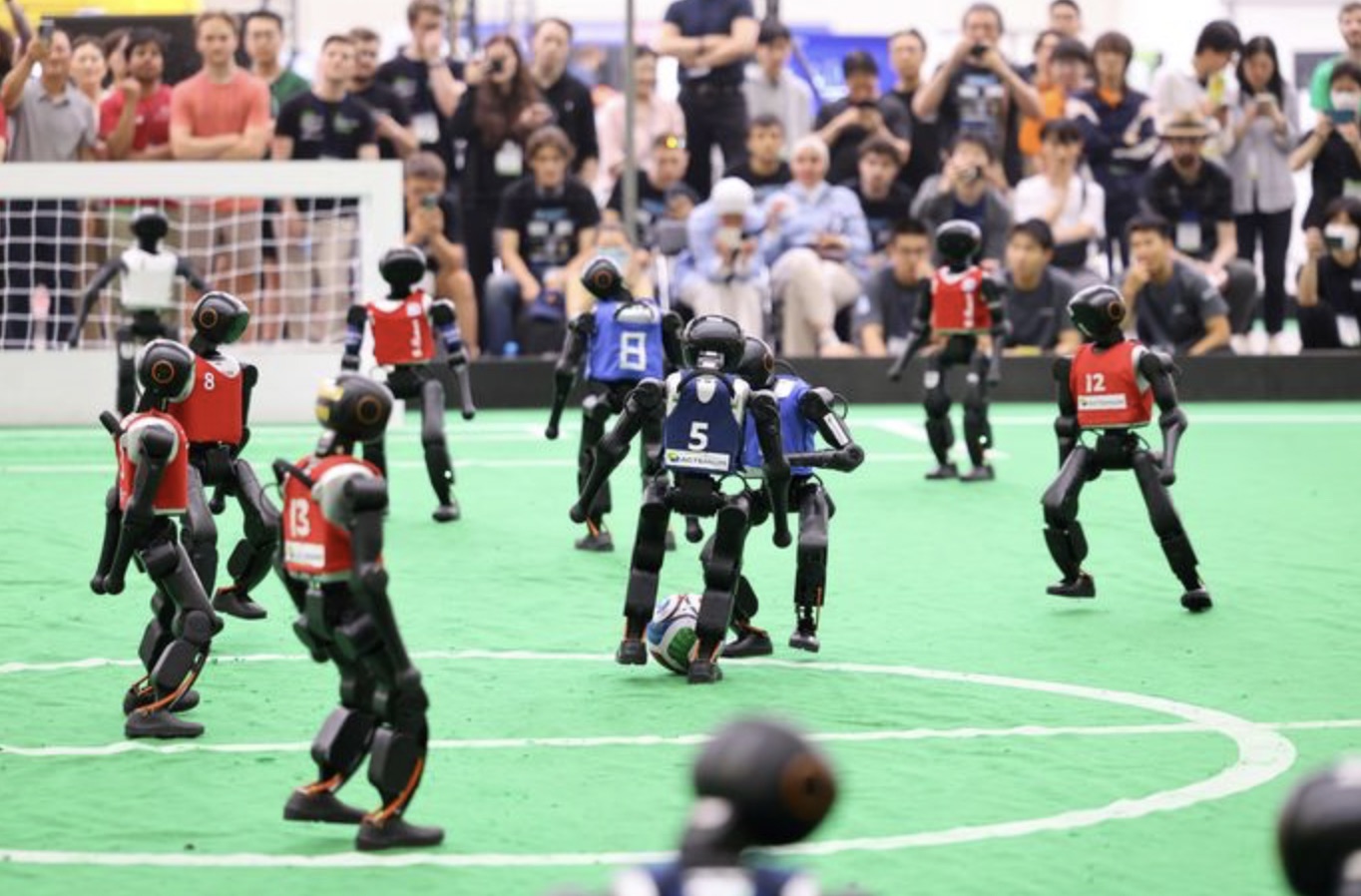
Action from the 11 vs 11 humanoid match at RoboCup 2026. Photo credit: RoboCup Federation.

RoboCup 2026 saw history made, as two teams of 11 humanoids took to the soccer field, the first time a full complement of robots has competed. The game saw B-Human (Bremen, Germany) take on HTWK Robots (Leipzig, Germany), with both sides using machines designed by Booster Robotics.

You can watch highlights of the match below:

Back in 1997, RoboCup’s founders set the lofty goal of developing a team of autonomous robots that could beat the human World Cup champions by 2050. There has been significant progress since those early days, and this match saw another step towards that ambition.

“This match shows how far humanoid robotics has come,” said Ubbo Visser, President of the RoboCup Federation. “We have seen increased teamwork and advanced skills over the years already, but the new humanoid hardware paired with the new level of intelligence provided by AI puts humanoid robot soccer on another level.”

Find out more:


tags: , ,


Lucy Smith is Senior Managing Editor for AIhub.

            AUAI is supported by:


Subscribe to AIhub newsletter on substack


Related posts :

Interview with Sarah Alyami – Continuous Sign Language Recognition: Dataset Development and Novel Frameworks

  25 Nov 2026
Sarah Alyami talks about her research into continuous sign language recognition, the value of AI to improve accessibility, and how to choose a good research problem.

‘The sacred object in mathematics’: the Riemann hypothesis, AI and a proof no human can read

  24 Nov 2026
On Friday, Levent Alpöge announced he had produced a proof of the Riemann hypothesis, one of the most important and famous open problems in mathematics, with the aid of an AI model.

State of AI Ethics 2026 report released

  23 Nov 2026
Compiled by the Montreal AI Ethics Institute, the report is titled "Power, Fracture, Resistance".

Using AI to help learn about and spot dangerous rips

An AI-powered mobile tool that can help identify rip currents from a photo of a beach.

AI translation sounds convincing, but it can be riddled with hidden errors

  19 Nov 2026
While AI translations are very fluent, fluency doesn’t equal accuracy.

A multimodal dataset for spatial proteomics

  18 Nov 2026
Spatial proteomics captures the molecular composition and spatial organization of tissues at single-cell resolution.

Controllable AI and the power of local knowledge: an interview with Carmen Amo Alonso

  17 Nov 2026
How can we build AI systems that do what we want them to do? Control theory can help.

Data-driven re-discovery of 2D materials

  16 Nov 2026
With the help of AI, researchers have found previously overlooked occurrences of the 2D materials MXenes in older databases.


↑


AUAI is supported by:


Subscribe to AIhub newsletter on substack


©2026.05 - Association for the Understanding of Artificial Intelligence