ΑΙhub.org
Graphic novel explains the environmental impact of AI
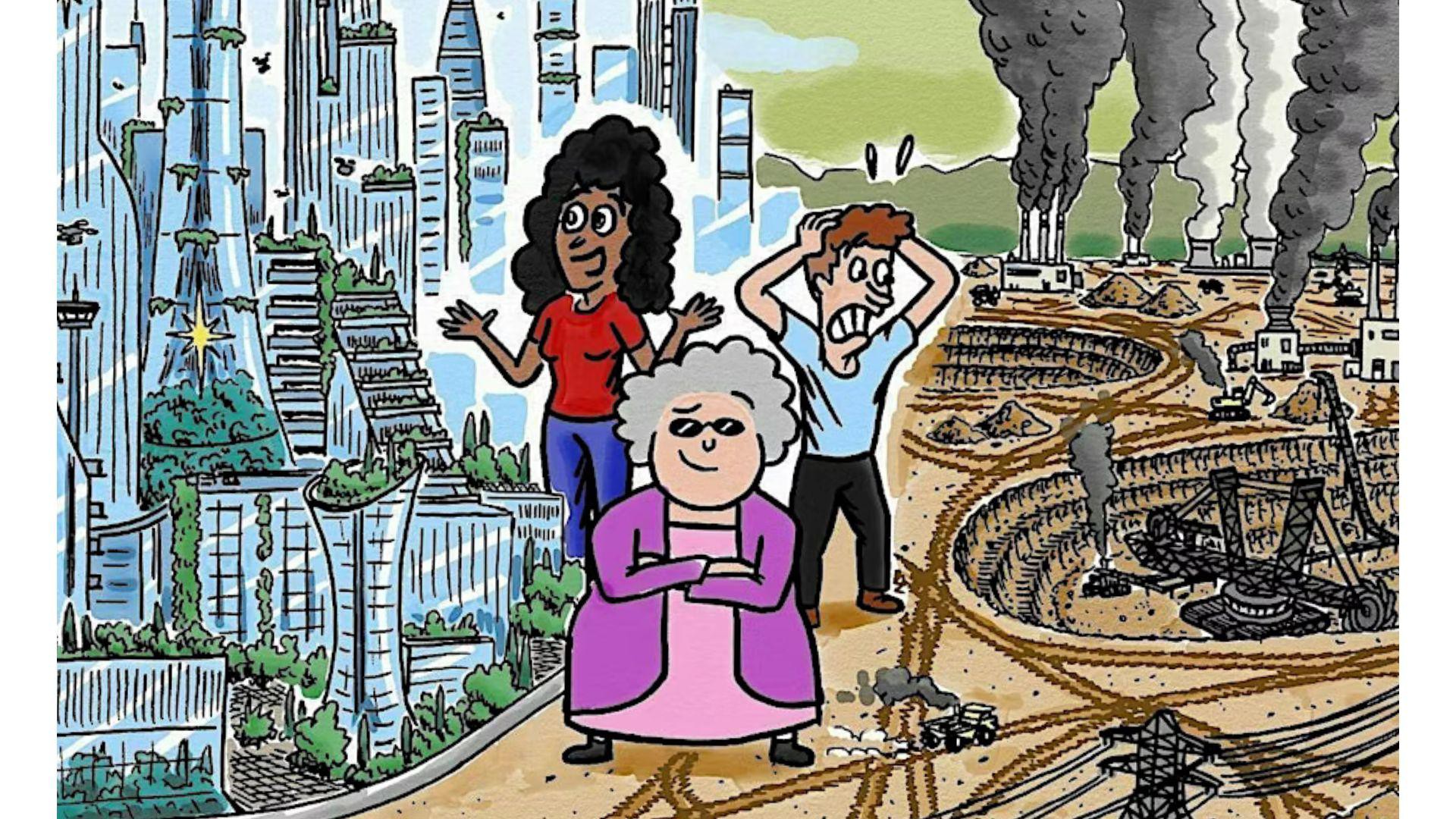 Utop’IA, Herji in collaboration with the LEARN Center of EPFL. © Julie Clerget
By Laureline Duvillard
Artificial intelligence (AI) is all around us. It’s in the headlines and public discourse and touches just about every part of society. But the technology is also adept at flying under the radar. For many, it’s an abstract concept – something nebulous and beyond reach. Yet it consumes vast quantities of very real resources. This is what Aïcha – a fictional Master’s student in AI – and her friend Félix discover in Utop’IA an educational (French language) graphic novel developed in association with author and illustrator Herji as part of a project initiated by LEARN.
“Exploring AI through an environmental lens brings its physical, tangible side into sharp focus,” says Sonia Agrebi, an expert in digital sociology and a LEARN projects manager. “Utop’IA examines how AI can make both a positive and negative impact on the environment. As a society, we use AI without realizing the repercussions. Our aim isn’t to moralize or point the finger of blame, but rather to challenge perceptions and explain concepts to raise awareness of the issues surrounding AI.”
Utop’IA is backed by solid scientific reasoning and evidence, since every detail was reviewed by a committee of EPFL experts in AI, sustainability and learning science. “AI is playing an increasingly important role in our everyday lives, but I find it alarming that so little is said about its environmental impact. Utop’IA offers digestible insights into this complex subject.” says Francesco Mondada, who sat on the committee in his capacity as a professor of robotics and the academic director of LEARN. “For example, AI image generators might be fun to play with, but people don’t understand just how resource-hungry they are.”
“Our aim isn’t to moralize or point the finger of blame, but rather to challenge perceptions and explain concepts to raise awareness of the issues surrounding AI.”
– Sonia Agrebi, an expert in digital sociology and a LEARN projects manager.
The graphic novel, published by EPFL Press, is aimed primarily at teenagers and is intended to help high-school teachers discuss the ecological pros and cons of AI. “One big challenge was to strike the right balance between the environmental costs and benefits,” says Herji. “I captured this dissonance by creating pairs of characters expressing different points of view. The explanations are given by a teacher – but she isn’t your typical aloof, self-styled expert. I didn’t want to draw a dividing line between her and the other characters.”
Between Utop’IA and M.I.A.M.
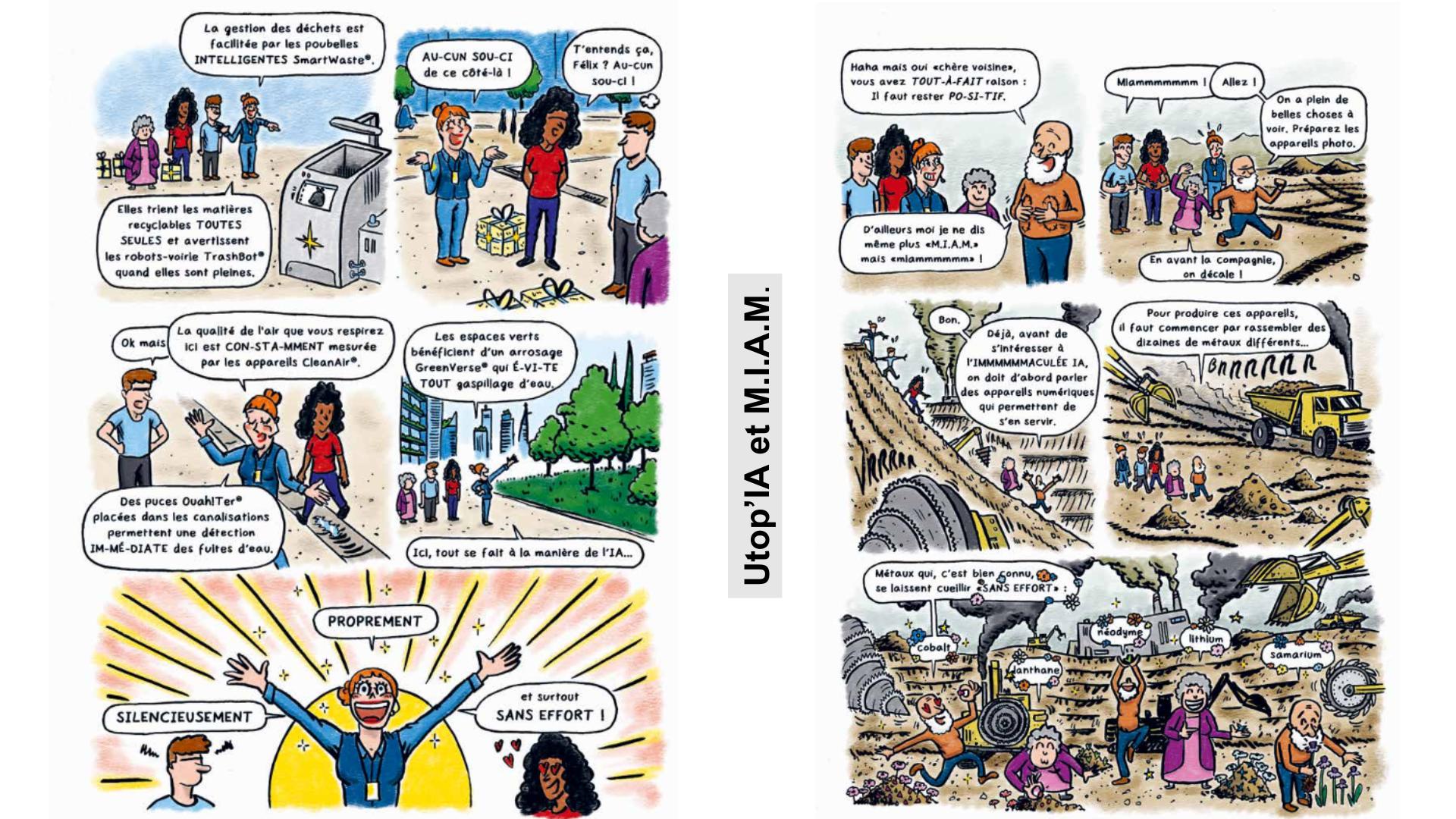
The story begins in Utop’IA, where a guide – whose pompous manner of speech is reminiscent of ChatGPT-generated text – shows the protagonists around a clean, quiet world plastered with posters of “Melon Usk” and “Jeff Pesos.” Here, smart software and devices conserve energy and water, monitor air quality, and reduce, sort and recycle waste. The action then moves to M.I.A.M. – a play on the French word for “yummy” – where a veteran scientist takes on the role of tour guide. In this world of mines, factories and pollution, the physical impact of AI is all too evident. 1.4 million km of undersea cable – enough to circle the globe 30 times – carry the data traffic on which the internet depends. Vast data centers consume huge amounts of energy and water. And metals and rare-earth elements are extracted from the ground to produce tens of billions of digital devices and other connected objects.
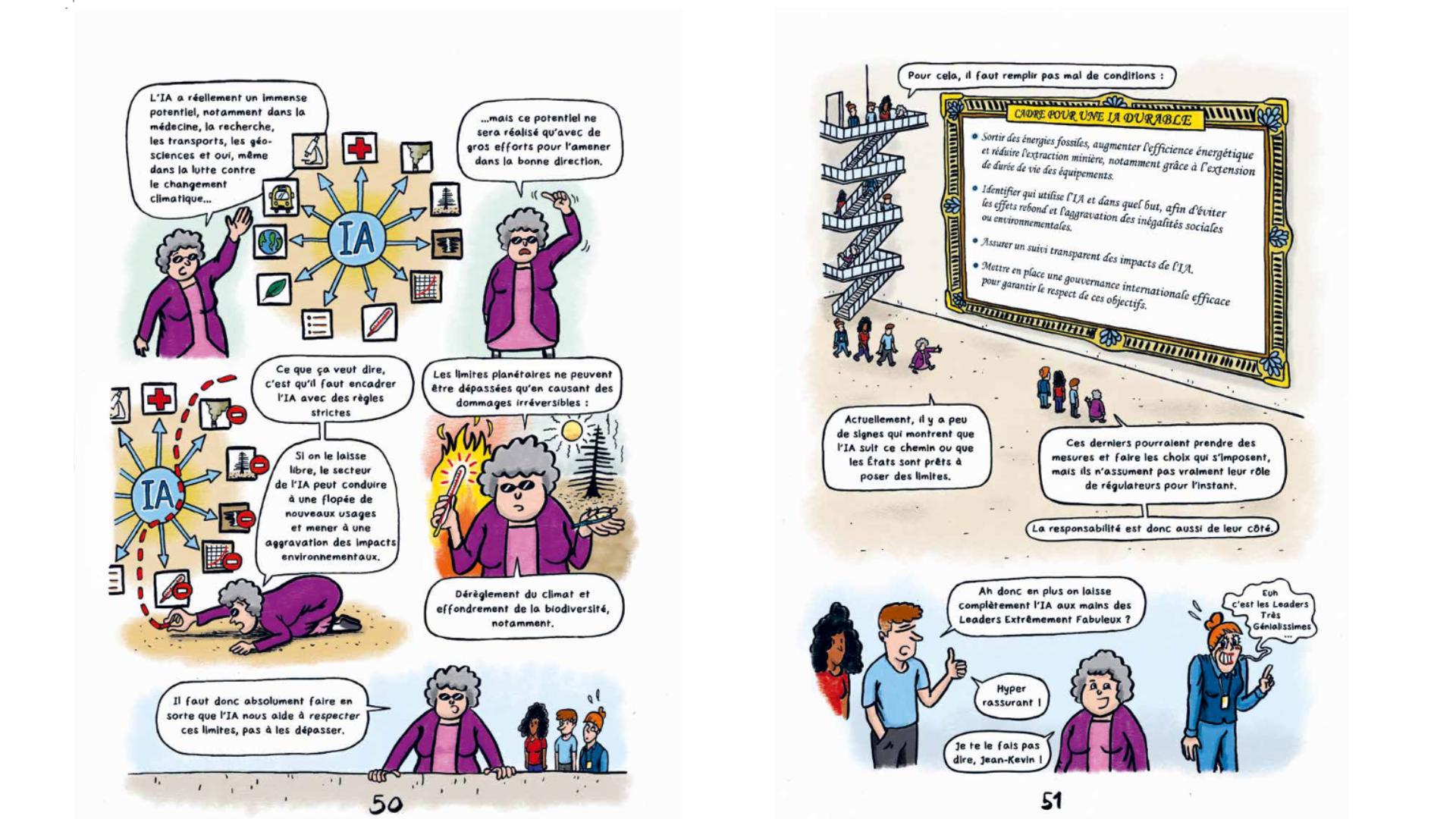
But Utop’IA offers more than a polarized vision. It also explores the middle ground, setting out a possible path towards sustainable AI that benefits society as a whole. “Every major innovation changes society in profound ways – and AI is no exception,” says Sascha Nick, a lecturer and scientist at EPFL’s Laboratory of Environmental and Urban Economics (LEURE) who also served on the book’s review committee. “There’s a lot of talk about the technical capabilities of AI, but we need to ask ourselves how it fits into our society and how it should be monitored and governed. AI has the potential to do incredible things. But it can live up to that potential only if we manage it properly. We need to stay alert and continuously challenge the dominant school of thought. Right now, we’re putting a lot of power in the hands of a small number of companies based in the United States and China.”
Activities for teachers
Utop’IA, which is available as a free download, aims to encourage critical thinking and help young readers better understand how AI works. LEARN has also developed a series of device-free educational games and other activities to accompany the book. “We worked with a small group of teachers to test our ideas, get feedback and adapt the materials to their classroom needs,” explains Agrebi. The activities are designed as conversation-starters, helping students grasp the inner workings of AI. As Eliza, the teacher in the book, puts it, AI is “neither artificial nor intelligent.” In the end, it’s what we – as human beings – make of it.

AUAI is supported by: