ΑΙhub.org
#RoboCup2019 Standard Platform League Competition Day 2
The Standard Platform League’s Competition Day 2 at RoboCup 2019 was busy with main competition games, mixed team games and an open challenge.
Open Challenge
In the evening on Competition Day 2, an Open Research Challenge was held. During this challenge, teams were invited to give a short presentation on SPL-related research that occurred this year. Six teams presented research talks:
- Berlin United: Simple, yet effective relaxation mechanism to prevent overheating
- B-Human: Ball detection and robot detection based on deep learning
- Camellia Dragons: Sound-location estimation method
- Dutch Nao Team: Interface widget
- SPQR: Gesture-based communication
- TJArk: Distance controlled passing
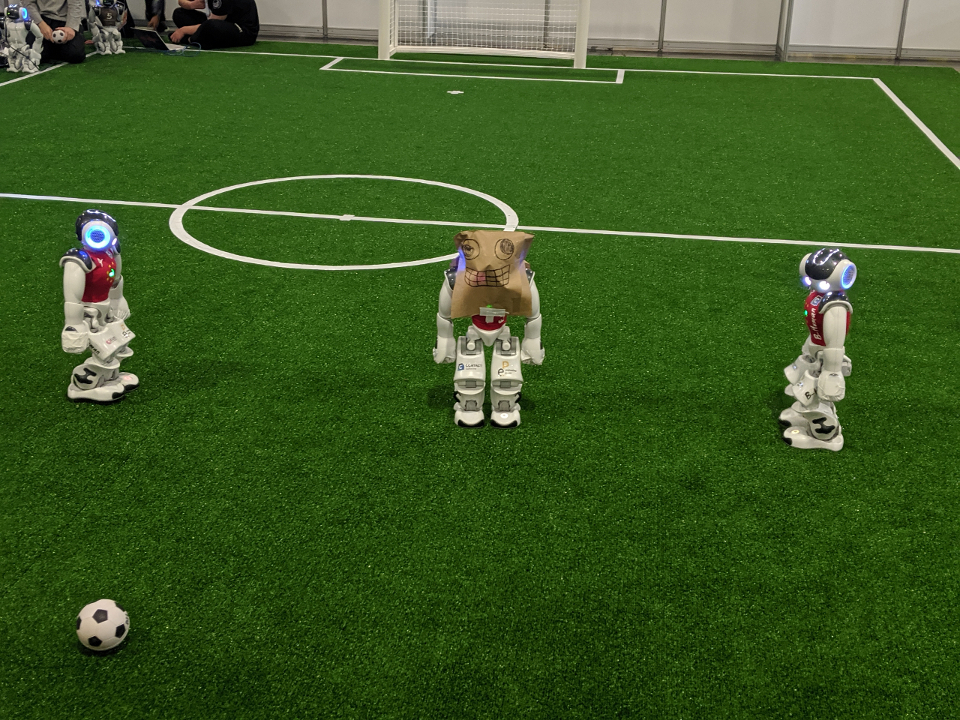
B-Human’s open challenge presentation. (Photo by JT Genter)
In addition to these six presentations, all twenty SPL teams brought and displayed a poster describing their RoboCup-related research within the past year.
Competition Day 2
Competition day 2 of the SPL started with Promotion Games between the league’s worst-performing teams in the first day’s Champion’s Cup and the best-performing teams in the first day’s Challenge Shield. Interestingly, each of the best-performing teams from the Challenge Shield won their Promotion Game which promoted them to the Champions Cup for the second round robins. It was great to see upward movement from four lower seeded teams.
Afternoon and early evening featured second round robin games in the Champions Cup and Challenge Shield. In the Champions Cup, all games ended as would be expected based on seeds — but there were some some close, exciting matches. For example, UT Austin Villa defeated SPQR 2:0 in Group G.
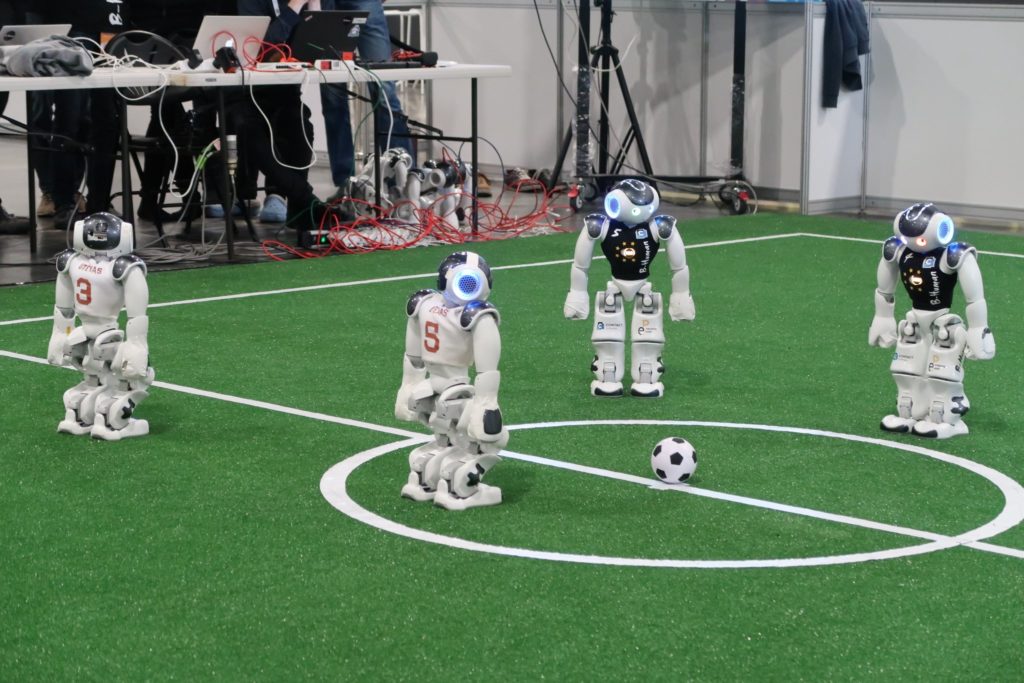
UT Austin versus B-Human at RoboCup 2019. (Photo by JT Genter)
Berlin United defeated NomadZ 3:0 in Group H, and HULKs defeated Bembelbots 3:1 in Group K.
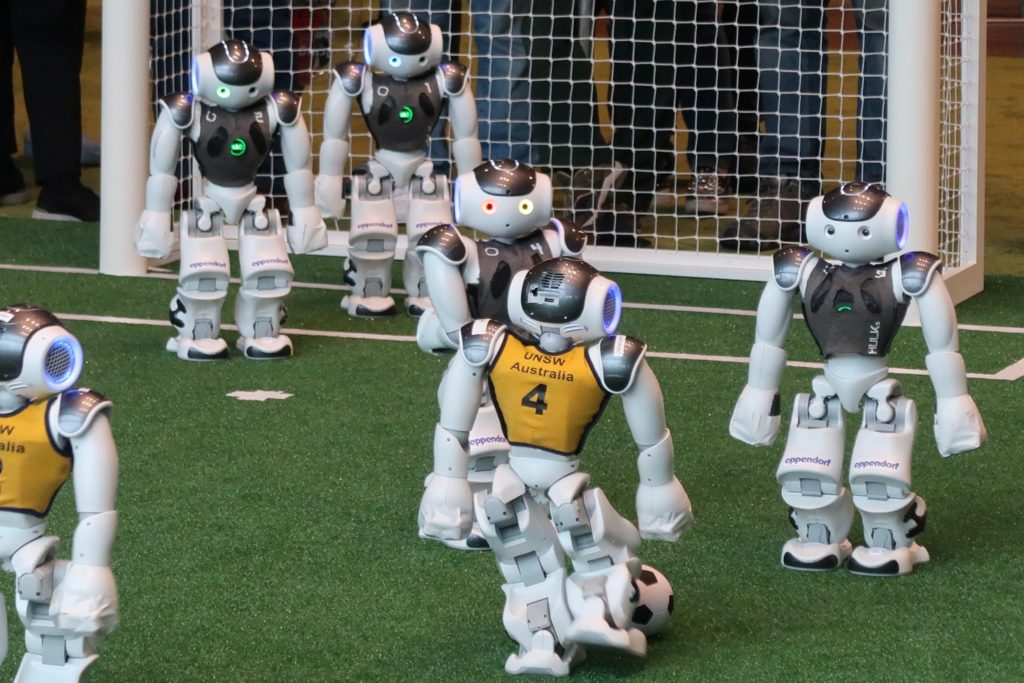
HULKs versus rUNSWift at RoboCup 2019. (Photo by JT Genter)
In the Challenge Shield, there were close games between many teams. For example, first-year team SABANA Herons tied second-year team Naova 1:1 and NTU RoboPAL defeated MiPAL 3:0.
Looking Toward Competition Day 3
Competition day 3 will feature the:
- End of the Mixed Team Competition round robin (more on this competition tomorrow)
- Intermediate Round and Quarterfinals for the Champions Cup
- End of the second round robin for the Challenge Shield and Challenge Shield Semi-final games
If you want to follow the SPL:
- Watch all SPL games live or after they complete on the Nao Devils Dortmund YouTube page
- See score updates and schedules on the SPL webpage
- Get timely updates by following the SPL on Twitter
- Like the league on Facebook
tags: RoboCup

AUAI is supported by: