ΑΙhub.org
 

#RoboCup2019 @Home finals


by
08 July 2019


share this:


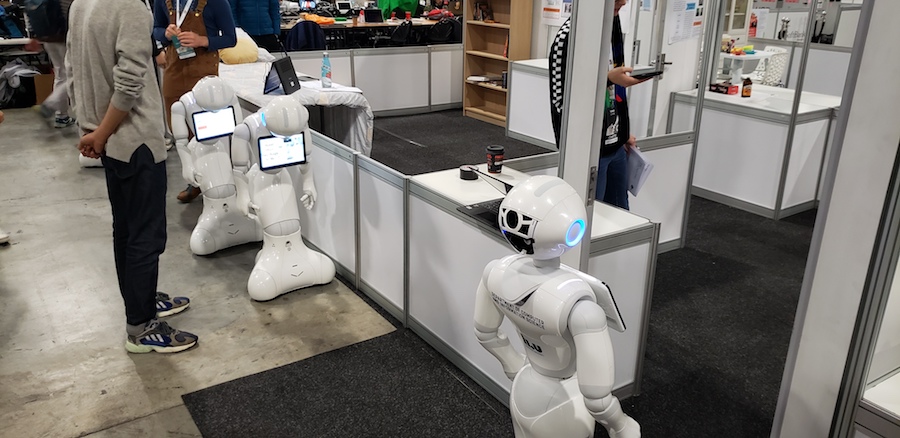
For the final stage of the @Home competition, the top 2 teams were selected in each of the sub-leagues (domestic, social and open platforms) to perform demos inside a 10 minute window followed by 5 minutes of questions from the judges. The scoring judges were comprised by trustee board members, external judges and members of the technical and organizing committees.

Social Standard Platform League
Uchile (2nd place) and UTS (1st place)

Chile showed an episodic memory demo based on their ongoing research, while UTS showed pepper as a social robot interacting with the “owner of the house” navigating environments and searching the house for the owner’s daughter.

Domestic Standard Platform League
Tidyboy (2nd place) and TUe (1st place)

Tidyboy did a demo about a manipulation task where the robot opened a cabinet door to get a juice, and then a snack from the kitchen table. It then placed both in a wheeled cart that it grabbed and took to the livingroom for a house guest.

TUe first showed how the robot understands pointing at objects in the room related to their research on human behavior recognition. Afterwards, they did a party demo where the robot recognized people in the livingroom and interfaced with a periscope app on a phone to get people’s drink orders. The robot then proceeded to navigate to the fridge, pushing a cart, to bring back multiple drinks at once and asked help from a bartender to get drinks from the fridge

Open Platform League
Pumas (2nd place) and Homer (1st place)

Pumas’ demo included both their robots from OPL and DSPL and showed how the robots can collaborate with tasks using cloud services like Alexa in social tasks like the robot party host.

As part of Homer’s final demo, they showed links to their ongoing research using their two open-platform robots about autonomous mapping, and adaptive learning from demonstration. As their last task of the demo they showcased the robot cleaning the toilet as part of a manipulation task that involves the use of contact forces.


tags:


Maru Cabrera is Research Associate at University of Washington.

            AUAI is supported by:


Subscribe to AIhub newsletter on substack


Related posts :

monthly digest

AIhub monthly digest: October 2026 – neurosymbolic planning, time-series forecasting, and robots for the home

  30 Oct 2026
Welcome to our monthly digest, where you can catch up with AI research, events and news from the month past.
AI pioneers

From teaching machines to teaching people: an interview with Michael Littman

  29 Oct 2026
AI Pioneer Michael Littman reflects on the evolution of reinforcement learning, the power of science communication, and how generative AI is changing the way we teach and learn.

From lab to life: Why translating AI advances to the real world is a major challenge

  28 Oct 2026
Systems that perform well in controlled lab settings often fall short when deployed in homes, in hospitals or on city streets.

Researchers get AI ‘drunk’ to expose new cyber security risks in chatbots

Fine-tuning large language models using drunken text makes them more likely to leak secrets and answer harmful questions.

AI is creating jobs as well as erasing them – but how rewarding are they?

  26 Oct 2026
One area of increased employment is in people “cleaning up” after LLMs, or quality controlling them.

How AI changes human decision-making

  23 Oct 2026
AI can identify patterns that people miss and bring new information into decision-making. However, this does not automatically lead to better decisions.

Competing in RoboCup@Home and winning the 2026 best paper award: an interview with Raphael Memmesheimer

  22 Oct 2026
Hear more about Raphael's research and his involvement in the RoboCup@Home league.

AI is distorting archaeology and flattening Indigenous Knowledge

While AI can help archaeologists, it can also spread pseudoscientific claims and false histories, stripping Indigenous Knowledge of context, consent and community control.


↑


AUAI is supported by:


Subscribe to AIhub newsletter on substack


©2026.05 - Association for the Understanding of Artificial Intelligence