ΑΙhub.org
#AAAI2025 workshops round-up 3: Neural reasoning and mathematical discovery, and AI to accelerate science and engineering
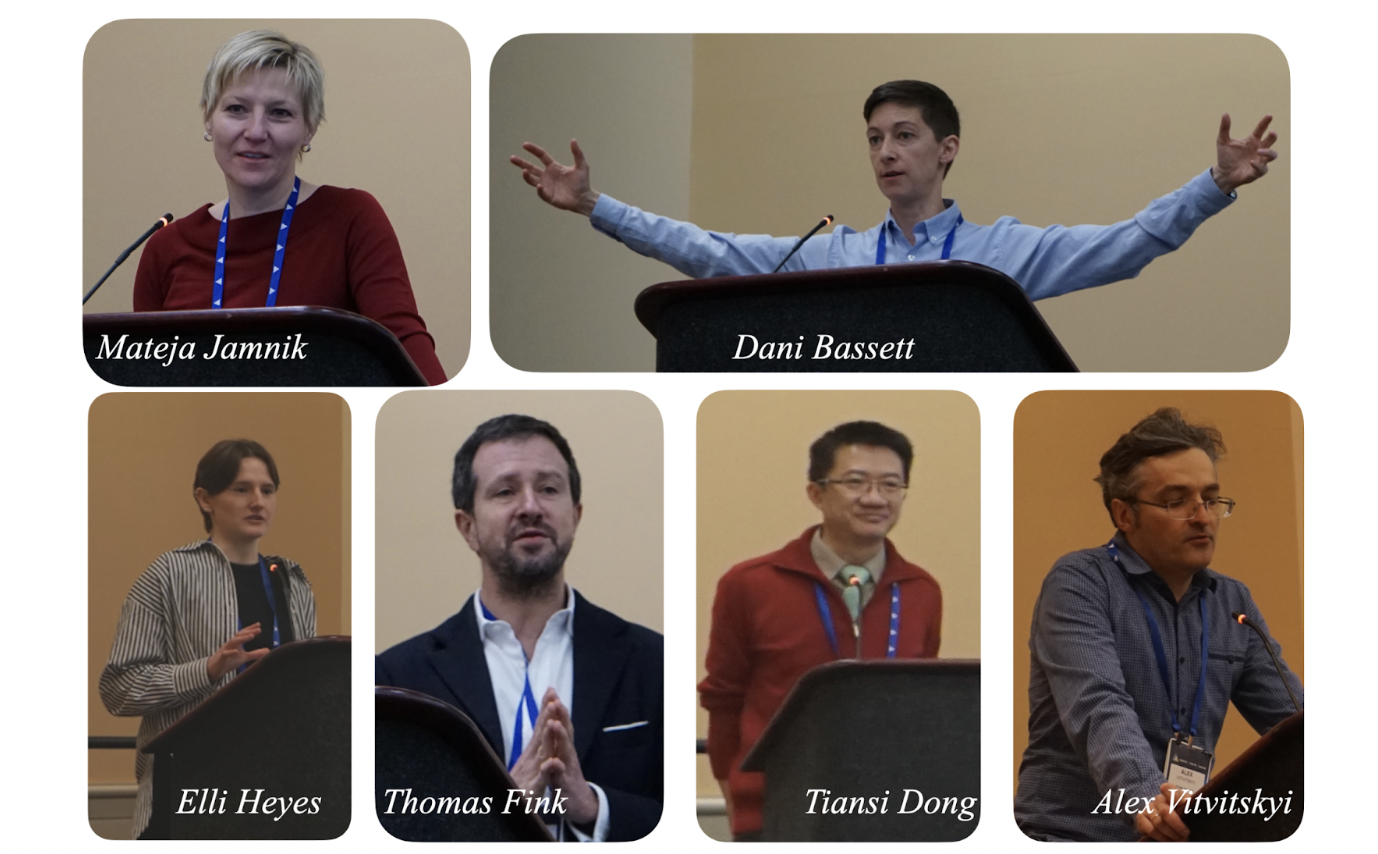
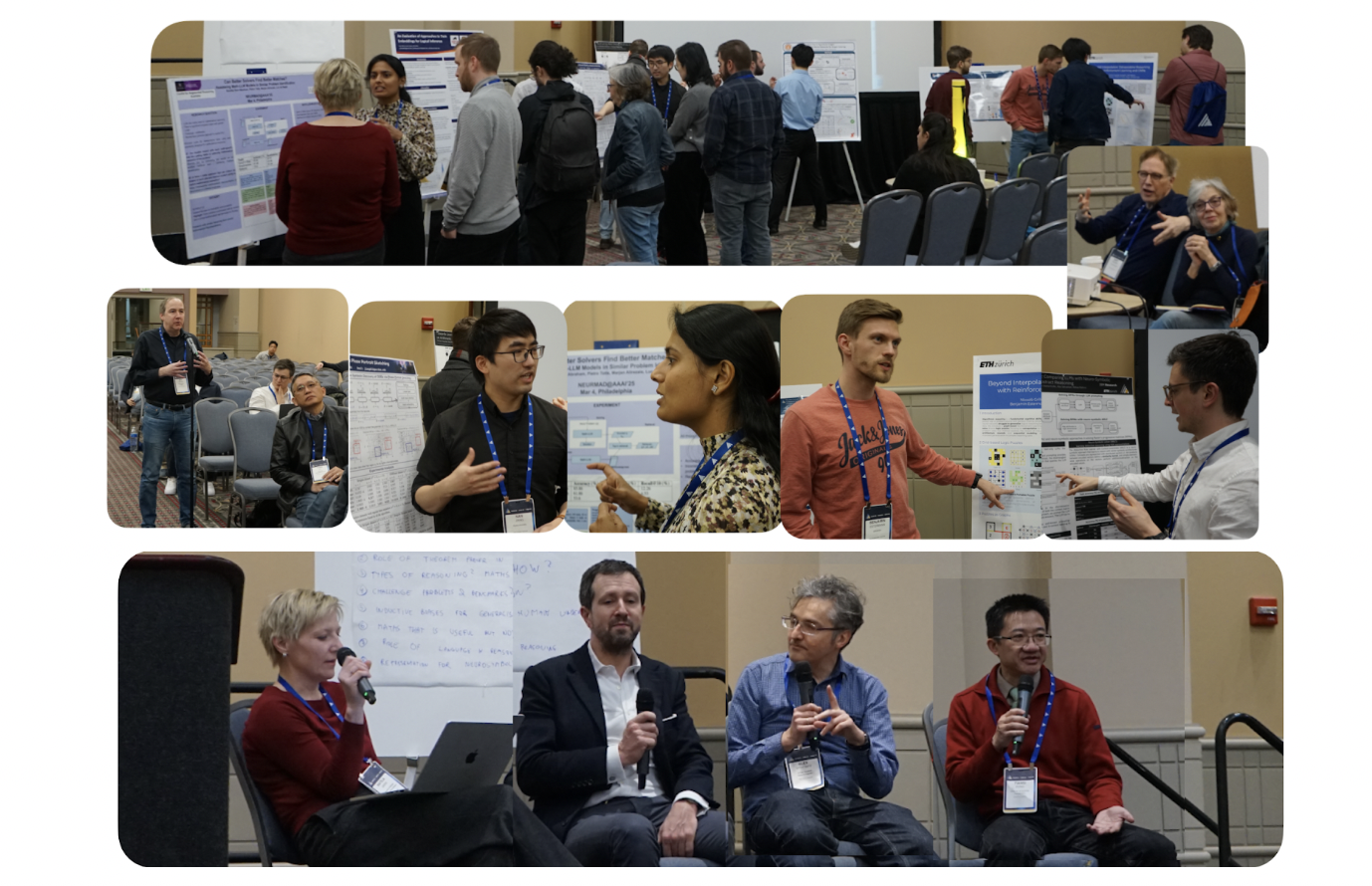 Images from the workshop on “Neural Reasoning and Mathematical Discovery – An Interdisciplinary Two-Way Street”.
In this series of articles, we’re publishing summaries with some of the key takeaways from a few of the workshops held at the 39th Annual AAAI Conference on Artificial Intelligence (AAAI 2025). In this third round-up article, we hear from the organisers of the workshops on:
- Neural Reasoning and Mathematical Discovery – An Interdisciplinary Two-Way Street
- AI to Accelerate Science and Engineering
Neural Reasoning and Mathematical Discovery – An Interdisciplinary Two-Way Street
By Tiansi Dong
Organisers: Challenger Mishra, Mateja Jamnik, Pietro Liò, Tiansi Dong.
Recent progress in Sphere Neural Networks demonstrates various possibilities for neural networks to achieve symbolic-level reasoning. This workshop aimed to reconsider various problems and discuss walk-round solutions in the two-way street commingling of neural networks and mathematics.
Some key takeaways from the workshop were as follows:
- Black-box neural networks can be successfully used to automatically raise mathematical conjectures and identities and generate new geometries.
- Irrelevant to the amount of training data, black-box neural networks cannot reach symbolic-level logical reasoning.
- Interdisciplinary approaches, from philosophy and neuroscience to mathematical modelling and artificial neural networks, can be successfully applied to scientific research, such as “What is curiosity?”
AI to Accelerate Science and Engineering
By Aryan Deshwal
Organisers: Aryan Deshwal, Jana Doppa, Syrine Belakaria, Vipin Kumar and Carla Gomes.
This workshop brought together researchers from artificial intelligence and diverse scientific domains to address new challenges towards accelerating scientific discovery and engineering design. This was the fourth iteration of the workshop, with the theme of AI for biological sciences following previous three years’ themes of AI for chemistry, earth sciences, and materials/manufacturing respectively. This workshop aims to achieve the following goals: 1. Identify and understand the challenges in applying AI to specific science and engineering problems. 2. Develop, adapt, and refine AI tools for novel problem settings and challenges. 3. Community-building and education to encourage collaboration between AI researchers and domain area experts.
The workshop has been growing significantly every year and saw double the number of papers presented and attendees this year. The program featured presentations from invited speakers, panel session and poster sessions covering a wide range of AI/ML methods and scientific/engineering applications.
The invited speakers’ presentations centered around several key themes:
- Foundation models for therapeutic design
- Generative models for drug discovery
- Lab-in-the-loop antibody design with deep learning and Bayesian optimization
- Promise and challenges of deep learning in genomics
- Importance of causal inference and causal discovery in biological applications
The invited speakers also discussed their views on open challenges in the broader field. The panel discussion addressed important questions regarding challenges and opportunities with generative models in AI for biological sciences, how to establish effective collaborations between domain scientists/engineers and AI experts, and safety considerations for AI systems in the scientific context.
The papers presented at the workshop covered wide-ranging application areas including materials science, chemistry, biological sciences, agricultural sciences, physics, manufacturing, and energy systems.
You can read the other workshop summary articles here:
- #AAAI2025 workshops round-up 1: Artificial intelligence for music, and towards a knowledge-grounded scientific research lifecycle
- #AAAI2025 workshops round-up 2: Open-source AI for mainstream use, and federated learning for unbounded and intelligent decentralization
tags: AAAI, AAAI2025
AUAI is supported by: