
ΑΙhub.org
AI for the ancient world: how a new machine learning system can help make sense of Latin inscriptions
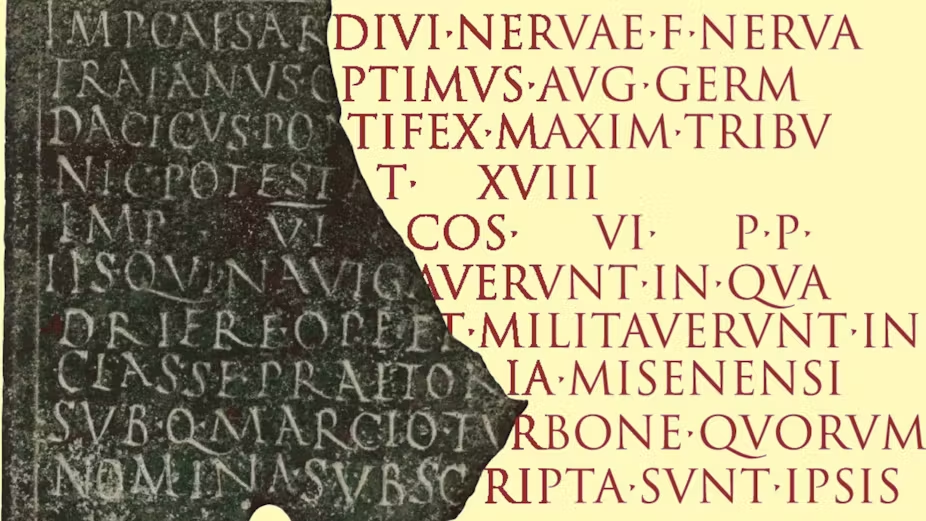 A fragment of a bronze military diploma from Sardinia, issued by the emperor Trajan to a sailor on a warship, as restored by Aeneas. Assael et al. / Nature. CC-BY-NC-ND-4.0.
By Trevor Evans, Macquarie University
If you believe the hype, generative artificial intelligence (AI) is the future. However, new research suggests the technology may also improve our understanding of the past.
A team of computer scientists from Google DeepMind, working with classicists and archaeologists from universities in the United Kingdom and Greece, described a new machine-learning system designed to help experts to understand ancient Latin inscriptions.
Named Aeneas (after the mythical hero of Rome’s foundation epic), the system is a generative neural network designed to provide context for Latin inscriptions written between the 7th century BCE and the 8th century CE.
As the researchers write in Nature, Aeneas retrieves textual and contextual parallels, makes use of visual details, and can generate speculative text to fill gaps in inscriptions.
A useful and accurate tool
All of these are attractive prospects for scholars who work with inscriptions (known as epigraphers). Interpreting and dating fragmentary inscriptions is not easy.
How well does it work? The team behind Aeneas asked 23 people with epigraphic expertise, ranging from masters students to professors, to try the system out.
The participants used outputs from Aeneas as starting points in an experimental simulation of real-world research workflows under a time constraint.
In 90% of cases, the historians found the parallels to a given inscription retrieved by Aeneas were useful starting points for further research. The system also improved their confidence in key tasks by 44%.
When restoring partial inscriptions and determining where they were from, historians working with Aeneas outperformed both humans and artificial intelligence alone. When estimating the age of inscriptions, Aeneas achieved results on average within 13 years of known dates provided by historians.
The system performs better for some regions and periods than others. Unsurprisingly, it performs better on material from around the period for which historians have not only the most evidence but also the most accurately dated inscriptions.
Nevertheless, the participants emphasised Aeneas’ ability to broaden searches by identifying significant but previously unnoticed parallels and overlooked textual features. At the same time, it helped them refine their results to avoid overly narrow or irrelevant findings.
A quicker way to the starting point
So how useful might it really be? Epigraphy is a challenging field with a long and messy history. It takes long years to develop expertise, and scholars tend to specialise in particular regions or time periods.
Aeneas will dramatically speed up the process of preliminary analysis. It will be able to sift through the complex mass of evidence to identify potential parallels or similar texts that a researcher may otherwise miss when dealing with fragmentary material.
Another use for Aeneas may be to locate an inscription geographically, and to estimate when it was produced.
Aeneas can also predict missing parts of a fragmentary text, even where the length of what is lost is unknown.
This last feature may seem the most exciting but probably has the least practical value for research. It is the equivalent of speculative restoration by a human authority and has an equal capacity to lead the unwary to unsafe conclusions.
A useful starting point
On the other hand, we should ask what Aeneas can’t do. The answer is the actual research (like all generative AI products to date, for all the hype).
However, the team behind Aeneas are perfectly frank about this. They are rightly proud of the achievement the system represents, but are careful to measure its capacity to yield “useful research starting points”.
Nor does this tool remove the fundamental necessity of checking the data it extracts against standard references, and where possible images or (ideally) original artefacts.
Researchers with appropriate expertise will still need to do the work of interpreting results. What Aeneas changes is the feasible scope of their work.
It allows a much broader view of parallels (especially through its capacity to harness visual cues) than is typical of previously developed tools. Its capacity for rapid retrieval will bring scholars to their research starting points much faster than before.
And for epigraphers, it may open up much broader horizons, allowing them to escape the restriction of particular geographical regions or time periods.
Trevor Evans, Associate Professor, History and Archaeology, Macquarie University
This article is republished from The Conversation under a Creative Commons license. Read the original article.

AUAI is supported by:








