ΑΙhub.org
What’s coming up at #AAAI2026?
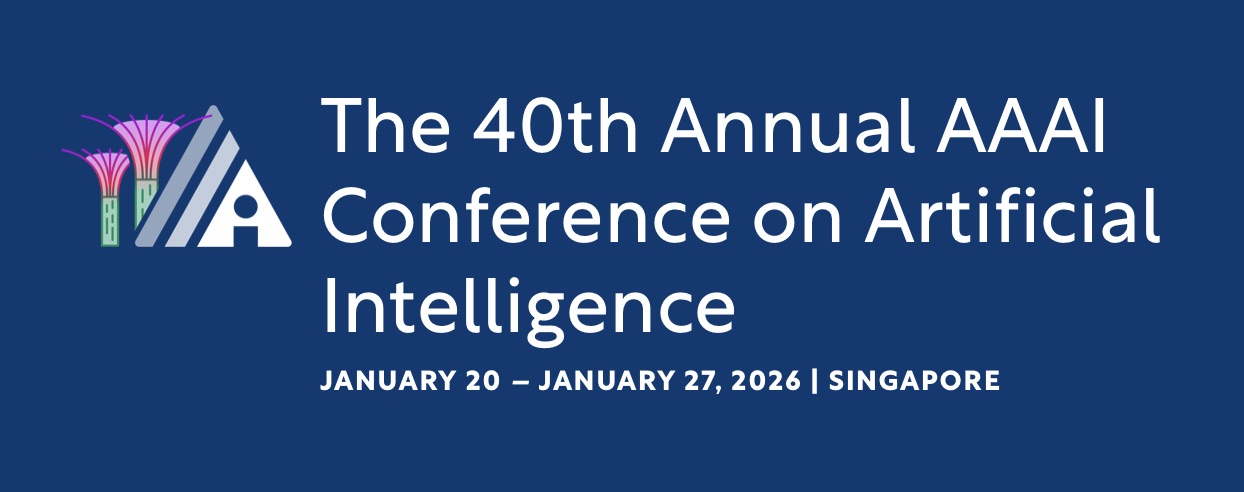
This year, the Annual AAAI Conference on Artificial Intelligence will take place outside of North America for the first time. From Tuesday 20 January to Tuesday 27 January, Singapore will play host to the 40th edition of the conference. The event will feature invited talks, tutorials, workshops, and an extensive technical programme. There are also a whole host of other sessions, including doctoral and undergraduate consortia, diversity and inclusion activities, posters, demos, and more. We (AIhub) will be running a science communication training session on Wednesday 21 January.
Invited talks
The invited talks this year are as follows:
- Peter Stone – From how to learn to what to learn in multiagent systems and robotics
- Bowen Zhou – Specialized generalist: Towards high-efficiency AGI
- Yolanda Gill – From workflows to water coolers: AI that can navigate human nature
- Daniel Whiteson – Fundamental physics and science communication
- Katerina Fragkiadaki – Learning world simulators from data
- Isabelle Guyon – AI in science and technology: the future in our hands
- Ece Kamar – Navigating the AI horizon: Promises, perils, and the power of collaboration
- Derek Haoyang Li – Small data: A new paradigm for the next generation of AI
- AAAI Robert S. Engelmore Memorial Lecture Award: Ashok Goel – AI for reskilling, upskilling, and workforce development
- Patrick Henry Winston Outstanding Educator Award: Alan Mackworth and David Poole – The essence of intelligence is appropriate action (not thinking, reasoning, learning or language) and other things every student of AI should know
Science communication for AI researchers – an introduction
We (AIhub) will be running a short course on science communication on Wednesday 21 January, from 13:00 – 14:30. In this brief tutorial, science communication experts will teach you how to clearly and concisely explain your research to non-specialists.
Tutorial and lab forum
The tutorial and lab forum will be held at the beginning of the conference, on Tuesday 20 and Wednesday 21 January.
- TH01: A Decade of Sparse Training: Why Do We Still Stick to Dense Training?
- TH02: Brain-Inspired AI 2.0: Aligning Language Models Across Languages and Modalities
- TH03: Handling Out-of-Distribution Data in the Open World: Principles and Practice for Reliable AI
- TH04: LLMs for Optimization: Modeling, Solving, and Validating with Generative AI
- TH05: Plan, Activity, and Intent Recognition (PAIR)
- TH06: Hyperbolic Geometry for Foundation Models: A Tutorial
- TH07: Uncertainty Quantification for Large Language Models
- LH02: Developing AI Agents for IT Automation Tasks with ITBench
- TQ01: Deep Representation Learning for Tabular Data
- TQ02: From Underspecification to Alignment: Breaking the One-Model Mindset for Reliable AI
- TQ03: Bridging Healthcare and AI: EHR- Enhanced Clinical Conversational Systems with LLMs: A Comprehensive Tutorial
- LQ01: SOFAI-LM: A Cognitive Architecture for Building Efficient and Reliable Reasoning Systems with LLMs
- TH08: Algorithms and Systems for Efficient Inference in Generative AI
- TH09: Multimodal Foundation Models in Modern Healthcare: Principles, Practices, and Beyond
- TH10: Trustworthy Machine Reasoning with Foundation Models
- TH11: Multi-modal Time Series Analysis: Methods, Datasets, and Applications
- TH12: Large Language Models meet Logical Reasoning
- TH13: Towards Trustworthy and Socially Responsible Generative Foundation Models
- TH14: Structured Representation Learning: Interpretability, Robustness and Transferability for Large Language Models
- TH15: Tutorial on LLM-based Multi-Agent Systems: From Foundations to Frontiers
- TQ04: Evolution of Neural Networks
- TQ05: The Many Faces of Multiplicity in Machine Learning
- TQ06: Auto-Formalization in Large Language Models era: From Mathematical Proofs to Verifying LLM Reasoning
- TQ07: Beyond Graph Distribution Shifts: LLMs, Adaptation, and Generalization
- TQ08: Rule Learning in the LLM Era: Foundations, Techniques, and Applications
- TH16: Bandits, LLMs, and Agentic AI
- TH17: Domain Model Learning for Automated Planning
- TH18: Foundations of Interpretable Deep Learning
- TH19: When AI “Forgets” for Good: The Science and Practice of Machine Unlearning for AI Safety — Progress, Pitfalls, and Prospects
- TH20: Model Reuse in the LLM Era: Leveraging Pre-Trained Resources with Classical and Modern Approaches
- TH21: Modern Methods in Associative Memory
- TH22: Optimal Transport-Driven Machine Learning: Techniques and Applications
- LH03: The Verification of Neural Networks Competition (VNN-COMP): A Lab for Benchmark Proposers,
Verification Tool Participants, and the Broader AI Community - TQ09: The Application of Generative AI and Intelligent Agents in Low-level Vision
- TQ10: Black-box Optimization from Offline Datasets
- TQ11: Knowledge Distillation for Language Models: Challenges and Opportunities with Sequential Data
- TQ12: Clustering High-dimensional Data: Balancing Abstraction and Representation
- TH23: Human centered AI: challenges and opportunities
- TH24: Foundation Models for Time Series Analysis: A Tutorial
- TH25: Agentic AI for Scientific Discovery: Benchmarks, Frameworks, and Applications
- TH26: Generative AI in Healthcare: Causality, Decision, and Real-world Case Study
- TH27: Discrete Choice and Applications
- TH28: Neural Network Reprogrammability: A Unified Framework for Parameter-Efficient Foundation Model Adaptation
- TH29: Toward Foundation Models for Detecting Abnormal Activities on Graphs
- LH04: Learning to Steer Large Language Models
- TQ13: Recent Advances in Multi-Objective Search
- TQ14: Computational Optimization in LLM Inference: Reuse and Delegation
- TQ15: Computational Pathology Foundation Models: Datasets, Adaptation Strategies, and Evaluations
- LQ02: From Inception to Productization: Hands-on Lab for the Lifecycle of Multimodal Agentic AI in Industry 4.0
Find out more about the tutorials and labs here.
Bridge programme
The bridge programme is designed to bring together two or more communities from different AI disciplines to foster collaborations. There are eleven different sessions this year, and these will be held on Tuesday 20 and Wednesday 21 January.
- B1: AI for Medicine and Healthcare
- B2: Logical and Symbolic Reasoning in Language Models
- B3: Combining AI and OR/MS for Better, Trustworthy Decision Making
- B4: Knowledge-guided Machine Learning: Bridging Scientific Knowledge and AI
- B5: Advancing Large Language Models and Multi-Agent Systems
- B6: AI and Wildlife Conservation
- B7: Artificial Intelligence for Scholarly Communication (AI4SC)
- B8: Bridging AI and Behavior Change (ABC)
- B9: Bridging Planning and Reasoning in Natural Languages with Foundational Models
- B10: Making Embodied AI Reliable with Testing and Formal Verification
- B11: Streaming Continual Learning Bridge
- B12: Trustworthy AI for Legal and Law Enforcement Applications: Foundations, Challenges, and the Path Forward
Find out more about the bridge programme here.
Workshops
There are 52 workshops to choose from this year. These will take place at the end of the main conference, on Monday 26 and Tuesday 27 January.
- W1: Workshop on Health Intelligence (W3PHIAI-26): Special Theme on “Foundation Models and AI Agents”
- W2: Agentic AI in Financial Services
- W3: AI for Healthy Aging and Longevity (AIAA2026)
- W4: AI in Agriculture (Agri AI)
- W5: AI to Accelerate Science and Engineering (AI2ASE)
- W6: Addressing Challenges and Opportunities in Human-Centric Manufacturing
- W7: Advancing Artificial Intelligence through Theory of Mind (ToM4AI)
- W8: Agentic AI Benchmarks and Applications for Enterprise Tasks
- W9: AI for CyberSecurity (AICS) 2026
- W10: AI for Scientific Research
- W11: Workshop on Multi-Agent Path Finding
- W12: Federated Learning for Critical Applications
- W13: AI in Drug Discovery: From Methods to Molecules
- W14: AI4EDU: AI for Education: On Opportunities and Challenges of Large Multimodal Models in Education
- W15: AIR-FM: Assessing and Improving Reliability of Foundation Models in the Real World
- W16: Artificial Intelligence for Air Transportation (AI4AT)
- W17: Artificial Intelligence for Time Series Analysis (AI4TS): Theory, Algorithms, and Applications
- W18: Audio-Centric AI: Towards Real-World Multimodal Reasoning and Application Use Cases
- W19: Automated Spatial and Temporal Anomaly Detection (ASTAD)
- W20: Bodily Expressed Emotion Understanding (BEEU) 2026
- W21: Bridging Neurons and Symbols for NLP and Knowledge Graph Reasoning
- W22: Consistency in Video Generative Models: from Clip to Wild (CVM @ AAAI ’26)
- W23: Creative AI for Live Interactive Performances
- W24: Deployable AI Workshop
- W25: Emerging AI Technologies for Music
- W26: AI Governance Workshop: Alignment, Morality, Law, and Design
- W27: Foretell of Future AI from Mathematical Foundation (MATH4AI)
- W28: Post-AI Formal Methods (P-AI-FM)
- W29: SPARTA — Spatial Reasoning and Therapeutics with AI : From Omics to Imaging
- W30: AI for Urban Planning
- W31: AI for Environment Science
- W32: Artificial Intelligence with Biased or Scarce Data
- W33: Linguistic and Cognitive Approaches to Dialogue Agents (LaCATODA’26)
- W34: Navigating the Model Uncertainty and the Rashomon Effect: From Theory and Tools to Applications and Impact
- W35: Language Models for Underserved Communities(LM4UC)
- W36: LLM-based Multi-Agent Systems: Towards Responsible, Reliable, and Scalable Agentic Systems (LaMAS 2026)
- W37: Machine Ethics: from formal methods to emergent machine ethics
- W38: Machine Learning for Wireless Communication and Networks (ML4Wireless)
- W39: Neuro for AI & AI for Neuro: Towards Multi-Modal Natural Intelligence
- W40: Neuromorphic Intelligence: From Algorithms to Systems
- W41: New Frontiers in Information Retrieval
- W42: Next-Gen Code Development with Collaborative AI Agents Workshop
- W43: Orchestrating Synthesized Human and AI-Agentic Workflows: AI Agency Benefits, Disruptions and Management
- W44: Personalization in the Era of Large Foundation Models
- W45: Foundations of Agentic Systems Theory (FAST)
- W46: Quantum Computing and Artificial Intelligence (QC+AI 2026)
- W47: RAI-2026: Workshop on Reproducible AI
- W48: SECURE-AI4H: Safe, Ethical, Certified, Uncertainty-aware, Robust, and Explainable AI for Health
- W49: Shaping Responsible Synthetic Data in the Era of Foundation Models (RDS)
- W50: Graphs and more Complex Structures For Learning and Reasoning (GCLR)
- W51: How Can We Trust and Control Agentic AI? Toward Alignment, Robustness, and Verifiability in Autonomous LLM Agents
- W52: XAI4Science: From Understanding Model Behavior to Discovering New Scientific Knowledge
Find out more about the workshops here.
Links to other events and sessions
- Main technical track
- Demonstration programme
- Community activities
- EAAI-26: The 16th Symposium on Educational Advances in Artificial Intelligence
- Programme for the Thirty-Eighth Annual Conference on Innovative Applications of Artificial Intelligence (IAAI-26)
tags: AAAI, AAAI2026

AIhub is supported by: