
ΑΙhub.org
Everything, eco-where, AI at once?
 Tania Duarte and Catherine Breslin / Better Images of AI / CC BY 4.0
In this blog post, Laura Martinez Agudelo builds upon her research of visual representations of ecology and digitalisation to explore how “AI eco-imagery” is portrayed. Martinez Agudelo introduces five “eco-digital” visual narratives from her recent paper – including the Earth as a glowing orb and nature through screens. She then explores how AI tropes are specifically embedded in “eco-images”, such as through green descending code and mechanical trees. She argues that these images shape our perception of AI, environmental issues, and their potential consequences.
Eco-digital narratives are a lens through which we imagine our relationship with the environment and technology. Visual storytelling plays a huge role in shaping how natural environments and sustainability are perceived and digitally represented. These narratives show how meaning is created and allows us to understand the ways visual communication defines the intersection between both topics.
The original article (written in French) “Eco-digital narratives and mediated visual representations” (Martinez Agudelo, 2025) offers a semiotic, discursive and techno-visual reflection on these narratives in online communication. The study is based on the analysis and conceptualisation of an online corpus of 100 images from Google, Yahoo, Ecosia, Bing, Lilo, Qwant and DuckDuckGo search engine results. It describes the modalities of meaning found, as well as the indices of practices and materialities represented in visual discourses dealing with “eco-digital” narratives.
For studying these thematised visual representations, we should look at both the content of images and the social practices they represent. As Descola (2021) puts it, “we only depict what we perceive or imagine”. In the context of digital technology, this often involves depicting specific technical devices, such as phones or computers. In ecology or environmental issues, the colour green is commonly used to represent visually natural environments.
These narratives are everywhere online, from institutional websites and social media visual identity to online (green tech) guides and e-book covers. Certain visual patterns recur, each conveying a specific story about the intersection between “nature”, “ecology”, “environment” and (new) technologies. The analysis provided some insights into how we perceive and communicate sustainability. Martinez Agudelo categorises eco-digital narratives into five types, summarised below:
1. Plants growing from technological devices

One of the first patterns identified was how often plants appear intertwined with technological devices. A seedling sprouting from a laptop keyboard, a tree emerging from a smartphone screen… These images immediately convey the hopeful idea that nature and technology coexist in harmony. However, these visuals made us question whether they oversimplify reality. They can create the false impression that technology and nature integrate seamlessly without conflict or environmental cost.
2. The Earth as a glowing orb

The Earth often appears as a glowing orb, sphere or marble cradled in human hands or glowing inside a lightbulb, a visual shorthand for “innovation”. But while holding the world in one’s hands feels empowering (for whom, exactly?), and sometimes it performs a gesture of care, it’s also misleading. Such imagery tends to sanitise the climate crisis, presenting it as something neat, homogeneous and manageable while airbrushing the messy, sometimes violent, and complex reality of the challenges we face (conflict minerals, e-waste dumping, rebound effect, cooling scarcity, subsea geopolitics, displacement…).
3. Nature through screens
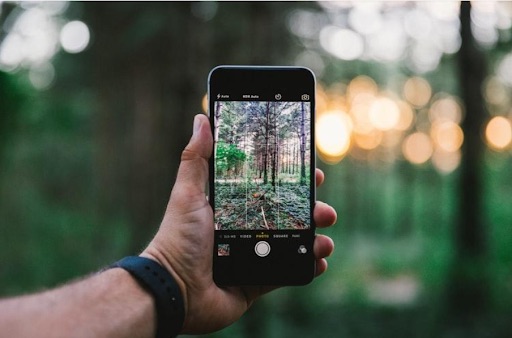
In some images, nature is framed by tech devices: a forest captured on a phone camera, a waterfall displayed on a laptop screen. These visuals can make us reflect on our own experience. How often do we experience “nature” through technology rather than directly? Are we connecting with natural environments, or simply consuming a curated digital version of it? How is this “nature” already present or recognizable in the materiality of our technological devices?
4. Eco-tech icons
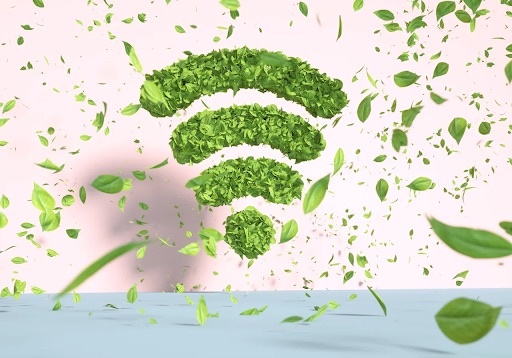
Then there’s the category of icons: green power buttons, recycling symbols, Wi-Fi signals entwined with leaves. These symbols are instantly recognizable and easy to understand. They communicate “eco-friendliness” at a glance. However, many of them simplify or obscure the real impact of technology on the environment. They create a comforting (sometimes green washing) narrative, without addressing material realities like e-waste, water and energy consumption, or resource extraction.
5. Critical frames

A smaller subset of analysed visuals challenges or questions the mainstream eco-digital narrative in some way, by highlighting labour and resource extraction, as well as the pitfalls of greenwashing. These images prompt us to pause and reflect, reminding us that visual storytelling is not always intended to provide comfort. Sometimes, its purpose is to urge us to confront what we would rather ignore or change our approach to a specific eco-digital issue. Recognising these dynamics helps us to identify the symbolic analogies that are currently present in the media landscape.
This analysis also highlights the inherent biases within the search engine results that were used to compile the visual corpus. However, it offers a framework for understanding how such visuals inhabit the online public sphere, facilitating the expression of diverse positions on contemporary socio-environmental contexts. Although most of the analysed images are not necessarily “anti-ethical”, they are often “anti-political” (Romele, 2023): they reinforce a rigid divide between experts and non-experts, preventing public disagreement regarding AI development.
Images actively influence how we conceptualise technology, sustainability, and our own roles within the digital ecosystem. Whether they inspire hope, frame nature as a passive object, or challenge us to face the material consequences of innovation, they somehow dictate the boundaries of our “ecological imagination”. Wagener (2023) suggests that some “narrative frameworks” can carry a “discursive anger” that also provides a structure for the climate crisis.
What about “AI eco-imagery”?
The categories concerning the intersection of “ecology” and “digital” are almost identical when discussing the visual interaction between the semantic field of ecology and AI technologies. Misleading AI tropes persist, albeit with slight variations, such as the use of a green colour palette (green anthropomorphism, green robots or cyborgs, grass hands, mechanical green hands, mechanical trees and green descending code), alongside objects related to environmental issues, such as wind turbines, solar panels and backgrounds depicting urban pollution. There are even depictions of small waste-collecting or plant-seeder robots in a future where Earth has been abandoned as a trash-covered wasteland (as in WALL-E).



Source pages for images left to right: Blue robotic hand | White brain | White robot.
Moving forward, we can engage with these images more critically: what story is this visual conveying? What is it concealing? If they are in dialogue with another image or text, what is their intrinsic relationship? “Eco-digital” narratives, reproduced explicitly within environmental discourses of AI systems, illustrate the intersection of the technological and ecological spheres and perspectives. Frequently, these images reduce ecology to a mere aesthetic rather than a lived practice or experience, shaping our perception of environmental issues and their potential consequences.
Questioning media-driven visuals enables a deeper understanding of the socio-technical and environmental realities behind and within them. While some images can create a false sense of security, others can distance us from reflection or meaningful action. Paying closer attention to our relationship with the living world and the way technology and AI systems mediate these connections enables us to engage more intentionally with our immediate environmental realities.
Critical visual frameworks that confront the real tensions and conflicts between emerging technologies and ecological collapse are necessary. The Better Images of AI library provides more complex and socially aware visual representations of the entanglements between environmental discourse, social systems and the material infrastructures of devices and digital technologies.
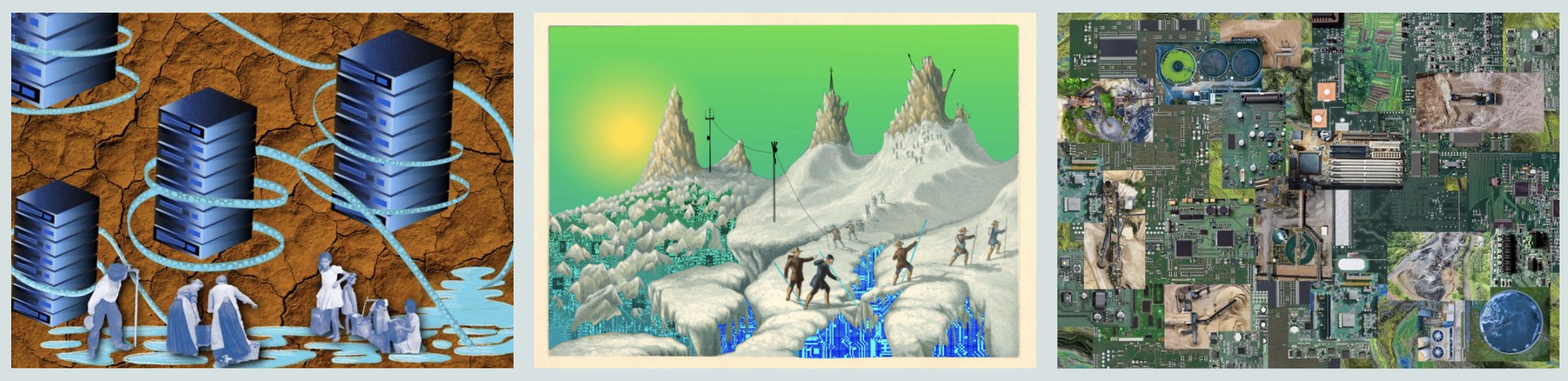 Images from the Better Images of AI library, from left to right: Gloria Mendoza / Better Images of AI / CC BY 4.0, Hanna Barakat & Archival Images of AI + AIxDESIGN / Better Images of AI / CC BY 4.0, Sinem Görücü / Better Images of AI / CC BY 4.0.
Rather than reproducing the sanitised aesthetics of clean innovation, these images expose the extractive supply chains, energy demands, labour conditions, exploitation and destruction that occur in the name of AI innovation, as well as all the planetary costs embedded in AI systems and technological progress.
Looking closely at these visual narratives reminds us that how we see, imagine or represent the world influences how we resist, act or create in it.
References
Descola, P. (2021) Les formes du visible: une anthropologie de la figuration. Paris: Seuil.
Latour, B. (2004) Politiques de la nature: comment faire entrer les sciences en démocratie. Paris: La Découverte.
Martinez Agudelo, L. S. (2025) Récits éco-numériques et représentations visuelles médiatisées, Interfaces numériques, 14(2-3).
Romele, A. (2023) Images de l’intelligence artificielle: Un punctum cæcum dans l’éthique de l’IA, in Sebbah, F-D. and Romele, A. (eds) Imaginaires technologiques. Paris: Presses universitaires de Paris Nanterre, pp. 142–164.
Wagener, A. (2023) Blablabla: en finir avec le bavardage climatique. Paris: Le Robert.


AUAI is supported by: