
ΑΙhub.org
CogTwin: A framework for adaptable digital twins
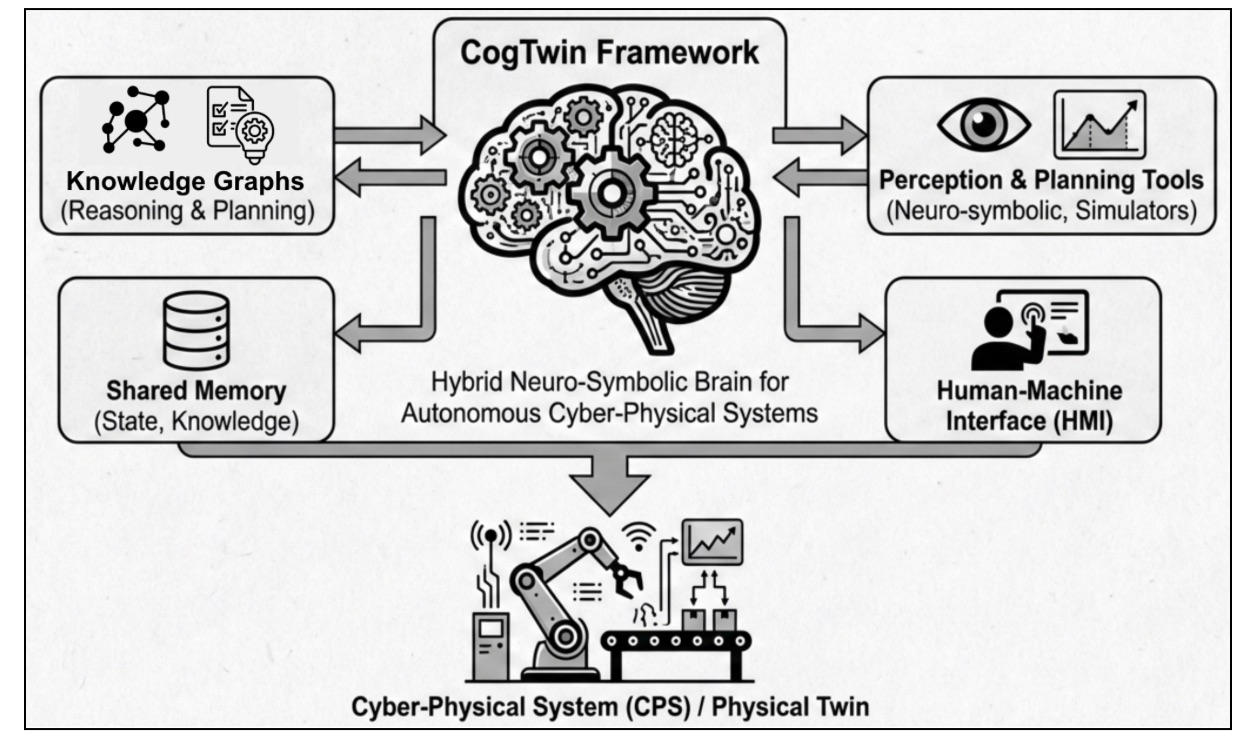
CogTwin is a hybrid cognitive architecture framework designed to bring autonomous reasoning and real-time adaptation to digital twin systems. Presented at IJCAI 2025, this work aims to advance the state of digital twin technology by addressing key gaps in autonomy, cognition, and real-time decision-making.
The problem landscape: shifting digital twins from reactive to proactive systems
Digital twin technology has transformed how complex systems are managed, from smart cities to industrial processes. However, most current digital twins remain fundamentally reactive: they rely on pre-programmed rules and static data-driven models, and therefore struggle when confronted with unforeseen events or evolving conditions. Real-time learning, reasoning, and adaptation – hallmarks of human cognition – are largely absent.
CogTwin aims to address this gap by equipping digital twins with human-like cognitive abilities, enabling them to perceive, reason, learn, and act autonomously in dynamic environments. This approach marks a shift from traditional emphasis on simulation and monitoring toward genuine intelligence and adaptability, with the goal of enabling true cognition in cognitive digital twins.
The CogTwin architecture: integrating three AI paradigms
At the core of CogTwin is a hybrid approach that integrates symbolic AI, sub-symbolic AI, and neuro-symbolic AI, each contributing complementary strengths.
- Symbolic AI supports structured knowledge representation and logical reasoning through dual knowledge graphs. A static domain knowledge repository (DKR) captures foundational knowledge about the environment, while a dynamic internal knowledge graph (DIKG) continuously updates with real-time information. This dual-graph design balances stability with adaptability.
- Sub-symbolic AI uses neural networks for pattern recognition and adaptive learning, particularly within the deliberative layer, where complex reasoning and decision-making occur.
- Neuro-symbolic integration combines the explainability of symbolic reasoning with the learning capabilities of neural models, enabling richer, more flexible cognition.
The architecture is organized into several interconnected modules that operate within a continuous cognitive cycle:
- Perceptual buffers receive real-time sensor data and apply a hybrid attention mechanism combining self-attention and cross-attention. This focuses processing on the most relevant signals while maintaining situational awareness.
- The real-time knowledge integration (RTKI) module converts raw sensor data into symbolic representations compatible with the knowledge graphs, managing conflicts and resolving inconsistencies to maintain data quality.
- The reactive layer handles immediate responses to critical situations using rule-based systems, enabling rapid action when timing is crucial, without waiting for higher-level deliberation.
- The deliberative layer supports advanced cognitive functions such as planning, decision-making, and complex reasoning. Multiple reasoning types are supported, including case-based, deductive, inductive, abductive, analogical, temporal, and spatial reasoning.
- Working memory and long-term memory store information related to active goals and accumulated experience, respectively. This structure provides fast access for immediate decisions while preserving long-term learning.
- The meta-cognitive layer oversees and regulates the cognitive process, monitoring performance, detecting inconsistencies, and dynamically allocating computational resources—effectively enabling the system to “think about its own thinking”.
The 50-millisecond cognitive cycle: thinking at human speed
A distinctive feature of CogTwin is a target 50-millisecond cognitive cycle, inspired by findings from years of cognitive science and cognitive architecture research. This rapid cycle is designed for real-time interaction and control in dynamic environments, aligning machine responsiveness with human-level reaction times while retaining digital precision and consistency.
The cognitive cycle is divided into six phases:
- Perception (5 ms)
- Knowledge integration (10 ms)
- Situation assessment (10 ms)
- Planning and decision-making (15 ms)
- Action selection and execution (5 ms)
- Feedback and learning (5 ms)
Throughout the cycle, the meta-cognitive layer continuously monitors performance with minimal overhead.
Preliminary complexity analysis and hardware assumptions indicate that the 50 ms target is achievable on cloud servers. Deployment on resource-constrained edge devices, such as Raspberry Pi 4, requires careful design of computationally intensive components. Strategies such as hierarchical graph representations, pre-computed paths, and optimized graph libraries support this goal, enabling CogTwin to operate across a range of platforms from cloud to edge.
From theory to practice: smart city applications
CogTwin’s capabilities are demonstrated through detailed pseudocode implementations in four smart city scenarios, illustrating the framework’s versatility:
- Traffic incident management: In a multi-vehicle accident during rush hour, CogTwin integrates inputs from traffic cameras, GPS devices, and social media. Within the cognitive cycle, it assesses the situation, predicts congestion propagation, adjusts traffic signals, recommends alternative routes, and alerts emergency services.
- Power outage response: During a transformer failure in extreme heat, the framework evaluates impacts on critical infrastructure and vulnerable populations, prioritizes power restoration, explores rerouting strategies, manages backup generation, and informs residents.
- Smart home automation: In residential settings, CogTwin personalizes the environment based on occupant preferences, current conditions, and historical energy use, continually learning and adjusting to balance comfort, cost, and sustainability.
- Medical emergency response: When a medical emergency occurs, CogTwin weighs severity, resource proximity, hospital capacity, and patient needs to coordinate ambulance dispatch and medical team allocation, illustrating how cognitive capabilities can support life-critical decisions.
Beyond single-domain scenarios, CogTwin supports cross-domain coordination — for example, synchronizing traffic signal control to accelerate ambulance routes during medical emergencies, or managing cascading effects of power outages on traffic systems and smart homes. This systems-level perspective extends beyond traditional, siloed digital twin implementations.
Keeping knowledge fresh: DKR enrichment
CogTwin places strong emphasis on knowledge lifecycle management. During real-time operation, the DKR remains static to ensure stability. Over longer timescales, however, the DKR is periodically enriched offline with knowledge derived from the DIKG.
The enrichment process identifies information within the DIKG that has proven stable, persistent, and useful in practice. Offline integration allows for thorough validation and conflict resolution without affecting real-time performance. Safeguards such as ontological alignment, DKR versioning, and expert review for complex changes help prevent knowledge degradation. This approach ensures that learning enhances system performance while preserving reliability.
Transparency and trust: the role of explainable AI
Trustworthy collaboration between humans and cognitive digital twins depends on transparency. CogTwin embeds explainability at multiple layers.
Symbolic components including the DKR, DIKG, and rule-based systems in the reactive layer naturally provide structured, queryable knowledge, making reasoning paths transparent and auditable. Planned enhancements include advanced explainable AI modules capable of generating counterfactual explanations and visualizing attention weights within neural networks. These capabilities will offer richer insight into both symbolic reasoning and sub-symbolic behavior, enabling stakeholders to understand not only what decisions are made, but why and under what conditions.
Looking ahead: the path to real-world deployment
The CogTwin framework will be transitioned from detailed pseudocode to a working software implementation, followed by rigorous evaluation in simulated and real-world smart city pilots. The reference implementation and ongoing updates are (or will be) made available at the project GitHub repository.
Several research and development directions are in focus:
- Performance optimization and scalability: Empirical validation of the 50 ms cognitive cycle across heterogeneous hardware platforms and development of standardized benchmarks for cognitive digital twins.
- Unified frameworks for CDT standards: Use of CogTwin’s structured architecture as a basis for methodologies, interfaces, and metrics that support comparison, interoperability, and standardization across cognitive digital twin solutions.
- Advanced reasoning and learning: Integration of probabilistic reasoning, deep reinforcement learning, and richer XAI methods, with context-sensitive selection of reasoning strategies.
- Multi-agent cognitive systems: Coordination of multiple CogTwin instances for distributed decision-making in large-scale urban systems.
- Privacy-preserving federated learning: Application of federated learning techniques to enable distributed training on sensitive smart city data without centralized aggregation.
- Ethical and safety considerations: Design of mechanisms for accountability, transparency, bias detection, and robust error handling to support responsible deployment.
Contributing to a unified theory of cognition for digital twins
CogTwin contributes a concrete step toward a unified view of cognition in the digital twin domain. By integrating diverse cognitive functions into a practical architecture tailored for real-time, dynamic environments, the framework illustrates how digital twins can evolve from passive simulators to autonomous, adaptive, and intelligent systems.
The modular structure, hybrid AI stack, and rapid cognitive cycle together enable digital twins that perceive, reason, learn, and act in ways that echo human cognition, yet operate at the speed and scale demanded by modern cyber-physical infrastructures.
Read the full paper
- CogTwin: A Hybrid Cognitive Architecture Framework for Adaptable and Cognitive Digital Twins, Proceedings of the Thirty-Fourth International Joint Conference on Artificial Intelligence (IJCAI-25), Special Track on AI4Tech: AI Enabling Critical Technologies.
- GitHub repository
Read our previous interviews with Sukanya
- Synthesizing multi-modal knowledge graphs for smart city intelligence
- Developing a cognitive digital twin framework for smart cities
tags: IJCAI, IJCAI2026

AUAI is supported by: