
ΑΙhub.org
#ICLR2023 invited talk: Data, history and equality with Elaine Nsoesie
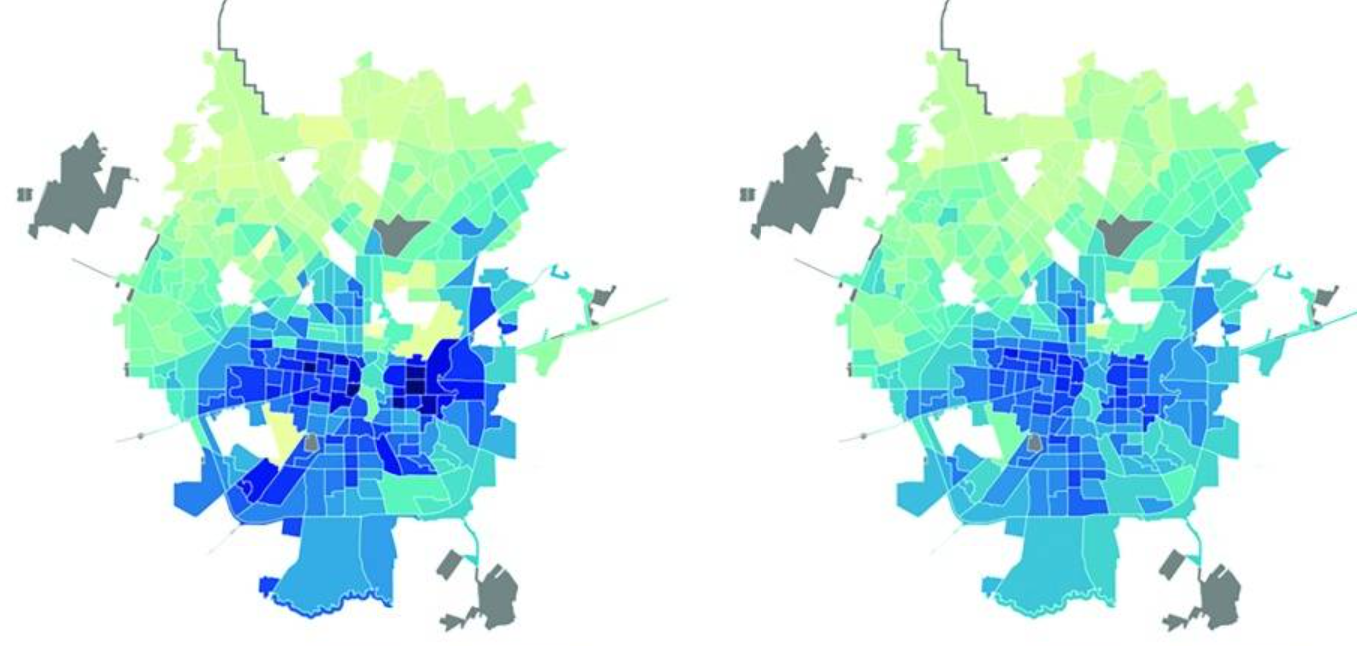 Figure from Use of Deep Learning to Examine the Association of the Built Environment With Prevalence of Neighborhood Adult Obesity, Adyasha Maharana and Elaine Okanyene Nsoesie. Image on the right represents actual obesity prevalence; on the left, cross-validated estimates of obesity prevalence based on features of the built environment extracted from satellite images. Figure reproduced under CC-BY licence.
The 11th International Conference on Learning Representations (ICLR) took place last week in Kigali, Rwanda, the first time a major AI conference has taken place in-person in Africa. The program included workshops, contributed talks, affinity group events, and socials. In addition, a total of six invited talks covered a broad range of topics. Following on from our post summarising the first two invited talks, we give a flavour of the presentation from Elaine Nsoesie.
Elaine Nsoesie – Data, History and Equity
Elaine Nsoesie’s research is primarily focused on the use of data and technology to advance health equity. One research direction is concerned with improving data, and increasing involvement, for under-represented communities in the development of AI models for health research. She also heads a project (the racial data tracker) which collects, analyses and disseminates racial data that point to the structural nature of racism in the USA. The results of this effort (which will be released later this month) take the form of interactive visualisations and infographics that citizens can use, either for advocacy, or for policy making.
One particular area that Elaine has focused on is the study of the links between neighbourhood and the health outcomes of its residents. Life expectancy is closely linked to the neighbourhood in which you live. As an example, Elaine highlighted Boston, and two neighbourhoods that are located just a few miles apart. In the neighbourhood North Roxbury (which consists of 50.3% Black population and 30.7% Hispanic population), the life expectancy is 59.8 years, whereas in Back Bay (with 73.4% white population) this figure is 84.5. These disparities can be linked to past governmental policies.
A specific policy that Elaine highlighted is “redlining“. Introduced in the 1930s, the US Government categorised neighbourhoods in cities across the country, with each given a grade based on how risky that area was deemed for investment. This led to residents of areas labelled as “hazardous” being denied services. The areas most frequently discriminated against were Black inner city neighbourhoods. The lasting effects of this policy continue to impact health to this day.
In her work, Elaine studies how racist policies, such as redlining, have created inequities in the built environment. In one study, she used deep learning (specifically a convolutional neural network (CNN)) to examine the association of environs with the prevalence of adult obesity. Using satellite images and obesity data from six US cities, Elaine, and colleague Adyasha Maharana, showed that physical characteristics of a neighbourhood (such as the presence of parks, highways, green streets, crosswalks, housing types) can be associated with variations in obesity prevalence across different neighbourhoods.
As a next step, Elaine and her team looked at street view images. Once again using a CNN, they classified the images according the physical characteristics of the built environment. Their aim was to investigate the association among neighbourhood racial and ethnic composition, the built environment, and health outcomes across urban areas in the US. They found significant differences (in terms of the built environment) between predominantly white neighbourhoods and neighbourhoods with predominantly Black, or other minoritized racial or ethnic group, residents. In terms of health outcomes, poor-quality housing was strongly associated with the prevalence of asthma and sleep problems.
Elaine closed her presentation by stressing that historical policies continue to impact our lives today. By studying, measuring, and quantifying these impacts, her objective is to provide concrete evidence of disparities to inform policy makers.
You can read more about this research, and Elaine’s other projects and published work here.
tags: ICLR2023

AUAI is supported by: