
ΑΙhub.org
Credit fairness: lending resources without losing out
 Hanna Barakat & Archival Images of AI + AIxDESIGN / Woven Circuit / Licenced by CC-BY 4.0
Consider several research groups at a university that buy machines and put them into a shared cluster. Computing demands vary over time, and one group’s quiet week may be another group’s deadline crunch. Pooling allows the same hardware to be used much more efficiently than separate private clusters.
But pooling raises a question: If you let your neighbour run on your machines this month, what claim do you have on theirs next month?
In our IJCAI-ECAI 2026 paper, Credit Fairness: Online Fairness in Shared Resource Pools, we show that standard notions of fairness do not address this question and propose one that does.
The setting
A group of agents share a pool of identical resources. Each agent contributes a fixed endowment every round, but their demands vary over time. In each round, agents report how much they need, and a mechanism divides the pool. Agents get one unit of utility for every unit they receive up to their demand, and nothing for anything beyond it. Utilities add up across rounds.
Three properties are standard here:
- Sharing incentives (SI): participating should be at least as good as walking away and using only your own machines.
- Strategy-proofness (SP): reporting your true demand should be at least as good as misreporting.
- Pareto efficiency (PE): no resource should be allocated to an agent who gets no value from it while someone else is still short.
Static max-min fairness passes all three, and still feels unfair
A common approach to resource allocation is max-min fairness. In a dynamic setting it comes in two flavours. Static max-min fairness (SMMF) maximizes the minimum utility independently in each round; it has no memory. Dynamic max-min fairness (DMMF) maximizes the minimum cumulative utility, so it does remember.
One might imagine that the memory of DMMF would allow for fairer allocations. In some cases it does, but there are also instances on which DMMF loses both SI and SP. In earlier work with coauthors, we showed that SMMF satisfies all three properties.
And yet SMMF can produce allocations that are hard to defend. Vuppalapati et al. (2023) showed that one agent can receive on the order of n times as many resources as another with the same average demand, where n is the number of agents. Here is a small instance illustrating this phenomenon. Consider three agents, each with an endowment of two units per round, over three rounds:
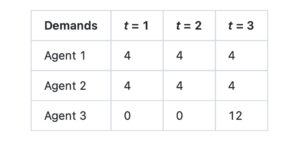
All three agents demand 12 units in total. SMMF allocates as follows:
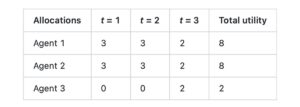
Agent 3 needed nothing in the first two rounds, so their two units went to agents 1 and 2. In round three, when agent 3 finally needs the pool, SMMF has no memory of that: it simply splits the six units evenly. Agents 1 and 2 walk away with eight units of utility each; agent 3 gets two.
Nothing has gone wrong by the usual standards. Agent 3 would also have received the same utility of two by keeping their own machines, so SI holds. But agent 3 lent their endowment away twice and got nothing for it. SI has nothing to say about that, and to our knowledge neither did any other formal property in this literature.
Credit fairness
Credit fairness makes this lending and borrowing explicit. A credit system assigns every agent a balance, initially zero, based on the history of reports and allocations. Intuitively, an agent with positive credits is owed resources by the pool, and an agent with negative credits owes resources to it. A mechanism is credit fair if there exists a credit system satisfying five conditions:
- C1 ties changes in credit to the amount an agent actually lends or borrows. A lender never loses credit and gains no more than they actually donated; a borrower never gains credit and loses no more than they actually borrowed.
- C2 forces credit to be granted when it is earned. If your donation was pivotal — other agents collectively received more than they contributed — you must gain credit for it.
- C3 requires the system to be non-inflationary: total credit can never increase. Credits are claims on resources, so letting the supply grow might let agents collectively claim resources that do not exist.
- C4 sets a floor on allocations. An agent who wants at least their endowment and is not in debt must receive at least their endowment; an agent in debt is guaranteed only their endowment minus what they owe.
- C5 uses an agent’s endowment plus their credit as their fair share this round. No agent may exceed their fair share while another agent with enough demand falls short of theirs.
Guarantees and trade-offs
Credit fairness is a strengthening of sharing incentives: any mechanism that is credit fair and Pareto efficient automatically satisfies SI. Intuitively, we can think of it as adding an equity guarantee on top of the stability guarantee that SI provides.
We also prove an impossibility result: No anonymous mechanism can be strategy-proof, Pareto efficient, and credit fair at the same time. The impossibility is tight in the sense that any two of the three are achievable. SMMF gives SP and PE. The trivial mechanism that hands every agent exactly their endowment every round satisfies SP and credit fairness, at the cost of never sharing anything.
LendRecoup
LendRecoup is Pareto efficient and credit fair. In each round, first serve every agent up to the smaller of their demand and their credit-adjusted endowment. If resources remain after this step, distribute them among agents who still have demand, prioritizing those with the lowest cumulative allocation so far. Credits simply track net lending by giving an agent one credit for every unit lent and deducting one for every unit borrowed.
Even though it violates SP, LendRecoup satisfies the weaker incentive guarantee of online strategy-proofness, meaning that no agent can improve their current-round utility by misreporting, holding the history fixed.
We simulated 50 agents over 500 rounds using demand profiles derived from Google cluster traces and compared LendRecoup against SMMF, DMMF, and Karma. Because all four mechanisms are Pareto efficient, they achieve the same total utility, with only distributional differences between them. Under LendRecoup and SMMF, no agent ended up worse off than they would have been without sharing at all. Under DMMF and Karma, roughly a third of agents did. No mechanism was best across every equity measure we tracked, but LendRecoup performed well across all of them.
The paper is available on arXiv: Seyed Majid Zahedi and Rupert Freeman, Credit Fairness: Online Fairness in Shared Resource Pools, IJCAI-ECAI 2026.
tags: ECAI, ECAI2026, IJCAI, IJCAI2026


AUAI is supported by: