
ΑΙhub.org
#RoboCup2019 Standard Platform League Competition Day 1
Twenty teams are competing in the Standard Platform League (SPL) at RoboCup 2019 in Sydney this week. However, the experience and skills of the league’s teams vary greatly, from six-time champion B-Human to new teams from Russia and Colombia. Although teams have been onsite for two days preparing, today was the first day of competition.
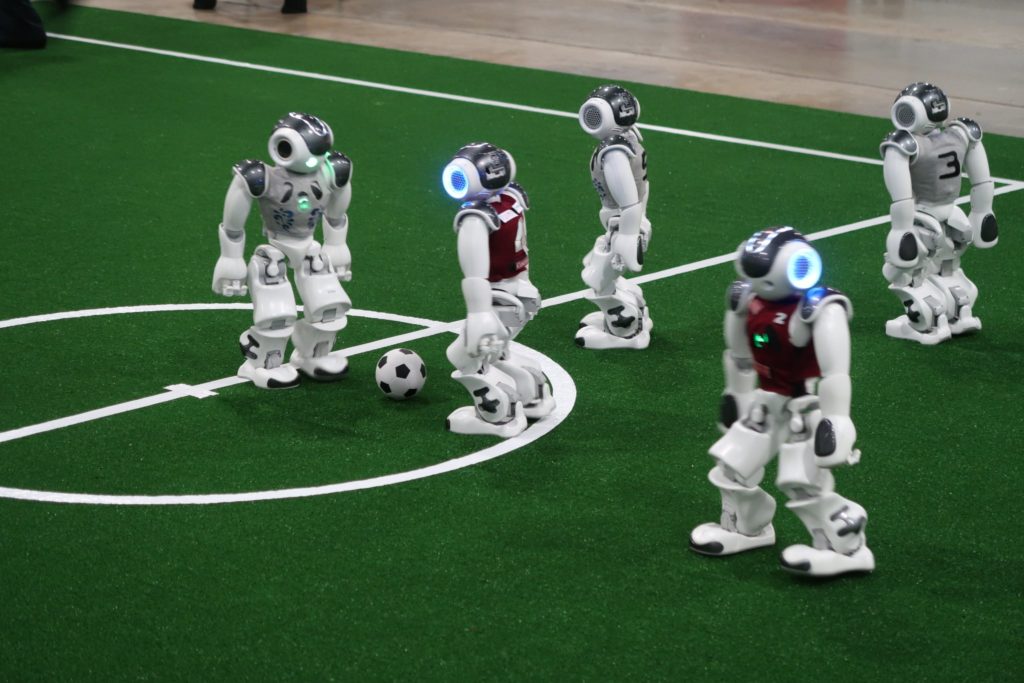
SPQR versus Bembelbots at RoboCup 2019. (Photo by JT Genter)
Tournament Set-up
Due to skill and experience differences, the SPL utilizes a two-tiered competition structure with the Champions Cup for the strongest teams and the Challenge Shield for all other teams. Teams are initially seeded into the Champions Cup or Challenge Shield using the Glicko system based on all available results from previous official RoboCup tournaments.
However, after the first round robin phase, the worst-performing teams in the Champions Cup play the best performing teams in the Challenge Shield. These so-called Promotion Games allow the best Challenge Shield teams a chance to move to the Champions Cup — as well as provide the worst performing Champions Cup teams the chance to drop down to the Challenge Shield. So, regardless of original seeding, any team can win the Champions Cup.
You can read more about the tournament set-up in Section A.4 of the SPL rulebook.
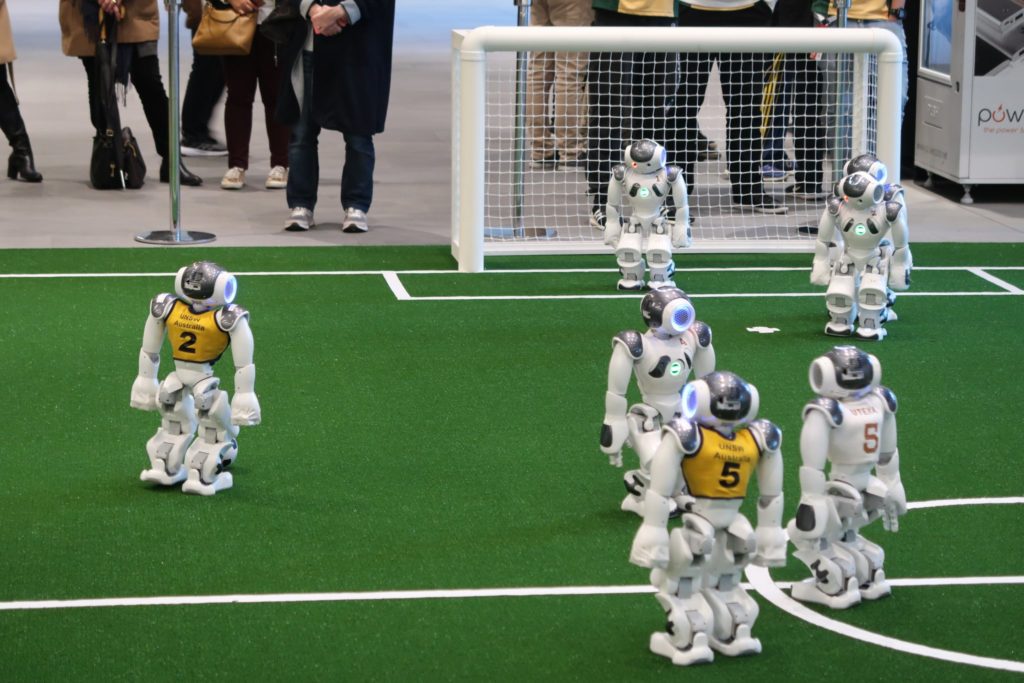
UT Austin Villa versus rUNSWift at RoboCup 2019. (Photo by JT Genter)
Competition Day 1
Competition Day 1 in the SPL contains all of the first round robin games in the Champions Cup and Challenge Shield. As the SPL planned for a tournament of 24 teams before some teams needed to withdraw, the league expected to have four pools of three teams each in both the Champions Cup and Challenge Shield. But, as only twenty teams could come to Sydney, the SPL opted to run the Challenge Shield round robin as two pools of four teams each.
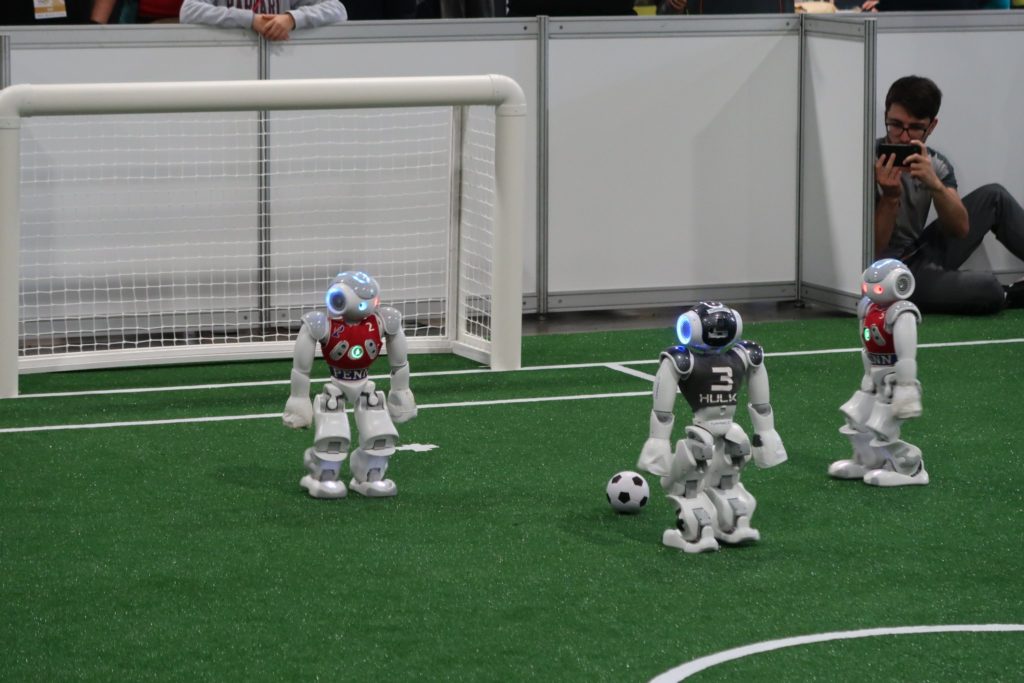
HULKs versus UPennalizers at RoboCup 2019. (Photo by JT Genter)
One advantage of the Champions Cup and Challenge Shield competition format is that teams are generally playing competitive games from the start. Even many of the games with moderate goal differences felt relatively close to both the teams and spectators.
As you can see, most of the groups played out as expected. But, there were some notable upsets. Berlin United (3rd Seed in Group C) defeated NTU RoboPAL (2nd Seed in Group C) 6 to 1, and only lost to Nao Devils Dortmund (1st Seed in Group C) by one.
Group C result: NTU RoboPAL 1:6 Berlin United #RoboCup2019 pic.twitter.com/BVE0fuJGWs
— RoboCup SPL League (@RobocupSpl) July 4, 2019
New team SABANA Herons (4th Seed in Group E) was able to defeat MiPAL (3rd Seed in Group E) 4 to 0 to claim the 3rd place spot in the group.
Group E result: MiPal 0:4 SABANA Herons #RoboCup2019
Congratulations to rookie team @USingenieria SABANA Herons on their first goals in competition and first RoboCup victory! pic.twitter.com/Jpfwa2o9dw
— RoboCup SPL League (@RobocupSpl) July 4, 2019
New team Starkit (4th Seed in Group F) was able to defeat RoboEireann (3rd Seed in Group F) 5 to 1 to claim the 3rd place spot in the group.
Looking Toward Competition Day 2
Friday morning will see Promotion Games between eight teams. Four of these teams will advance to the Champions Cup to join B-Human, Berlin United, HULKs, Nao-Team HTWK, Nao Devils Dortmund, rUNSWift, TJArk and UT Austin Villa. Meanwhile, the losing teams from these games will join the Challenge Shield. The Promotion Games are as follows:
- UPennalizers vs. NomadZ
- Naova vs. SPQR
- NTU RoboPAL vs. Bembelbots
- Camellia Dragons vs. Dutch Nao Team
If you want to follow the SPL:
- Watch all SPL games live or after they complete on the Nao Devils Dortmund YouTube page
- See score updates and schedules on the SPL webpage
- Get timely updates by following the SPL on Twitter
- Like the league on Facebook
tags: RoboCup

AUAI is supported by:








