ΑΙhub.org
#RoboCup2019 Standard Platform League Competition Day 3
The Standard Platform League’s Competition Day 3 at RoboCup 2019 was busy with main competition games, mixed team games and a directional whistle challenge.
Mixed Team Competition
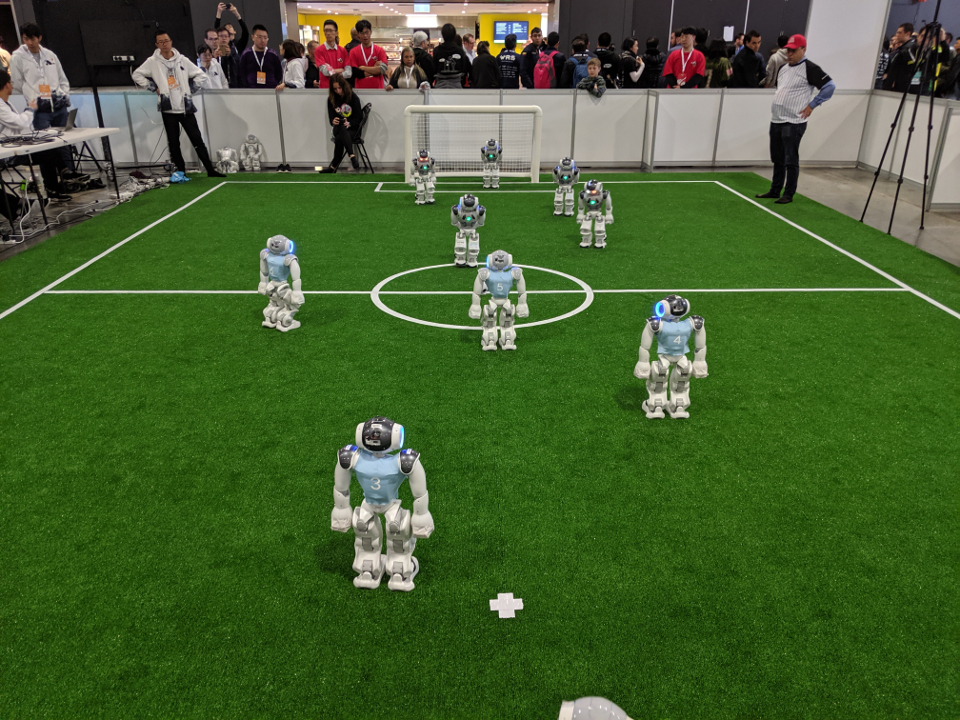
After the SPL ran the drop-in player competition from 2013 to 2015 (see Three Years of the RoboCup Standard Platform League Drop-in Player Competition for a full description of the competition), the league replaced it with the mixed team competition. The mixed teams competition allows two main competition teams to join forces as a single team for mixed team competition games. These mixed team games are played in addition to main competition games.
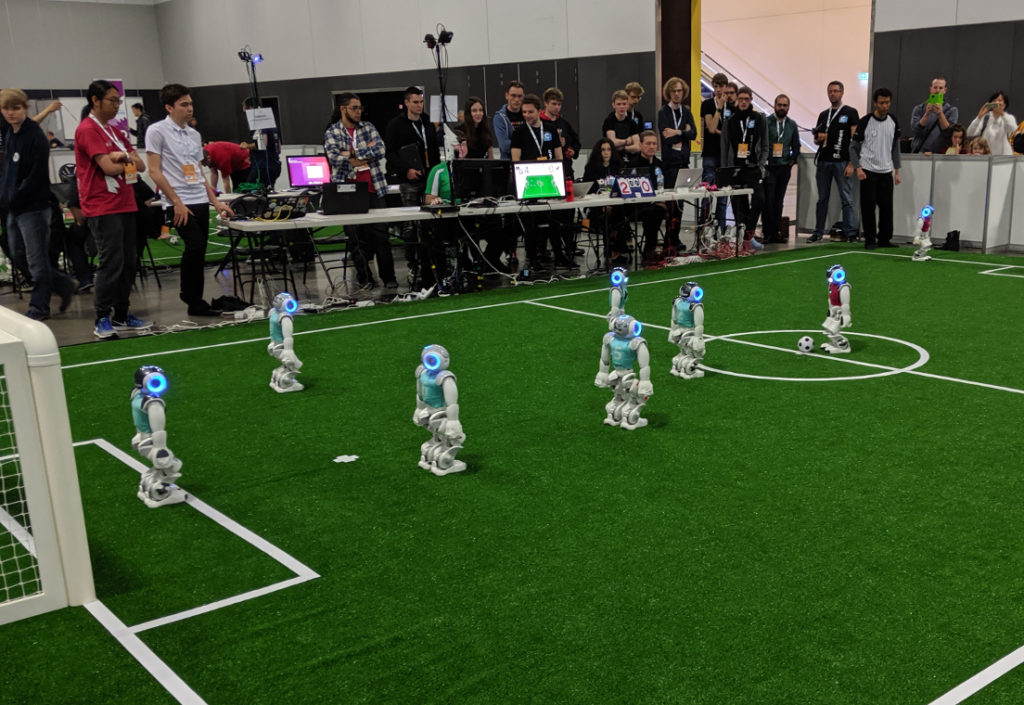
A mixed team game at RoboCup 2019.
Most teams program their robots to work as part of a pre-specified team. So, mixed teams must make sure they can communicate successfully. Doing so allows the teams to coordinate their positions, behaviors and game state information (such as ball location). Most mixed teams say that the largest benefit of being part of a mixed team is getting to work closely with another SPL team. These teams often share limited amounts of code, but they also allow each team a look into how another team codes and functions.
Directional Whistle Challenge
The intention of the directional whistle challenge is to investigate the possibilities of localizing the point where the referee whistle is blown. For this challenge, each team can choose to use between one and five robots, each of which is placed at a pre-defined spot according to its jersey number.
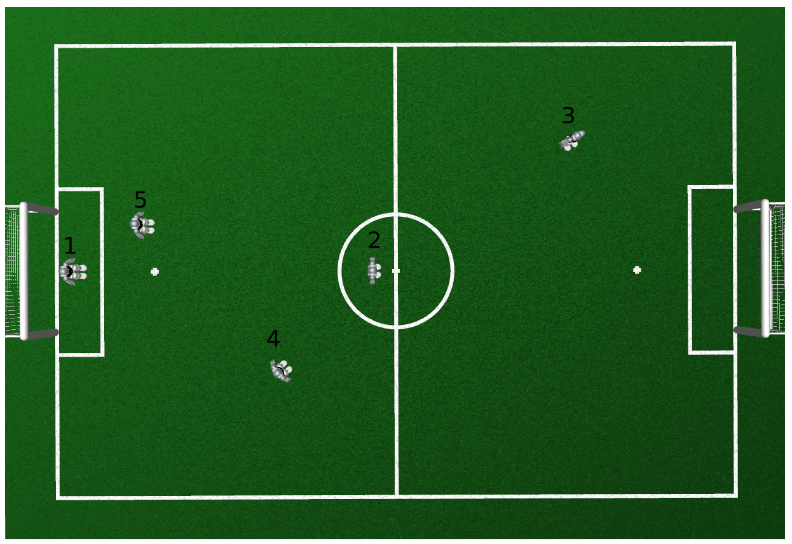
Pre-defined positions for robots in the directional whistle challenge.
A referee then blows a whistle from eight different locations on and around the field. These locations are the same for all teams, including the orientation of the referee. The team then has up to five seconds after each whistle blow to send a message back to the GameController with an estimate of the position from which the whistle was blown. The full challenge rules, including the scoring metrics, can be found in the challenge document. Results of the challenge can be found on the results page.
Competition Day 3
Competition Day 3 featured more mixed team games, as described above.
A mixed team game at RoboCup 2019.
There were also Intermediate Round games in the Champions Cup. In these games, the second and third place finishers in each second round robin group crossover. The winner of each game moves on to the quarter finals to face a team that finished first in a second round robin group, while the loser is eliminated.
Playoff play-in result: Berlin United 0:0 (0:0) Bembelbots #RoboCup2019
The two teams were so closely matched up that there was no decision after six rounds of penalty shoot-outs. So, a coin was flipped.
Bembelbots advances to the quarterfinals vs. B-Human at 13:00 pic.twitter.com/t3AQByYATG
— RoboCup SPL League (@RobocupSpl) July 6, 2019
In the late afternoon, there were quarterfinal games in the Champions Cup.
Quarterfinal result: Nao Devils 2:1 HULKs #RoboCup2019
A very hard fought match between two great teams resulted in Nao Devils advancing to the semi-finals. But @Team_HULKs didn't make it easy. pic.twitter.com/JBPSfxdAgg
— RoboCup SPL League (@RobocupSpl) July 6, 2019
The winners of these games — B-Human, HTWK, Nao Devils and rUNSWift — advanced to the semi-finals (which will be held the next morning).
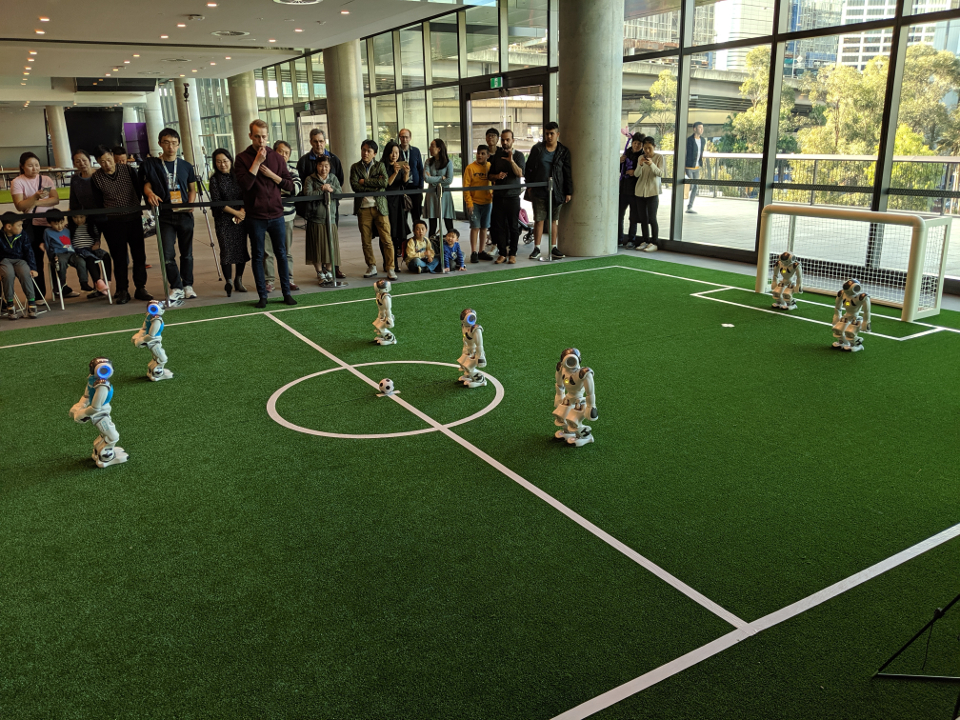
Quarterfinal SPL game between UT Austin and HTWK on a field with natural lighting.
In the Challenge Shield, second round robin group play completed in the morning and then semi-finals were played between the top two teams in each group. The winners — Starkit and SABANA Herons, both new teams to the league this year — advanced to the Challenge Shield finals (which will be held tomorrow). The losers — NTU RoboPAL and Camellia Dragons — will play in the Challenge Shield third place game.
Looking Toward Championship Day
Championship Day will feature the:
- Champion’s Cup semi final games, championship game and 3rd place game
- Challenge Shield championship game and 3rd place game
- Mixed Team Competition championship game
- Award ceremony
- Major Party
If you want to follow the SPL:
- Watch all SPL games live or after they complete on the Nao Devils Dortmund YouTube page
- See score updates and schedules on the SPL webpage
- Get timely updates by following the SPL on Twitter
- Like the league on Facebook
tags: RoboCup

AUAI is supported by: