
ΑΙhub.org
IJCAI in Canada: 90-second pitches from the next generation of AI researchers
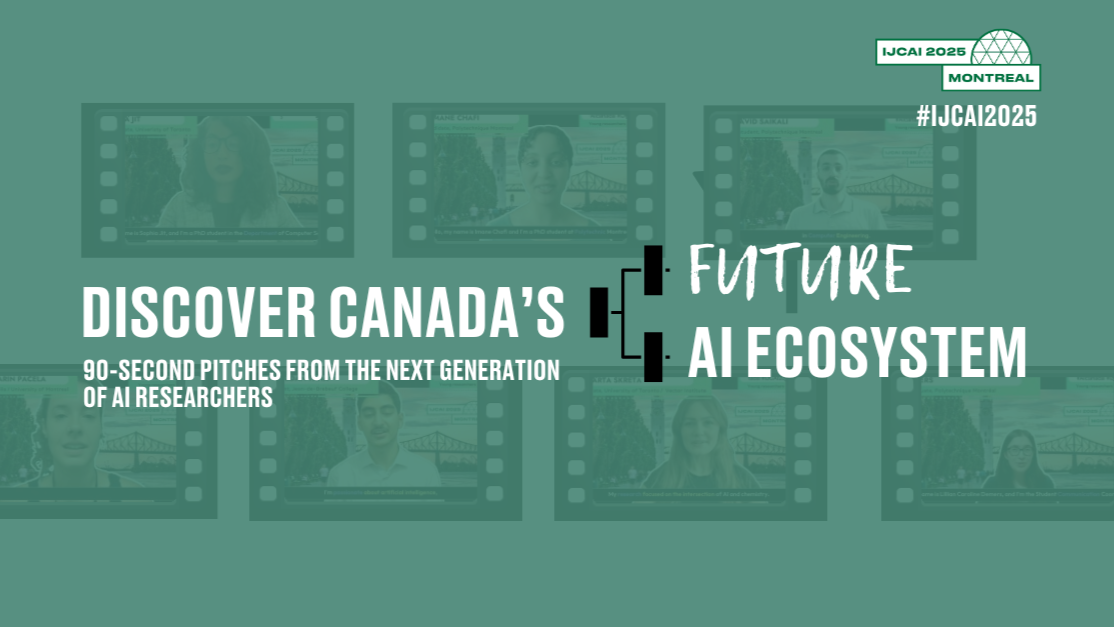
Ahead of the 34th International Joint Conference on Artificial Intelligence (IJCAI 2025), which will take place in Montréal, Canada, from 16 to 22 August 2025, the Local Arrangements Committee has launched a campaign to showcase the next generation of AI researchers in Canada.
Through a series of 90-second videos, we meet students based in Canada and find out a bit about their work. You can watch the videos below:
Imane Chafi, PhD candidate at the Polytechnique Montréal, uses AI models to support dentists in designing dental preparations for dental crowns more efficiently and accurately.
Liliane-Caroline Demers, Student Communication Coordinator for IJCAI 2025 Local Arrangement Committee and a recent master’s graduate from Polytechnique Montréal, researches AI-generated music. Using a neurosymbolic approach that combines machine learning with constraint programming at inference time, she creates music that is both stylistically authentic and structurally coherent.
Sophia Jit, PhD candidate at the University of Toronto and Polytechnique Montréal, translates ethical and social norms into testable requirements to make large language models safer and more trustworthy.
Marta Skreta, PhD candidate at the University of Toronto and Vector Institute (incoming post-doc at the University of Montreal and Mila) applies AI to Chemistry, designing molecules that are both physically accurate and tailored to specific functions.
Vitória Barin Pacela, PhD candidate at the University of Montreal and Mila – Quebec Artificial Intelligence Institute, studies how to disentangle and identify hidden factors in data to make AI models more interpretable and robust.
David Saikali, a graduate of the Polytechnique Montréal, combines machine learning with constraint programming to improve sequence models by enforcing structural rules at inference time—particularly in drug discovery—enabling constraint enforcement without the need for retraining.
Aidan Taha, a pre-university student from Jean-de-Brébeuf College, is driven by a passion for AI safety and works to make advanced AI concepts more accessible to the broader public.
You can find out more about this video series here.
tags: IJCAI, IJCAI2025, quick read

AUAI is supported by: