ΑΙhub.org
CLAIRE COVID-19 taskforce webinar
By Joyce Anne Quinto
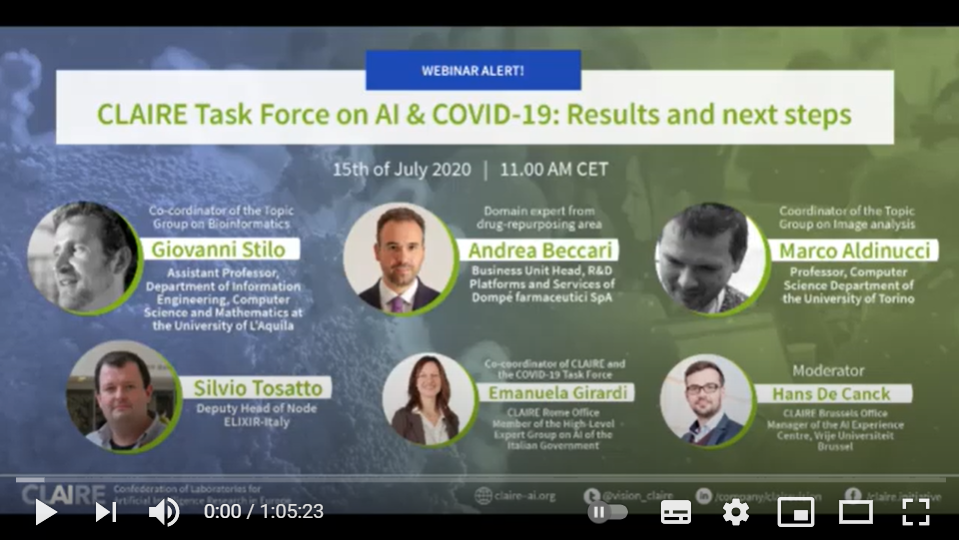
As part of its second anniversary activities, CLAIRE hosted a webinar presenting the progress and future plans of its COVID-19 taskforce. Entitled, “CLAIRE taskforce for AI and COVID-19: results and next steps”, the webinar was conducted on 15 July 2020 with a focus on the three-month research outcomes in the areas of AI for bioinformatics, drug repurposing, and medical image analysis.
Watch the webinar in full:
“When the pandemic hit Europe, we immediately thought that we have to do something to support the European government and health institutions, with CLAIRE being the biggest community of AI experts in the world,” said Emanuela Girardi, co-coordinator of CLAIRE COVID-19 taskforce in her introductory note during the event.
Following the launch of CLAIRE’s COVID-19 taskforce on 20 March 2020, more than 150 AI researchers throughout Europe collected and curated resources which aimed to leverage AI techniques in the context of COVID-19 and to support the development of new projects in several application areas. Under this taskforce, seven major groups were formed working on mobility and monitoring data analysis; bioinformatics; medical image analysis; social dynamics and networks monitoring; robotics; and scheduling & resource management.
Girardi shared that the first phase of the taskforce experience revealed two important lessons. “One of the key lessons we learned is that we really need a multidisciplinary approach in dealing with AI technologies and projects,” said Girardi who highlighted that AI researchers need to work closely with the domain experts. The taskforce believes that this is the only way to develop efficient solutions that can be useful to health institutions and the government.
“Secondly, we need better coordination within Europe to be able to develop and share the best practices in AI and health,” Girardi noted. With CLAIRE having a huge number of supporters and members across Europe, the taskforce believes that it could play an important role in creating a better sharing ecosystem within the European AI research community.
Moderated by Hans De Canck (Vrije Universiteit Brussel and member of the CLAIRE Office Brussels), the webinar featured the experiences and insights of Giovanni Stilo (University of L’Aquila, member of the CLAIRE COVID-19 taskforce), Andrea Beccari (Dompé farmaceutici SpA), Marco Aldinucci (University of Torino, member of the CLAIRE COVID-19 taskforce), and Silvio Tossato (ELIXIR-Italy).
Find out more about the CLAIRE COVID-19 taskforce here.
tags: CLAIRE, Focus on good health and well-being, Focus on UN SDGs
AUAI is supported by: